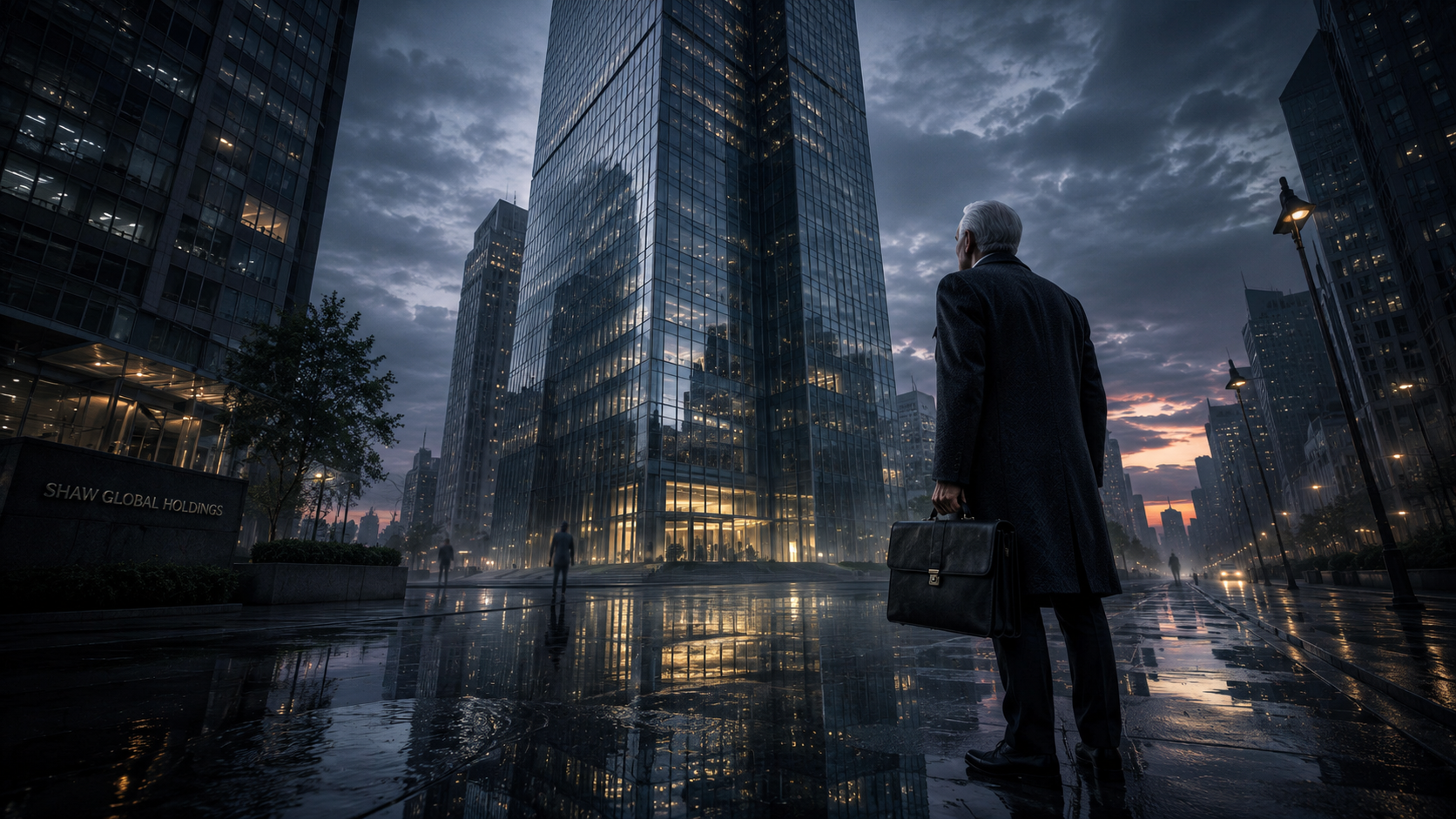
The gleaming skyscraper loomed before him, its mirrored surface catching the dying embers of the setting sun. Adrian Shaw stood at the base, head tilted, squinting at the building as though trying to place it. His reflection stared back—a man in his late sixties, silver-threaded hair combed back with surgical precision, the sharp lines of a custom-made suit framing his lean frame. The embodiment of success.
But why was he here?
He glanced down at the embossed leather briefcase in his hand. His initials were stamped in gold: A.R.S. They meant something—didn’t they? His gaze drifted up to the gilded plaque near the revolving doors. Shaw Global Holdings.
“Ah, yes,” he murmured, more to himself than anyone else. His voice came out as little more than a rasp. My building.
He stepped forward, but something heavy settled in his feet. He couldn’t quite remember why he’d come. Was it a meeting? A celebration? Or just a need to stand inside the empire he’d built from nothing but sleepless nights and unrelenting ambition?
The lobby swallowed him in opulence—marble floors, golden accents, the faint scent of polish and perfume. The receptionist looked up with a professional smile.
“Good evening, Mr Shaw. You’re here late today.”
He hesitated. There was a warmth in her voice he almost recognised, but her face… her face belonged to a stranger. Polished. Pleasant. Unreachable.
“Yes, of course,” he said, a little too quickly. The instincts kicked in—old reflexes. Confidence without context. “Is… is my office still open?”
Her brow furrowed, but the smile held. “Your office is always open, sir. Would you like me to call up?”
“No,” he said, sharper than intended. “No need. Just… carry on.”
The lift opened with a soft chime, and he stepped inside. As it ascended, the walls caught and distorted his reflection—long limbs, blurring edges, a face that looked stretched too thin across the years.
What’s her name? he thought. The receptionist. She’d been there for years. Always sharp, always kind. He used to pride himself on knowing every name in the building, from janitor to junior executive. But now her name danced just out of reach, teasing him like a dream already fading.
When the lift chimed again, he stepped into the top floor corridor. The mahogany doors loomed, and the brass plate gleamed:
Adrian R. Shaw – Founder and CEO.
His hand paused above the handle, a flicker of dread curling in his gut. What if it had changed? What if something inside no longer belonged to him?
He shook the thought away and pushed through.
Everything looked the same. His desk, vast and commanding, papers neatly arranged. A glass paperweight sat at the centre, catching the light from overhead. Beyond the windows, the city pulsed—alive, indifferent.
And yet…
Something was wrong.
A vase stood on the shelf. He stared at it for a long moment, certain it had never been there. He moved to the wall of photographs—images of handshakes with world leaders, ribbon-cuttings, construction sites. Familiar moments.
But the faces beside his own blurred. Names vanished. Events untethered themselves from time.
On his desk, a silver frame caught his eye. A woman smiled from behind the glass, eyes creased with laughter. A boy stood beside her, clutching her hand.
He reached for it slowly, fingers trembling. “Anna,” he whispered, the name floating up like a half-remembered tune. His wife. His son.
The memory held for a moment… then shattered.
He sank into the leather chair, the photograph still in his hands. Why can’t I remember her face? Why can’t I hear his voice anymore?
For the first time in years, Adrian Shaw felt small—reduced. His empire stood untouched, but the man who built it was drifting from himself.
The car ride home passed in silence. He sat in the passenger seat, cradling the frame like something that might break if he looked away. Nathan drove, his hands steady on the wheel, eyes darting occasionally toward his father.
“You scared Sheila downstairs,” he said at last. “She called me the second she saw you. Said you looked… lost.”
Adrian’s gaze remained on the window, where the city lights smeared into hazy streaks. “She always worries too much,” he murmured. “I wasn’t lost. I knew where I was going.”
Nathan pressed his lips into a thin line. “Dad… it was nearly midnight. You were sitting in your office with the lights off. What were you looking for?”
Adrian didn’t answer. He traced the boy’s outline in the photograph with his thumb. “Nathan,” he said softly, tasting the name.
“That’s right.”
A flicker of something broke through. His brow furrowed. “You were six,” he said. “When I took this. We’d gone to the beach. Anna packed sandwiches. Ham and… and mustard.” A small chuckle escaped him. “You hated mustard.”
Nathan smiled. “Yeah, I did. You made me eat it anyway.”
“It was good for you,” Adrian said, mock-stern. His face gentled. “You spent hours chasing the waves. Every time they rolled in, you’d run screaming back to your mum, laughing like it was the best joke in the world.”
Nathan glanced over, caught between hope and surprise. “You remember that?”
He nodded slowly. “Clear as glass.”
But then… his expression dimmed.
“But after that…” His voice faltered. “Something happened. Didn’t it?”
Nathan hesitated. “No, Dad. Nothing bad happened. It was a perfect day.”
Adrian’s hand tightened around the frame. “I can’t see her face anymore.”
Nathan’s grip on the wheel tightened. “It’s alright. I see her. I remember it all—for both of us.”
Home.
The elegant townhouse Adrian once bought to be near the office now loomed too large, every room echoing with memories just out of reach.
Nathan helped him inside, took his coat, and guided him gently down the hall. “Let’s get you settled.”
But Adrian didn’t move.
His eyes were fixed on the fireplace. A row of photographs lined the mantel. One stood out—Anna, her head wrapped in a bright scarf, smiling through chemo. Radiant. Unyielding.
He stepped closer, hand shaking as he picked it up. “She was always so brave,” he said.
“She was,” Nathan replied quietly.
A flicker of mischief touched Adrian’s smile. “Do you remember when she threw my briefcase out the window?”
Nathan blinked. “No. She what?”
Adrian chuckled—fragile, but real. “I was late for your school play. She’d warned me all week. I kept saying I’d make it. But work…” He shook his head. “Work always came first. So she didn’t shout. Just calmly opened the window and tossed the briefcase onto the lawn. Said if I wasn’t out the door in five minutes, the suits were next.”
Nathan laughed. “Sounds exactly like her.”
Adrian’s smile faded. “I can’t remember how the play ended.”
Nathan moved beside him, placing a hand on his shoulder. “You came. That’s what mattered.”
Later that night, Nathan peeked in.
His father had dozed off in the armchair, the photograph still resting in his lap. The bedside lamp cast long shadows across his face, deepening the creases memory had left behind.
Nathan lingered, then reached for the switch. “Goodnight, Dad.”
He didn’t see the old man’s eyes flutter open.
Adrian sat in the dark for a moment longer, gaze fixed on the photograph. Then, with slow determination, he stood and placed it gently on the table.

7/10/2026
The Words That Got to Me
What’s her name? he thought. The receptionist. She’d been there for years. Always sharp, always kind. He used to pride himself on knowing every name in the building, from janitor to junior executive. But now her name danced just out of reach, teasing him like a dream already fading. This happens to me more frequently than I want to think - I meet old pupils who expect to be remembered but sometimes memories are a little too vague for comfort!
I found the relationship between Adrian and his son a believable and tenderly drawn one. I liked the details revealing Anna's character and history, especially the briefcase moment. Hell hath no fury like a mother scorned!