The world didn’t end. It just stopped bothering.
Streetlights blinked out and stayed that way. Timetables curled in the sun, uncorrected. Government broadcasts faded to static, then silence, and no one fixed the antenna. Not out of fear. Just… disinterest. The last headlines weren’t dramatic; they were apologetic. A shrug, printed daily, until even the printers gave up.
The shops emptied themselves. Somewhere between looting and letting go, people took what they needed and left the doors open behind them. A note stuck to one automatic door read:
"No power. Push if you like."
It was still there a year later, smudged by weather, the ink running slightly like it had tried to cry but lost the motivation halfway through.
Someone had chalked over the road markings at a junction:
“Give way to whatever.”
The post boxes still stood. Some still filled. Somewhere, maybe, someone still emptied them. Letters addressed simply to “You, if you're still here” grew more common than names. No one cared about postage anymore. A few were left open, like mouths trying to form words that had already drifted off.
A bus stood forever at the bottom of a hill, doors open. The destination screen read:
“Eventually.”
One night, someone turned every book in the library sideways. Not in rebellion. Just because they could. The labels peeled. The indexing system fell out of favour, replaced unofficially by:
“Books that feel read.”
“Books you’d read aloud.”
“Ones you forgot until now.”
The clocks didn’t stop all at once.
They just disagreed. One in the café said it was half-past eight for a week and a half. The digital one in the chemist blinked “8:88” until its battery gave up entirely. No one reset them. Appointments became suggestions. Birthdays became vague seasons. Time gave up on us, and we gave it space.
You could still hear laughter, now and then.
Children still played, though mostly in ruins and mostly without shoes. They climbed collapsed fences and invented new rules for games they never named.
But there were no new ones. No prams. No cots. No startled cries in the night.
The ones who were already here carried on. But nobody was making more.
People still shared food. Some homes still had lights on, strung with solar panels or luck.
But the future stopped being a thing people pointed at.
They started looking down instead. Or back.
It rained on and off for three days.
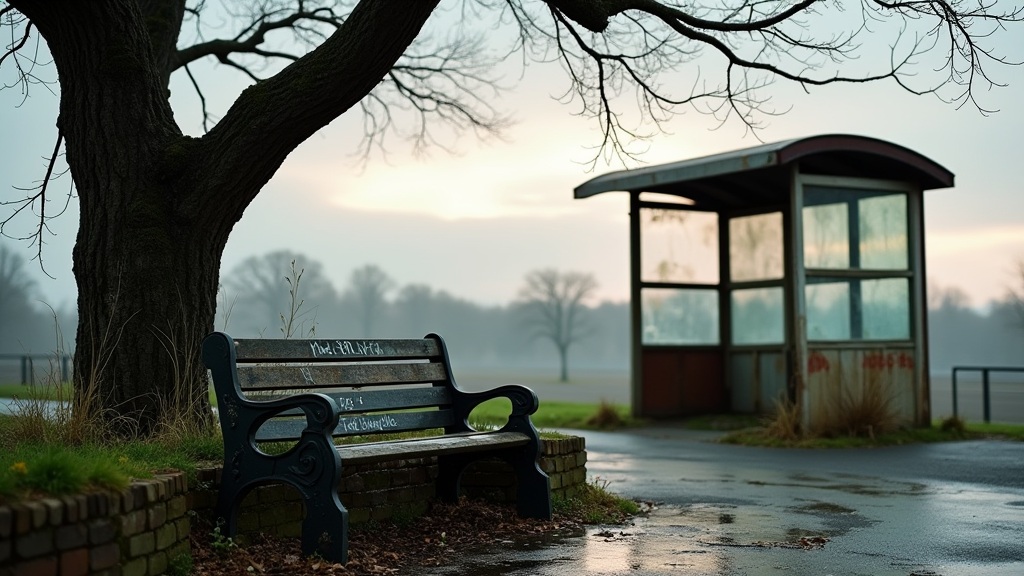
The bench outside the collapsed bus shelter stayed mostly dry beneath the canopy of a half-dead tree. When the clouds cleared, someone sat there for a while. Long enough, at least, to leave a message.
Written in white chalk on the armrest:
“Today smelled like oranges. I don’t know why, but it helped.”
No name.
No date.
Just a moment.
Left behind.
The chalk already softening in the next breeze.
The message stayed longer than it should have. Rain smudged the “g”, and a falling leaf covered half the word “oranges”, but it was still legible the next day.
By the third, it was gone. Not erased, just... gone. Washed away. Or taken by someone who needed it more.
No one claimed it. No one admitted to writing it.
But people noticed.
Someone left a mandarin on the bench the following week. Unpeeled. Undisturbed.
A few days later, it was gone too. In its place: a scrap of cereal box, tucked under the bench slat.
Written in ink:
“I took the mandarin. I hope that’s alright. I ate it slowly. Thank you. It reminded me of something good.”
The next appeared on the door of the old pharmacy, taped carefully, centred.
Blue pen, neat handwriting:
“I remember the smell. My grandmother used to hide cloves in them at Christmas.”
No name.
No reply expected.
But the tape was fresh.
Some places held on longer than others. The train station still had power, sometimes. One platform light buzzed like a trapped fly, flickering day and night. The ticket machine printed blank receipts. A sign above the schedule board read:
“Delays likely. Or not. Who’s to say?”
No one tore it down, and trains never came.
In the market square, moss had overtaken the bricks between stalls. Old chalk prices still lingered on empty boards: “3 for £2”, “Last of the season”, “Sorry about the apples.”
No one bartered anymore. If you needed potatoes, you took potatoes. Someone had left a lemon in a hat with a note that read: “Please return the hat.”
The hat was never returned, but another appeared beside it two days later — this time with a slightly squashed pear.
People still moved, but slowly.
Some had shoes held together with fishing line. Others wrapped their feet in old t-shirts. One woman pushed a pram filled with bottled water and paperback novels. A man cycled in circles around the civic centre with a basket full of feathers. No one stopped him. Why would they?
There were no rules now. Just habits. And most of those were wearing thin.
In the museum, a single security light stayed on. The exhibits hadn’t been touched. They hadn’t been tended, either. The dinosaur skeleton had lost a tooth. A child’s fingerprint smudged the glass in front of an Egyptian coin. A voice recording at the entrance still played if you pressed the red button hard enough:
“Welcome to the past.”
Ironic really. Certainly, no one would ever say “welcome to the present.” Not anymore.
Outside the museum, someone had scrawled in charcoal on a bus shelter:
“Remember fireworks?”
Below it, in much smaller letters:
“I miss the sound of surprise.”
And somewhere else - not far, not marked - a person found a folded page in a book left in a hollow wall.
The message was careful.
“Would you tell me a thing you still look forward to?”
The handwriting was new. And the question hung there, absurd and enormous, like asking the sky to explain itself.
The question lingered. No one rushed to answer. That wasn’t how things worked anymore. Things were slow now. Sometimes on purpose. Sometimes, because slowness was all that was left.
The reply came days later, maybe weeks. Time had become unsupervised.
It was left inside an old suitcase, propped open outside the train station. The suitcase was filled with buttons. Someone had arranged them by colour. The note was tucked beneath the yellows.
Written in pencil on cardboard torn from a cereal box:
“I look forward to dreams. Do you?”
The cardboard was flipped, and a reply in red crayon said:
“I dreamt I heard a plane the other day. I dream about things I used to know. From years ago. Before the world gave up.”
No sign-off. No reply expected.
But someone rearranged the buttons to say…
“Yes.”
That was all.
Three letters.
Nothing else.
But the note was gone the next day. The buttons left untouched.
Later, on a wall near the footbridge where the ivy hung like stage curtains, someone had chalked:
“Dreams are how the world rehearses being alive.”
The messages grew simpler.
No more folded notes. No long reflections. Just scraps.
A piece of masking tape on a window frame:
“The sky smelled like bread this morning.”
A single word chalked on a kerbstone:
“Still.”
A napkin wedged into the shutter of an old café:
“I laughed today. Out loud. It startled a bird.”
No replies.
No arguments.
Only faint echoes.
The bench by the bus shelter was damp again. The tree above it had lost most of its leaves. Someone had placed a scarf on the armrest, weighted with a small stone. There was no note. Just the gesture.
The scarf was gone the next day.
The stone remained.
One last note appeared in the returned-books slot at the library. It was written on the back of a used envelope.
“I don’t know if this is still you reading. But I made tea today and pretended you were here. I imagined you’d say something stupid about the mugs not matching.”
It stayed in the slot for three days. Then the rain came sideways and blurred the ink until it became nothing but soft lines, like veins in a leaf.
No one wrote again.
Or if they did, no one found it.
Eventually, the messages weren’t gone.
They were just overwritten by wind, by moss, by years.
And the world kept drifting.
Not broken.
Just… forgotten in places.
And if someone passes that bench again, they might run a hand over the armrest and wonder if it ever said anything.
Or if maybe,
for a while,
it did.
6/14/2026
The Words That Got to Me
The world didn’t end. It just stopped bothering. Wow. That said it all
Different shades of hopelessness expressed by various people, connecting in small ways in a world dying of indifference. wow (again :) There have been many stories about the end of the world, but this is totally different and probably the saddest of all--disinterest, because there's nothing to be interested in. Well, you imagined it logically and simply through people's few, pitiful words left in various small spaces. A last gasp of communication. Had to look up Entropy. :) Great word for this. Tim, I think you should send this to our New Yorker Magazine. They are very snooty and only take extremely well written and different things, which this definitely is. Or are your magazines still publishing people's thoughts? This is excellent and a lot of people should read it. What do you think? It is truly amazing and one that readers will think about for a long time, I believe.