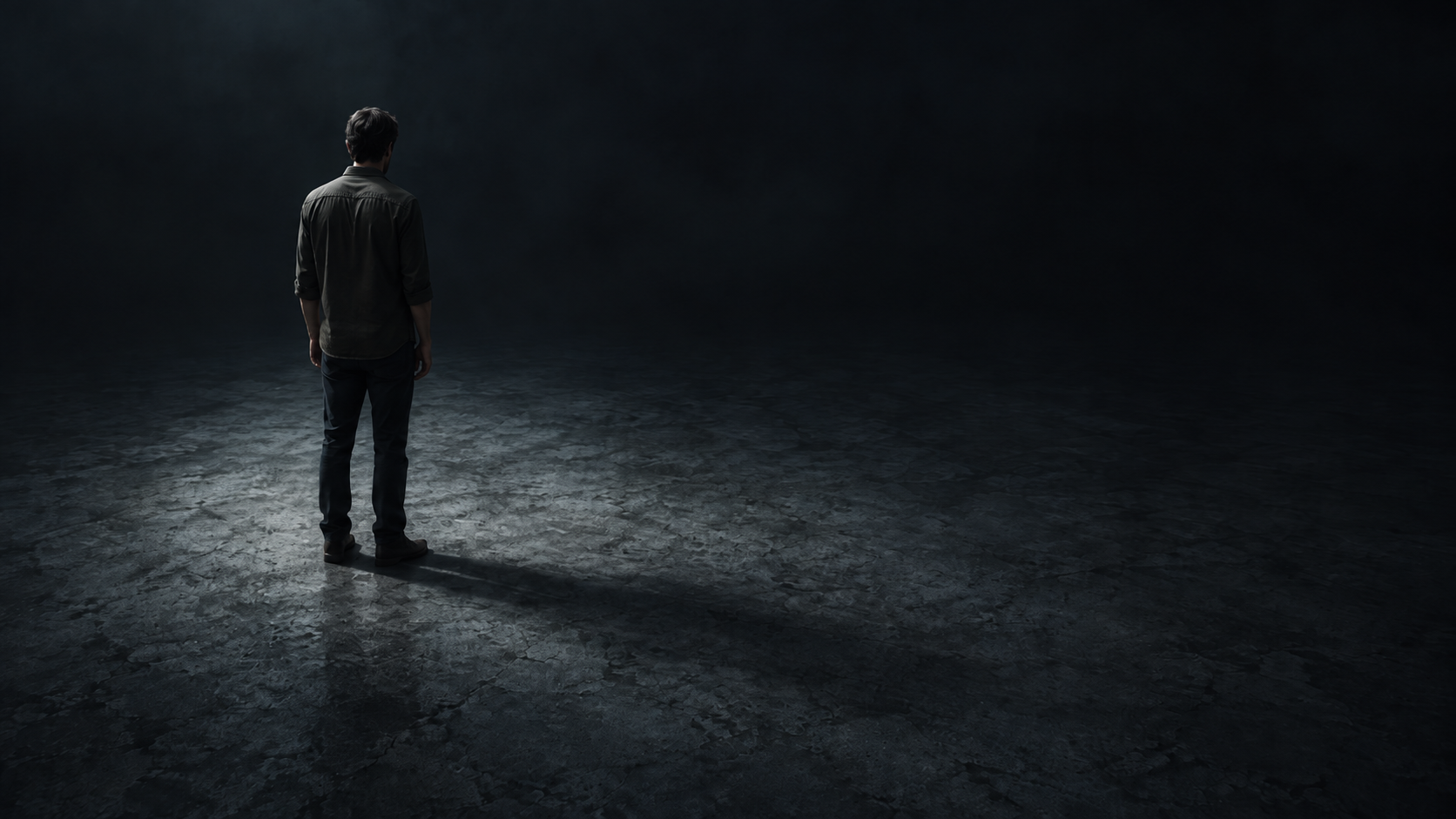
When the word 'eight' echoed in my head, I knew I had missed ten and nine, though I couldn't say how.
It wasn't a voice. Not exactly. There was no sound, no sense of someone speaking, yet the word possessed a weight and clarity that made it impossible to mistake for one of my own thoughts.
Eight.
I waited for something to follow.
Nothing did.
I tried to remember where I was. That should have been simple. I was standing in a room, or at least I believed I was standing. There was a floor beneath my feet, firm enough to support my weight, and something resembling a wall a few paces ahead. Beyond that, the darkness made it difficult to distinguish one thing from another.
Not complete darkness. I could see, although I couldn't identify a source of light. It reminded me of the strange illumination in dreams, where everything is visible despite there being no sun, no lamps, no windows.
I looked down at my hands. They were perfectly ordinary. Five fingers on each, the usual creases across the knuckles, a small pale scar beside my left thumbnail. Why had I thought for a moment they wouldn’t be?
I flexed my fingers, watching the skin stretch and settle. They were unquestionably my hands. I recognised them with the same unthinking certainty with which I recognised my own breathing.
But something was wrong with the scar.
It was on the right hand now. I stared.
No. Left. It had been on the left. I was certain of it. I held both hands out, palms down, examining them carefully. The scar was on the left.
Of course it was. I laughed, a short, embarrassed sound that seemed far too loud in the stillness. Until I remembered — I had never had a scar on my hand.
Then I heard it again.
My laugh.
Not an echo. An echo should have followed the original, diminished and distorted by distance. This was precisely the same sound, repeated at precisely the same volume, and it came from somewhere ahead of me.
I stopped breathing. The sound stopped too. For several moments I stood perfectly still, listening.
Nothing.
Perhaps I had laughed twice without realising it, or perhaps the sound I thought I'd heard a second time had simply been the first, somehow lingering in my imagination. Perhaps I had even remembered laughing before actually doing so.
I tried to dismiss the thought, but my attention was drawn to an uncomfortable pressure against the back of my head. There was something beneath it, something firm enough to support its weight, and as I became aware of the sensation I realised I could also feel a surface pressing against my shoulders and the length of my spine. For a moment I wondered whether I had fallen without noticing, but that was absurd. I was standing upright, my weight distributed comfortably between my feet, my knees straight and my arms hanging loosely at my sides.
The sensation grew more distinct as I concentrated upon it. I could feel the slight discomfort of lying upon a hard surface, the familiar pressure beneath my shoulder blades and the back of my skull, as clearly as I could feel the floor beneath my shoes. I tried shifting my shoulders, expecting the sensation to disappear, but instead the pressure against my back altered precisely as it would have done had I been lying flat. I looked down at my feet, hoping that would settle the matter. They were exactly where I expected them to be, planted firmly upon the floor, and I could see the ordinary folds in my trousers where the fabric rested against my shoes.
I attempted to lift one foot, but the movement brought a peculiar hesitation, as though my body couldn't decide which set of sensations it ought to obey. I could feel my weight shifting onto the other leg but simultaneously experienced the faint movement of a heel against whatever supported me from beneath. I lowered my foot again, although I wasn't entirely certain I had lifted it in the first place.
What disturbed me most was not the contradiction itself, but the fact that both sensations seemed perfectly natural when considered separately. Neither experience contained anything unfamiliar when considered alone. It was only when I tried to reconcile the two that the impossibility became apparent. For the first time, I found myself wondering whether I could trust what my own body was telling me.
Seven.
I wondered how long it had been since eight. The question seemed reasonable enough, but I found I had no means of answering it. I could remember the word arriving and the increasingly unsettling experiences that had followed, yet I couldn't determine whether they had occupied a few moments or several hours.
Even the contradictory sensation of lying down had vanished without my noticing, leaving me standing upon a floor whose existence I was no longer entirely prepared to trust.
I looked around the dimly illuminated space, hoping to discover something familiar. There was still the suggestion of a wall ahead of me, although I couldn't remember whether I'd examined it before. Nor could I remember entering the room. What had I been doing before eight? I searched for something ordinary, perhaps walking somewhere or waking from sleep, but found nothing.
I tried thinking about that morning instead, but couldn't remember waking, eating breakfast or even what the weather had been like. I could imagine sitting with a cup of tea beside a window, looking out across a garden, yet the image seemed to be assembling itself as I considered it. Had there actually been a garden? Did I even drink tea? The longer I examined the scene, the more elaborate it became, until I could almost hear birds outside the window and feel the warmth of the cup between my hands. It seemed increasingly like a genuine memory, despite my knowing that I had invented at least some of its details.
I abandoned the attempt and decided to concentrate upon something simpler. My name.
For a moment I was almost amused by the idea that I should need to remind myself of it. I had spent an entire lifetime answering to a name, writing it, introducing myself with it and hearing others use it. Surely there could be no more firmly established piece of knowledge. I opened my mouth, expecting the familiar sounds to present themselves.
Nothing came.
But I couldn't stop searching. I tried to establish my age instead, reasoning that a lifetime must have some measurable length, even if its details were temporarily inaccessible. I knew I was an adult, but when I tried to narrow it down, I discovered I had no reliable idea how many years I had lived. Thirty? Forty? Sixty? Each seemed equally plausible.
I examined my hands for signs of age, then touched my face, tracing the skin beside my eyes and the line of my jaw. There might have been wrinkles, but I couldn't remember what my face was supposed to feel like. In my imagined reflection, the face grew younger or older according to whichever age I happened to be considering.
I lowered my hands, suddenly uncomfortable with the realisation that I might not recognise myself if a mirror were placed before me. There must have been years behind me, decades perhaps, filled with experiences that had shaped the person I had become.
I could speak, reason and understand the world around me, so I must have learned these things somewhere. Yet I couldn't recall my childhood, my home or even the faces of those who might have raised me.
I tried to remember being loved.
Something stirred at the thought, an unexpected warmth accompanied by a sadness I couldn't explain. For an instant I felt certain that someone had loved me, someone whose presence had mattered enormously. I could almost imagine an embrace, the sound of laughter, the comforting pressure of another hand holding mine.
But whose hand?
That was when I began to panic.
Not because I had forgotten particular events, but because I could no longer distinguish recollection from invention. Every attempt to establish something about myself produced another possibility, and the more convincing these possibilities became, the less I trusted them.
I closed my eyes, hoping to shut out the confusion, but fragments of apparent memories appeared without invitation. Sunlight falling across an unfamiliar surface, the sensation of running, the sound of distant laughter. Each carried the peculiar familiarity of something once experienced, yet none possessed any context that might establish its authenticity.
I opened my eyes again. The room remained dark and unchanged, although I found myself wondering whether I had actually seen it before or merely remembered seeing it. I could no longer be certain which parts of my experience belonged to the world around me and which had originated somewhere inside my increasingly unreliable mind.
I wanted something definite, some point of reference against which I could measure everything else. A name, an age, a face, even a single memory I could accept without question. I searched desperately for the last ordinary moment before eight, some instant when I had known who I was without needing to ask.
Perhaps I had been asleep, or suffered an accident, or was recovering from an illness that had damaged my memory. Each explanation depended upon a life I couldn't remember living. Then something stirred beneath the confusion.
Not a clear memory, but the impression of warmth and sunlight, of voices nearby and the familiar sensation of having settled somewhere for a particular purpose. I concentrated, afraid that the slightest distraction might cause it to disappear.
The warmth became more distinct, accompanied by an uncomfortable pressure against the back of my neck. I shifted slightly, and the pressure changed, sending a familiar ache through my shoulders. There was something beneath me, a coarse fabric stretched across a metal frame, and I became aware of the weight of my arms resting upon narrow supports.
I opened eyes I had already thought open.
Six.
Sunlight flooded my vision, forcing me to squint against its brilliance. I was sitting in a folding camping chair beneath a cloudless blue sky, the Florida heat pressing against my skin with an intensity that made me immediately conscious of how thirsty I was. Beyond a broad expanse of water, a white rocket stood beside its launch tower, shimmering in the haze rising from the distant shoreline.
Of course. Cape Canaveral.
I had come to watch a rocket launch and must have dozed off while waiting. It explained the strange numbers, the confused sensations and the extraordinary nonsense that had filled my sleep. The countdown must have begun while I was unconscious, its announcements weaving themselves into a succession of increasingly unpleasant dreams.
The ache in my neck was real enough, as was the uncomfortable dampness of my shirt against the canvas chair. I straightened and stretched my arms, enjoying the reassuring resistance of muscles and joints behaving exactly as they should.
There were other spectators scattered across the grassy viewing area, some seated beneath sunshades, others standing beside their folding chairs. I could see children among them, their bright clothing contrasting with the muted colours of the surrounding landscape. It was a perfectly ordinary scene, and I found its very ordinariness wonderfully comforting.
I settled back, looking across the water towards the launch complex. I wondered how long remained before liftoff and glanced towards my wrist, only to discover I wasn't wearing a watch.
No matter. Someone nearby would know.
I turned towards the nearest group of spectators, intending to ask, and noticed something peculiar. They were facing away from the water. Perhaps someone was giving an announcement behind us. I looked over my shoulder, expecting to find a large screen or a public address platform, but there was nothing beyond the grassy area and a distant line of trees.
I turned back.
The people nearest me remained facing the wrong way. So did those farther away. In fact, as I examined the gathering more carefully, I realised that nobody appeared to be watching the launch site at all.
I stood, shading my eyes with one hand.
I called to a man standing a few yards away, asking whether there had been some change to the launch schedule, but he didn't respond. He didn't turn when I called again.
He stood with his hands resting loosely at his sides, his head inclined slightly towards the trees. There was nothing particularly unusual about his appearance, but I couldn't detect the smallest movement. No adjustment of his weight, no shifting of his shoulders, not even the subtle motion of breathing.
A woman stood with one hand raised towards her forehead, apparently shielding her eyes from the sun, although she was facing in precisely the wrong direction. Nearby, a child leaned forward as though preparing to run, one foot lifted slightly from the ground.
Neither moved.
I began walking towards the man, intending to tap him on the shoulder, but stopped when I noticed the water.
The distant shoreline seemed closer.
I stared across the lake, struggling to understand what had changed. The rocket and its launch tower remained visible, yet their proportions seemed subtly wrong, as though the entire complex had been flattened and reduced in size.
The horizon was moving.
At first, I dismissed the notion as another trick of the heat, but the line separating water from sky continued advancing, swallowing the distant buildings as it approached. The rocket disappeared from the bottom up, followed by the launch tower, until there was nothing left of either.
The approaching horizon was not a wave or a wall of darkness. It was simply the point beyond which the world ceased to possess any visible detail. Water, shoreline and sky were being erased, leaving behind something that offered my eyes no suggestion of distance or substance.
I turned towards the spectators. The man I'd been approaching no longer looked entirely real. His clothing had lost its texture, the natural folds of fabric replaced by faint pencil lines. His face was flat and delicately shaded, his hair composed of drawn strokes rather than strands.
I moved sideways, expecting his profile to change.
It didn't. He remained facing away, presenting exactly the same outline regardless of where I stood.
I circled farther around him, my unease deepening as I realised that he possessed no discernible thickness. He resembled a drawing cut from a sheet of paper and placed upright against the scenery, a two-dimensional imitation of a person.
The other spectators were becoming drawings too. The woman shielding her eyes had become little more than a pencil sketch, her raised arm merging into her head where the artist had failed to distinguish the two. The child poised to run appeared suspended above the grass, a flat silhouette without depth or shadow.
I looked desperately towards the chair I'd been sitting in.
It too had begun to lose its substance, the metal frame reduced to narrow grey lines, the canvas seat an uneven patch of shading against the grass.
I reached towards it, but my fingers met nothing.
Behind it, the advancing horizon had reached the far edge of the viewing area.
The people nearest it vanished without movement or sound. One moment their pencilled outlines stood against the grass; the next, there was nothing, as though an unseen hand had passed an eraser across the scene.
The grass flattened into broad strokes of colour before fading entirely, while the remaining spectators lost their outlines one after another.
I tried to run, but the ground beneath my feet felt strangely insubstantial, and I couldn't tell whether I was moving or merely imagining the sensation of movement.
I looked down at my own hands.
They were still there, unmistakably solid, with every crease and imperfection visible beneath the brilliant sunshine. I turned them over, examining the skin with an almost desperate gratitude.
Then I noticed: I cast no shadow.
The grass around my feet had disappeared. The empty expanse was closing from every direction, taking with it the last traces of the viewing area. Beyond the narrow space around me there was no landscape, water or sky.
I reached outward, trying to establish where the boundary lay, but my hand found nothing to touch. There was no resistance, no sensation of temperature, no indication that anything existed beyond the diminishing fragment of reality upon which I stood.
The sunlight faded.
I looked once more at my hands, terrified that they too might begin to flatten into lifeless outlines. Their familiar appearance had become the only remaining evidence that I was something more than another drawing awaiting erasure.
A faint electronic beep sounded somewhere beyond the shrinking world.
Five.
I wanted to scream, to demand an explanation from someone, anyone, but there was nobody to hear me. Worse, I could no longer be certain there had ever been anyone there. Had I actually sat beside that lake, feeling the Florida sunshine upon my face, or had I invented the entire experience? The chair, the heat, the rocket had been as convincing as the floor beneath my feet.
What was happening to me?
Perhaps I was dreaming.
The possibility offered momentary relief, until I remembered that I had already believed myself to have awakened from a dream. If that awakening had been false, what assurance could I have that any subsequent awakening would be genuine?
I tried to remember what reality felt like.
What made something real? The ability to see it, to touch it, to experience it through the senses? I had done all those things. I'd felt the chair against my back, the sunlight warming my skin, the grass beneath my feet, and watched them disappear as effortlessly as a thought abandoned halfway through its formation.
My breathing quickened as I searched desperately for something that couldn't be questioned, some fundamental certainty upon which I might rebuild an understanding of my existence. But every possibility seemed to depend upon another, equally uncertain assumption.
If everything else could be imagined, why not fear itself?
I wanted to hold on to something, anything, but I no longer knew what holding on meant. I couldn't establish where I was, whether I possessed a body, or even whether there was a world beyond the thoughts racing through my mind.
Perhaps there was nothing outside my thoughts. And if that were true, what was doing the thinking?
For one desperate instant I wished I could simply cease thinking, if only long enough to escape the unbearable uncertainty.
What if I did stop thinking?
Would there be anything left?
And through it all, beneath the frantic confusion of my thoughts, something continued to trouble me.
Five.
Why five?
What was being counted?
And what, in God's name, was going to happen when the counting stopped?
Three.
For a moment I was too bewildered to understand what had happened. The word had arrived just as the others had, unmistakable and utterly indifferent to the confusion it caused, but something about it was wrong. I repeated it silently, trying to understand why it had provoked such an immediate sense of alarm.
But that couldn't be right. The last number had been five, and between five and three there should have been another. I knew that as surely as I knew anything, although by now that was hardly a reassuring comparison.
Four. What had happened to four?
Perhaps I had simply failed to hear it. After all, I had somehow missed ten and nine, so there was no reason to suppose another number couldn't have passed unnoticed. But I had been listening, hadn't I? I remembered five arriving, remembered the desperate confusion that followed, and I was certain there had been nothing between that and the sudden intrusion of three.
Unless there had been something and I had forgotten it.
The possibility sent a fresh surge of panic through me. I tried to reconstruct my thoughts since five, searching for a gap, some discontinuity that might reveal where the missing number belonged. Those memories seemed continuous, but how could I be certain? A missing memory wouldn't necessarily leave a space I could recognise. For all I knew, an entire lifetime might have passed between two thoughts, and I would have no more awareness of it than I had of whatever happened before eight.
I tried counting backwards.
Five, four, three.
I could almost persuade myself that four had occurred. I could almost imagine another experience between five and three. But whenever I attempted to examine it, the impression changed, acquiring details I couldn't be sure I wasn't inventing.
I stopped myself.
That was precisely what had happened before, when I'd tried to remember who I was. I had filled the emptiness with imagined experiences until I could no longer distinguish them from genuine memories. I couldn't allow that to happen again, not when the missing number might hold some explanation for everything.
But how was I supposed to remember something without imagining it?
I tried approaching the problem differently. Perhaps four had never occurred. Perhaps whatever was counting had simply skipped it.
The idea was almost more frightening than forgetting.
I felt an almost overwhelming urge to correct the mistake. If I could somehow restore four to its proper place, perhaps the sequence would make sense again. I began repeating the numbers silently, concentrating upon each one as though the act of remembering their order might undo whatever had happened.
Five, four, three.
Again.
Five, four, three.
I became increasingly frustrated by the ease with which I could complete the sequence. My mind knew perfectly well where four belonged, yet it offered no explanation for its absence. I could imagine the number, think it, repeat it, but none of those things proved that it had actually happened.
Perhaps I needed to say it aloud.
"Four."
My voice sounded unfamiliar, but I barely noticed. I was concentrating upon the word itself, listening for some recognition, some response from whatever had been placing the numbers inside my head.
"Four."
Nothing happened.
I tried again, louder this time, feeling a ridiculous embarrassment at shouting a number into an empty space. Embarrassment gave way to frustration. Surely something as simple as counting should obey the rules.
"Four!"
I waited, half expecting the number to return in that peculiar voiceless manner, restoring itself to the sequence.
It didn't.
I began to wonder whether I had somehow caused the omission. Perhaps I'd been so absorbed in questioning reality that I'd failed to notice the next number arriving. Perhaps my thoughts had interfered with whatever was happening, or perhaps I'd unconsciously refused to acknowledge four because I was frightened of what it represented.
But why four? What could possibly be so important about a number?
I couldn't answer, and the inability only increased my agitation. There was something intolerable about an absence I couldn't explain, particularly when the missing thing was so simple, so ordinary, so entirely beyond dispute.
Four existed. I knew it existed. I could count four fingers, imagine four walls, picture four corners of a square. I didn't need to prove the number itself was real.
I needed to know where it had gone.
The distinction became increasingly difficult to maintain. I found myself thinking about four as though it were something tangible that had been misplaced, something I might discover if only I searched thoroughly enough. I tried reaching backwards through my memories again, no longer particularly concerned about whether the images that emerged were genuine. Surely even an invented recollection would be better than this maddening emptiness.
What if I'd known something during four? What if the explanation I'd been seeking had finally become clear, only to vanish along with the memory of receiving it? The thought was unbearable. I might have understood everything, only to lose it beyond recovery.
I had to get it back.
I couldn't bear the possibility that something so important had happened without my knowing. My thoughts began circling around the missing number, returning again and again to the same questions, each repetition making the absence seem more significant.
What had happened to four? Where had it gone? How could a number simply disappear from a sequence that had been progressing with such dreadful certainty?
I tried counting again, but this time I couldn't bring myself to move beyond four. I repeated it silently, holding it in my mind as though concentrating hard enough might somehow prevent it from slipping away.
Four.
There had to have been a four.
There must have been something between five and three, some interval of existence that belonged to me, whether I remembered it or not. I couldn't have simply lost it. Time didn't work that way. Numbers didn't work that way. Nothing worked that way.
Except, apparently, everything did.
I was becoming desperate now, not merely frightened but furious at the impossibility of what had happened. I wanted to tear through my own thoughts, to force open whatever concealed the missing moment and drag it back into consciousness. Nothing mattered beside this single, intolerable omission.
"Four!" I shouted again, my voice breaking with frustration. "Where is four?"
I waited, straining for some response, some indication that I had finally been heard.
"Please," I whispered, appalled by the desperation in my own voice. "There has to be a four."
I couldn't remember why it mattered so much, only that it did. The number had become the centre of everything, the one thing I must recover if I was ever to make sense of what was happening.
I tried once more to summon it, concentrating so fiercely that every other thought seemed to recede. I could almost feel the missing moment somewhere beyond my reach, impossibly close and yet inaccessible.
Surely if I could just remember—
Two.
The number arrived with such quiet inevitability that, for a moment, I scarcely acknowledged it. I was still searching for four, still trying to force some recollection of whatever had been lost, when I became aware that my frantic thoughts had simply stopped.
The desperation that had consumed me no longer possessed any meaning. Four was gone, and whether I had forgotten it or it had never existed made no difference whatsoever.
Because after two came one.
I considered that simple fact with a calmness that surprised me. There was no uncertainty about the sequence this time, no desperate need to recover a missing number. I knew precisely what would follow, and for the first time since eight, knowing something offered no comfort at all.
One.
And then?
I understood perfectly well that zero came after one, but the knowledge seemed inadequate, almost childish. I understood its place among the numbers, but not what would happen when it arrived.
Until now, I had been so occupied with understanding what was happening that I had scarcely considered where it might be leading. The numbers had seemed part of the confusion, another impossible experience to be questioned and examined. Now I realised they were progressing towards something, and that whatever else might be uncertain, their approach to an ending was unmistakable.
The thought brought no immediate panic. Instead, I experienced a peculiar stillness, as though my mind had exhausted its ability to protest against the impossible and could do nothing but contemplate what remained.
What would happen after zero?
Perhaps I would wake. The possibility had offered such wonderful reassurance beside the Florida lake, and I wanted desperately to believe it again. Perhaps I really was asleep somewhere, caught in an extraordinarily vivid nightmare that would end with the final number.
But I had already awakened once.
Or believed I had.
I could remember the sunlight, the uncomfortable camping chair, the distant rocket. I had accepted all of it without question, grateful for the familiar world into which I seemed to have returned, only to watch that world disappear around me.
If I woke again, how would I know it was real?
I tried considering another possibility, one I had been reluctant to acknowledge. Perhaps the countdown marked the final moments of my life. I might be dying somewhere, my failing mind struggling to interpret sensations that no longer corresponded to anything outside itself.
There was something almost reassuring about that explanation. Death, at least, was comprehensible. It happened to everyone eventually, and although I couldn't remember how old I was, I knew enough to understand that my own life must end someday.
Yet the thought of dying did not trouble me nearly as much as the question of what might follow.
I could imagine a world continuing without me. People going about their lives, the sun rising, rain falling, seasons changing. That seemed perfectly reasonable until I tried to imagine my own absence from it. Every picture I constructed required someone to observe it, someone to recognise that I was no longer there.
And that someone was always me.
I couldn't conceive of a time in which I would have no thoughts, no awareness, no experience of anything whatsoever. Even the darkness I imagined possessed a quality that required consciousness to perceive it.
What if zero meant the end of that consciousness?
The question settled within me, cold and immovable. I could no longer remember my name, my age or the life I might have lived, yet there remained this small, persistent awareness that I existed. Whatever had happened to everything else, there was still something capable of wondering about it.
I had begun to regard that awareness as the one thing that couldn't be taken away.
Now I wasn't so sure.
I wanted more time, although I couldn't have explained what I intended to do with it. I had been given what felt like hours between some numbers and scarcely a moment between others, and none of that time had brought me any closer to understanding. Another hour might change nothing. A thousand years might leave me just as confused.
But I wanted them anyway.
I wanted the next number to be delayed, to remain suspended somewhere beyond my thoughts while I searched for a reason to hope. I wanted the sequence to stop progressing, even if stopping meant remaining here forever, uncertain of everything except my own existence.
Then I wondered whether the numbers had anything to do with time at all.
Perhaps they were merely thoughts, arriving without purpose or connection. Perhaps zero would be followed by another number, or by nothing, or by some entirely different experience that I couldn't begin to imagine.
I almost welcomed the possibility.
Almost.
Because even if the countdown meant nothing, I had no way of knowing that either.
I found myself listening, although there was nothing to hear, waiting for a word that would arrive without sound. I knew it was coming, and that knowledge occupied my thoughts with a quiet insistence that left little room for anything else.
I no longer cared what had happened to four.
I no longer cared whether the lake had existed, or whether the room around me was real, or whether the memories I had lost could ever be recovered.
I cared only that there was one number left between me and zero.
And I wished, with an intensity that surprised me, that I had never learned to count.
One.
It came with a thump.
Not the word itself, not at first, but the sudden violent awareness of a pulse hammering through me as though it had only just remembered its duty. My chest tightened, breath rushing in and out too quickly, and I found myself turning in frantic, senseless circles, searching for something — a wall, a light, a shape, any point against which to measure myself — and finding nothing at all.
There was no room now, no lake, no fading horizon, no grass, no shadows, no world stripped down to emptiness. There was only nothing, stretching in every direction with such perfect indifference that I could not even tell whether I stood within it or merely thought I did.
My heartbeat became the only proof I possessed. It struck against my ribs with desperate force, too fast, too hard, the rhythm of something trapped and terrified. I clung to it instinctively, as though the frantic thudding might anchor me to existence itself. I breathed with it, or tried to. Each breath came ragged and incomplete, and the more I struggled to draw air, the more it seemed to elude me, until panic rose sharp and blinding through every thought.
I looked for my hands and could not see them.
I tried to cry out and heard nothing.
The nothing around me did not echo, did not resist, did not acknowledge me in any way. It was not darkness, because darkness at least implies the possibility of light. This was absence. It had no surface, no depth, no quality beyond the fact that it was there — or that I was, helplessly, within it.
My heart raced faster.
I felt it in my throat and temples. Breath rasped in and out with humiliating urgency. I turned again, as though some change in direction might reveal an edge to the void, some opening, some sign that I remained in a place rather than in the collapse of all places.
Nothing.
And because there was nothing, there was nowhere to run, nowhere to fall back to, nowhere even to point my fear. Panic fed upon itself, each frantic breath confirming only that I was still here, still waiting, still balanced on the brink of whatever came next.
I knew then, with a certainty colder than terror, that there was nothing left to lose except myself.
I think I began to beg. I felt the shape of the plea inside me, though whether it formed words I cannot say. Perhaps I was asking for time. Perhaps for mercy. Perhaps only for something to happen before expectation tore me apart completely.
My heart gave one immense, stumbling lurch.
And in that suspended instant, before the next beat could come, before breath could return, before panic could finish its climb into madn—
Zero.

10/14/2026
The Words That Got to Me
I no longer cared .... whether the memories I had lost could ever be recovered. Perhaps I was asking for time. Perhaps for mercy. Perhaps only for something to happen before expectation tore me apart completely.
He ceased to exist? Lord have mercy, Tim! You have left Spielberg and Stephen King in the dust! This psychological thriller is terrifying beyond imagination. I kept thinking, throughout, what were you feeling? What kept you going? Why were you writing this? What were you left with when you finished it? But I guess the main thing I thought was why this poor soul deserved such an ending? Were you considering a similar lost feeling you had at one time? (I am playing psychologist, here, I guess.) Anyway, WHEW! That was quite a story! Well done. The exhaustion of constant self-examination and his frustration WAS exhausting. And of course, typical you, you left the reader thinking "What the Hell?", if you will pardon me. The stuff of nightmares, for sure, so realistically written the reader gets lost in the situation and is practically screaming, WHAT IS GOING ON, HERE! About midway through, when you mentioned the pressure behind him and the rocket, I thought for sure he was actually an astronaut, or if not, he was strapped in the rocket, anyway. Well, sir, it was mesmerizing, for sure and deserving of an award for wearing out the reader! You do have an extravagant imagination. People will be thinking about this story through many a lonely night, I bet, and perhaps wishing he would just wake up! You are a masterful story teller!