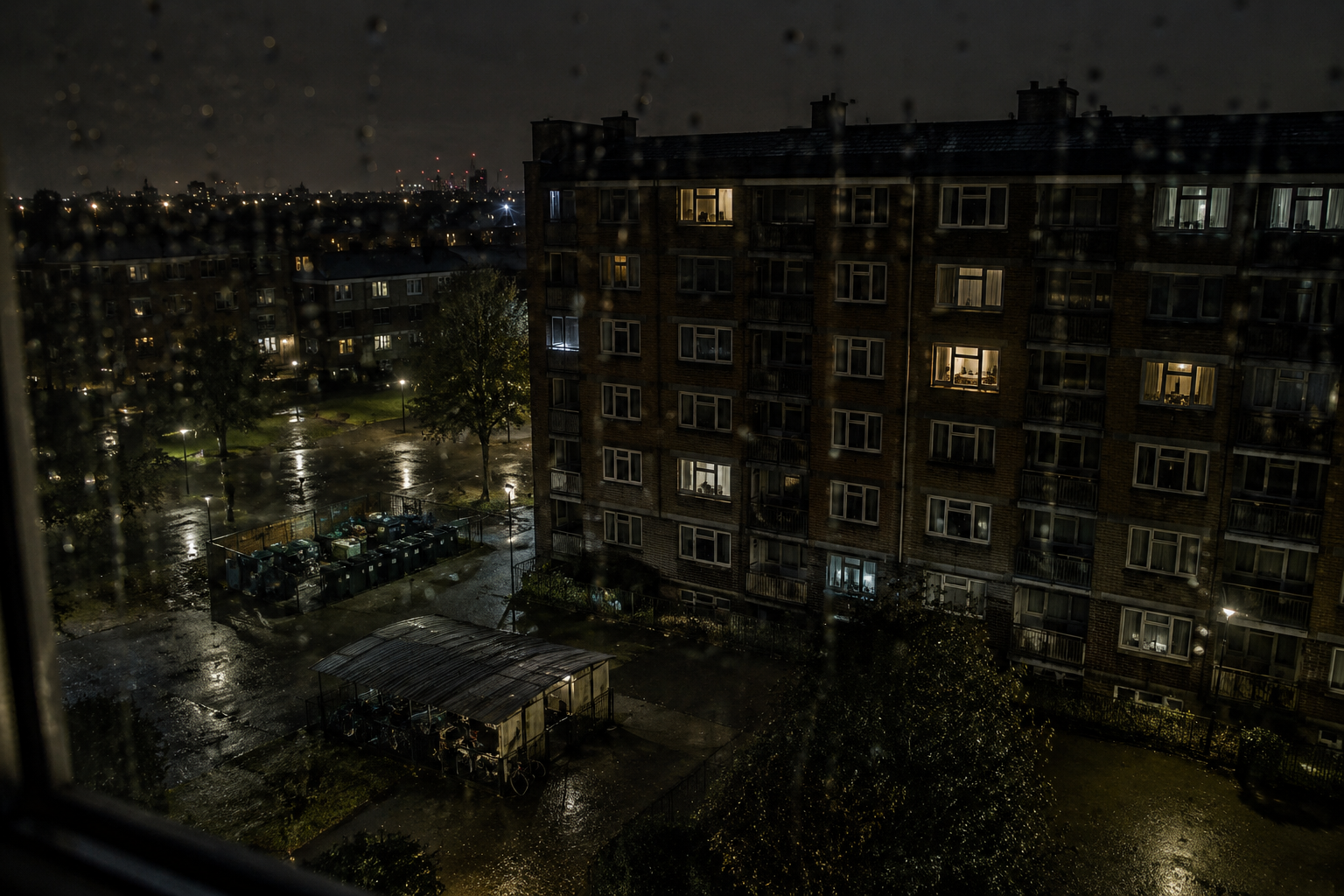
I had lived in Harker House for eight months before I learnt the man in flat fourteen had a cough.
That sounds like nothing. It was nothing. People cough. Especially in old buildings where the walls sweat in winter and the windows never quite seal. But I remember the first time I heard it because it came through the wall just after two in the morning, three short bursts followed by a wet, swallowed silence, and I lay there with my eyes open, waiting for it to happen again.
It didn’t.
After a while the pipes clicked. The night bus sighed somewhere beyond the estate. Rain touched the window in small, dry taps, as if apologising for disturbing me.
I turned over and told myself to sleep.
Most nights were like that then. Not frightening. Just unfinished. I would wake at odd hours and find the room already waiting for me, grey with streetlight, the ceiling cracked above the wardrobe, my phone face-down on the crate beside the bed. I never used to wake like that. I used to sleep heavily, greedily, the kind of sleep that made mornings feel like being dug out of the earth.
That was before.
I do not mean anything dramatic by that. There was no great disaster. No sudden death. No divorce. No diagnosis. I moved because the rent on my old place went up and because Harker House was close enough to work that I could walk if the buses were bad. That was the whole story, really. A practical decision. Sensible. Dull.
People make too much of beginnings. Most things begin because of admin.
Harker House stood at the back of the old municipal estate off Candle Street, six storeys of brown brick and stained concrete, with balconies like open drawers and a flat roof nobody was allowed onto. The entrance doors had frosted glass reinforced with wire mesh, though one pane had been cracked since before I moved in. There was a smell in the lobby that changed with the weather. Damp carpet. Old cooking oil. Bleach. Sometimes dog. Sometimes something sweeter, rotten almost, from the bins when the collection was missed.
I did not hate it.
That is important.
People assume, when you tell them where something happened, that you must have sensed it from the start. They want the building to brood. They want the shadows to lean. They want the lift to open on its own and the old woman upstairs to whisper warnings over a bag of shopping.
It wasn’t like that.
In the mornings, children ran down the stairs with their coats half on. Somebody on the third floor played radio phone-ins too loudly. The woman in flat nine smoked on the fire escape in a dressing gown and trainers, even when it rained. Mr Kale from flat six watered the dead plant outside his door every Sunday with a seriousness I admired and did not understand.
There was life there. Not warmth exactly, but life.
I worked in records at St Anselm’s, which sounds more interesting than it was. Hospital records. Digitisation, filing, logging requests, finding the same missing discharge summaries for three different people who all sounded annoyed in slightly different ways. My job was ninety per cent searching for things that should already have been where they belonged.
I was good at it, I think. I was not careless. I noticed discrepancies. I noticed when a form had been scanned upside down, or when a consultant’s name had been misspelt, or when a box number had been entered with two digits reversed. People used to ask me because I could usually find things. There are skills that do not look like skills until they are missing.
I left work most days at half five unless Sarah needed help clearing backlog. I walked back along Mill Road past the takeaway, the little minimart, and the betting shop. The Polish grocer always had condensation clouding the windows. If it was raining hard, I took the 14, though the bus often got stuck by the railway bridge and I could usually walk faster.
At home I ate badly. Toast. Eggs. Tins. Supermarket curries that left orange oil on the plate. Salad bought optimistically and thrown away three days later. Yoghurt I pretended counted as self-care.
Some evenings I watched things without following them and paused them to check my phone, then forgot what I was watching. Some evenings I read. Some evenings I opened a book and held it until the pages blurred.
I kept telling myself I would start running again.
Then again, there are entire identities built out of intentions people never act on. I had gone jogging briefly at university because a friend insisted it would clear my head, then spent the next fifteen years thinking of myself as somebody who might start again any day now.
I spoke to my sister on Thursdays.
Usually.
She had two children, a mortgage, a husband who cycled everywhere regardless of weather or common sense, and the kind of voice that became brisk when she was worried. She would ask how I was and I would say fine because nothing was wrong in a way that could be usefully described. Work was work. The flat was the flat. The boiler made a noise like an animal clearing its throat, but only when the heating first came on.
“Are you getting out at all?” she asked me one Thursday.
“I go to work.”
“That is not what I mean.”
“I went to Tesco yesterday.”
“Claire.”
“What?”
“You know what.”
I did. I just did not want to have the conversation where she suggested joining things again. Yoga classes. Running groups. One of those women-only bootcamp things in the park where everybody looked aggressively hydrated.
As though loneliness were a cupboard you could tidy if you bought enough storage boxes.
“I’m all right,” I said.
There was a pause. In the background one of the children shouted something about a shoe.
“You sound tired.”
“I am tired.”
“Are you sleeping?”
“Mostly.”
That was true then. Mostly.
After the call I made tea and stood at the kitchen window while the kettle boiled. My flat was on the fourth floor at the back of the building. From there I could see the rear courtyard, the bins, the bike shed with its bent roof, and the block opposite, where other people’s windows hung in the dark like separate screens.
You could learn things without meaning to. Who worked nights. Who had a baby. Who cooked late. Who watched television in bed. Who never closed their curtains properly.
Across the courtyard, on the fifth floor, a man stood at his own window with his hands cupped around a mug. I had seen him before. Balding, narrow shoulders, always in a white vest even in February. He was looking down into the courtyard.
Not at me.
I remember the small automatic discomfort of thinking he was looking at me, followed immediately by the correction. He was looking past me. Or below me. Or at nothing in particular. People were allowed to stand at their windows without it meaning anything.
The kettle clicked off.
When I looked again, he had gone.
That night the lift stopped on the second floor though nobody got in.
It did that sometimes. The doors opened to the empty landing where the carpet had lifted in a dark ridge near the skirting board. I waited. The lift hummed softly beneath my feet. The lights gave their usual tired flicker.
“Come on,” I said, because people talk to machines when they live alone.
The doors closed.
On the fourth floor Mrs Amadi from flat eleven was struggling with two bags of shopping outside her door. I held one while she searched through her handbag for keys.
“Thank you, love,” she said. “You’re in thirteen, aren’t you?”
“Twelve.”
“Ah. Sorry. My memory’s going.”
She smiled, though her attention seemed elsewhere. She glanced down the corridor towards the stairwell.
“Everything all right?” I asked.
“Yes, yes.” A little laugh. “Just listening. These walls.”
I nodded as though I understood what she meant.
Behind us, somewhere beyond the bend in the corridor, a door closed quietly.
Not slammed. Not even firmly. Just the soft press of wood into frame.
Mrs Amadi looked that way again.
Then her key turned and she disappeared inside.
I stood there a moment longer with my own keys in my hand, suddenly aware that I was alone in the corridor.
Not frightened.
Just aware.
The hallway smelled faintly of wet coats and somebody’s fried onions. The movement sensor light outside flat fourteen blinked once, dimmed, then steadied again.
I went inside.
That was all.
At the time, that was all.
The first thing I noticed was the shoes.
Not the pair outside flat nine. Those had been there for weeks, white trainers gone grey at the toes, probably belonging to the woman who smoked on the fire escape. These were outside flat fourteen.
Men’s shoes. Black leather. Wet.
I only noticed them because they were placed unusually neatly beside the door, heels aligned carefully against the skirting board. It struck me for a second because most people in Harker House left things carelessly. Umbrellas collapsed onto the carpet. Shopping bags abandoned outside doors. Parcels kicked half against the wall.
The shoes looked deliberate.
Then I felt stupid for thinking about another person’s shoes at seven thirty in the morning.
I went to work.
By lunchtime I had forgotten them.
Or mostly forgotten them.
At St Anselm’s the heating had stopped working properly again, and everyone on our floor wore their coats indoors with the passive resignation of office workers everywhere. Sarah spent half the morning complaining about duplicate patient numbers while drinking peppermint tea that smelled vaguely medicinal.
“You look exhausted,” she said at one point without looking up from her screen.
“Thanks.”
“I mean it.”
“I slept badly.”
“You always sleep badly.”
“That isn’t true.”
She raised her eyebrows in a way that suggested it absolutely was true.
I opened another archive request instead of answering.
There were twenty-seven unprocessed files waiting in the system. Twenty-seven names. Twenty-seven histories reduced to missing paperwork. I liked the rhythm of it sometimes. Search. Locate. Confirm. Resolve. There was comfort in systems that behaved logically.
At three in the afternoon, I realised I had entered the same patient ID twice.
Not just typed it wrong. Properly duplicated the entry.
I stared at the screen for longer than necessary.
“You alright?” Sarah asked.
“Yeah.”
“You sure?”
“Just tired.”
She nodded, though not convincingly.
I corrected the error and carried on.
It bothered me more than it should have.
I did not make mistakes like that often.
The rain had stopped by the time I left work. The pavement still shone black beneath the streetlights, and traffic hissed softly through standing water along the kerb. I stopped at the minimart for milk and one of the overpriced pasta salads I always bought when I wanted to feel briefly healthier than I was.
The man behind the till nodded at me.
“You’re late today.”
I looked at him.
“What?”
He shrugged. “Usually see you earlier.”
I smiled automatically, but something in me tightened slightly.
Not because it was strange. It wasn’t strange. People notice regular customers. That was normal. Entire jobs depended on people noticing patterns in strangers.
Still.
Walking home, I found myself wondering how often he had noticed me before.
Harker House was unusually quiet when I got back.
No television through the walls. No distant shouting from the upper floors. Even the lift seemed quieter somehow, its cables humming softly overhead as it descended.
The lobby lights flickered once as I crossed towards the stairs.
I took the stairs instead of the lift.
No reason.
Halfway between the third and fourth floors I heard movement below me. Somebody entering the stairwell from the lobby. Heavy footsteps climbing slowly.
I moved automatically to the inside of the stairs to let them pass.
The footsteps stopped.
I waited.
Nothing.
Probably someone checking their phone. Or tying a lace. Or hearing me above them and waiting for me to move first. Perfectly ordinary things.
I realised I was holding my breath and started climbing again.
The footsteps resumed almost immediately.
By the fourth floor landing I felt embarrassed enough by my own awareness that I nearly laughed.
A woman alone hears footsteps behind her in an empty stairwell and notices them. Incredible. Alert the scientists.
My keys were already in my hand before I reached the corridor.
The sensor light outside flat fourteen flickered on.
The shoes were gone.
I remember noticing that because I had expected them to still be there. Which was ridiculous. People wore their shoes. That was their purpose.
I unlocked my door.
Behind me, further down the corridor, another door opened.
I glanced back automatically.
The man from flat fourteen stood half inside his doorway holding a black bin bag.
Not old exactly. Mid-fifties maybe. Thin hair. Pale face. Grey tracksuit bottoms. He looked briefly surprised to see me looking at him.
Then he smiled politely.
I smiled back.
He carried the bin bag towards the stairs while I went inside.
That should have been the end of it.
Instead, while I unpacked shopping, I found myself replaying the tiny hesitation before he smiled.
As though I had interrupted something.
Or caught him thinking something.
Which was absurd.
People hesitate all the time.
I ate standing at the kitchen counter and watched half an episode of something involving Scandinavian detectives and snow. At ten I brushed my teeth, checked that the front door was locked, then checked it again immediately because I could not remember feeling the latch catch the first time.
The second check annoyed me enough that I deliberately walked away without testing it again.
At two fourteen in the morning, I woke suddenly.
Not gradually. Properly awake at once.
For a few seconds, I did not know why.
Then I heard it.
Footsteps.
Not above me. Outside.
Slow movement in the corridor beyond my front door.
I lay still listening.
One step.
Pause.
Another.
The old building carried sound strangely sometimes. Pipes amplified things. Doors softened them. You could hear somebody coughing three flats away, but not the person speaking beside them.
Another step.
Then silence.
I looked at my phone.
2:14am.
The corridor light slid faintly beneath the doorframe.
Somebody was standing outside.
The certainty arrived fully formed.
People came home late. People worked nights. People smoked on the fire escape. People argued in corridors after too much drink. Buildings were full of sounds that lost meaning once separated from context.
Still, I listened.
Nothing.
After a while I got up quietly and crossed the flat.
I do not know why I moved quietly. That is the sort of thing you only think about afterwards.
The peephole blurred at the edges as I leaned towards it.
The corridor outside was empty.
I stood there for another few seconds anyway.
I could hear the light outside number fourteen buzzing softly.
I went back to bed feeling faintly foolish.
The next morning there was a folded note halfway under my door.
PLEASE CLOSE THE MAIN DOOR PROPERLY AT NIGHT.
Nothing else.
I stared at it longer than necessary before remembering the lobby door sometimes failed to latch unless you shoved it properly.
That was all it meant.
Still, I found myself carrying the note into the kitchen instead of throwing it away immediately.
At work I kept thinking about it.
Not because it was threatening.
Because it felt oddly specific.
As though somebody had watched me failing to close the door properly.
Except I didn’t remember leaving it open.
By the end of the week, I had started noticing how often people stopped talking when I entered rooms.
Not dramatically.
Nobody fell silent mid-sentence or exchanged meaningful looks over cups of tea. It was subtler than that. Conversations reaching natural endings just as I approached. Pauses that might have happened anyway. Somebody glancing down too quickly at their phone.
The sort of thing that becomes suspicious only after you begin looking for it.
Which, to be fair, I had.
I knew that.
On Friday Sarah asked whether I wanted to come for drinks after work.
“Just one,” she said. “You look like you’ve been assembled from spare parts.”
“I’m fine.”
“You said that yesterday.”
“I was also fine yesterday.”
“You’re weird lately.”
She smiled when she said it, but I still felt something tighten unpleasantly beneath my ribs.
“Thanks.”
“You know what I mean.”
I did.
That was the problem.
I had become careful around people without meaning to. Listening too hard. Watching reactions. Measuring pauses. It embarrassed me enough that I kept trying to correct for it, which only made me feel more artificial.
At one point that afternoon I caught myself checking whether Sarah’s screen angled away when I walked past her desk.
I hated that immediately.
Not because it proved anything.
Because it proved something about me.
That evening I bought wine I could not really afford and drank two glasses too quickly while sitting on the sofa in my work clothes. Outside, rain moved across the windows in uneven bursts. Somebody upstairs was vacuuming at nearly nine o’clock.
Normal building noises.
Normal life.
I remember thinking that phrase repeatedly: normal life.
As though repetition itself could stabilise things.
Around ten, I took the rubbish down to the bins behind the building. The rain had eased to drizzle, enough to leave the concrete slick and reflective beneath the security light.
The rear courtyard always looked abandoned at night. The bike shed leaning sideways. Overflowing bins. Moss climbing the lower brickwork. The windows above black except for one blue television glow on the fifth floor.
I threw the bag into the skip.
Behind me, somewhere near the entrance to the alley beside the building, somebody coughed.
Three short bursts.
Wet. Muffled.
I froze before I could stop myself.
Then immediately felt stupid again.
The man from fourteen coughed. Congratulations, Claire. Extraordinary detective work.
I turned.
There was nobody there.
Just the alley running alongside the building towards the street, half-shadowed beyond the reach of the courtyard light.
I told myself somebody had already walked past. Sound echoed strangely between the walls.
Still, I found myself walking back inside faster than usual.
The lobby door had not latched properly again.
I shoved it harder until it clicked.
The lift doors stood open across the lobby.
Empty.
Waiting. The fluorescent light inside buzzed softly. I pressed the button for my floor, because that was what people did when they used the lift.
The doors closed.
Nothing happened.
Then slowly reopened.
A small pulse of irritation went through me.
“Honestly,” I muttered.
I took the stairs instead.
Halfway up I heard the lift begin moving somewhere below me.
By the time I reached the fourth floor, it had stopped again.
Then silence.
I unlocked my flat.
As I stepped inside, I realised something small but immediate: the air smelled different.
Like cold air after somebody else has been in a room.
5/17/2026
The Words That Got to Me
Too many to mention, but just starting out, "...wet, swallowed silence," "...balconies like open drawers.' "children run down the stairs with their coats half on..." "the man who kept watering his dead plant, etc, etc, etc
I have decided that (to me) one of your main qualities as a writer is your attention to details - little, familiar instances, remembered, not for their particular importance to the story, but they show the kinds of small, delightful things, sometimes memories, that the writer paints a sentence with. (pardon prep at end) Like the children with their coats half on. I haven't read all the way through yet, but had to stop and mention these wonderful little details you are so good at.. (another prep, sheesh) Now, forward. ho... more to come. Oh, but first, I'm reading along, The protag goes to sister's and surprise, suddenly she calls the protag, "Claire," who, up until then I thought was a he. Now, to read more. and of course, another one: "...As though loneliness were a cupboard you could tidy if you bought enough storage boxes." And then... you get me all involved in the story, and she steps into her room, and... Stay tuned for the next chapter. Well, sir, again, your details are marvelous. And now we have someone leaving a note outside Claire's door in the middle of the night which is definitely strange. and a good hook at the end of the chapter! Muy bueno!