The letter arrived on a Tuesday.
Arthur found it on the mat when he came back from the shops, a loaf of bread tucked under his arm, milk swinging lightly in a thin plastic bag. The envelope was pale blue. His name was written in a careful hand he had not seen in nearly forty years.
He stood there for a moment, door still open behind him, letting the cool air drift in around his ankles. Then he stepped inside and closed it.
He did not open the letter straight away. He set it on the kitchen table, beside the bread, and filled the kettle as he always did. The small rituals mattered more these days. They gave shape to time.
Only when the tea was made did he sit down and turn the envelope over.
There was no return address. Only the faint impression of a thumb where the letter had been pressed closed.
He slid a finger beneath the flap and took out the pages, carefully folded.
Arthur,
If this finds you, I suppose I have been lucky.
I’m writing because there’s no one else left who would remember it properly. Not the version people tell afterwards. Not the softened one. Just how it was.
I won’t pretend this is easy. It has taken me three days to begin, and even now I’m not sure I’ll finish.
Arthur leaned back in his chair, the letter resting between his fingers. Somewhere down the street, a dog barked twice, then stopped. He looked again at the handwriting as if he needed to place it, though he already had.
You used to say time was like the sea. That it took everything in the end, however tightly we held on. I used to argue. I said there were things it couldn’t touch. Moments that stayed as they were.
I think I said that because I was afraid.
He folded the letter closed, then opened it again, as if that might change the words.
They had been young and had mistaken that for permanence.
The summer of 1978 had been brutally bright in that stubborn, almost excessive way some summers are. Even now, if Arthur closed his eyes, he could see heat lifting off the pavement and the long evening light slanting across the street.
They met by accident. That was how he had always told it. In truth, he had seen her twice before—once crossing the high street, once at the bus stop with a book held loosely in one hand.
The third time, she dropped the book.
He picked it up before she could, brushing dust from the cover with his thumb.
“You’ve read it?” she asked.
“No,” he said, though he recognised the title. “Is it any good?”
She considered him for a moment, as though weighing whether honesty would be wasted.
“It depends,” she said. “Do you mind being a bit sad for no reason?”
Arthur smiled, not because he understood, but because he wanted to.
“I suppose not.”
“Then it’s very good.”
Her name was Margaret.
At the time, it was only a conversation.
The second page of the letter was written more quickly, the lines leaning slightly.
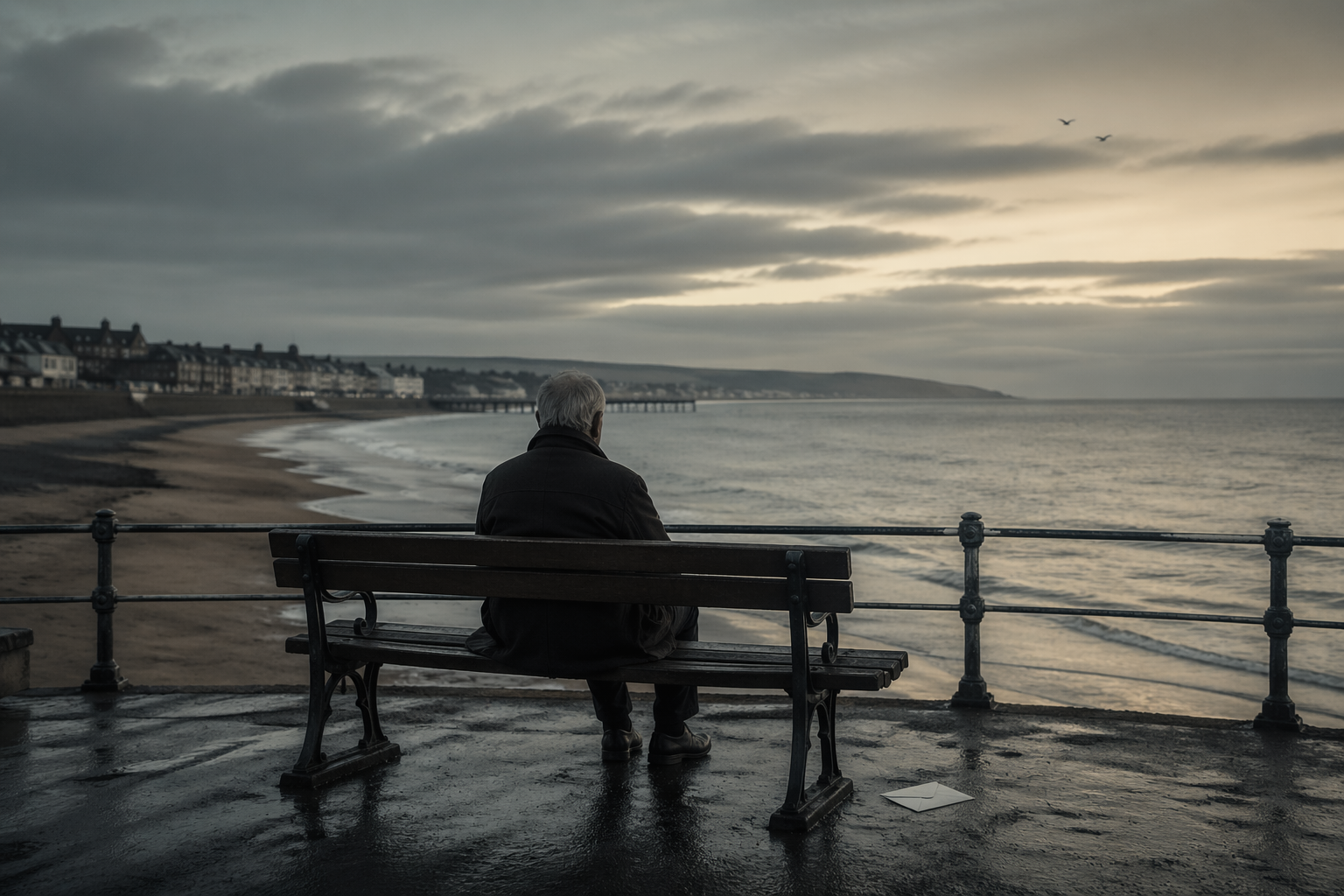
Do you remember the bench near the old pier? The one with the rusted armrest you said would give way one day if someone leaned too hard?
You were wrong about that. I went back once, years later. It was still there, stubborn as ever. The wood had faded, of course. But it hadn’t broken.
It seemed too small, somehow.
I sat there for a while. I thought about writing to you then, but I didn’t know what I would say. What do you say, after so much time? “I am still here”? “Do you remember me”?
Arthur closed his eyes.
It had stood slightly apart from the others, angled toward the water. They used to sit there in the evenings, watching the tide creep in, slow and patient, swallowing the sand inch by inch.
“Listen,” she had said once.
“To what?”
“The water.”
“It’s just waves.”
“It’s not just anything,” she said. “Not if you pay attention.”
So he listened.
Years later, he would still be able to recall that sound — not the roar of the sea, but the softer, persistent rhythm of it against the shore.
He opened his eyes and looked back down at the letter.
I am not writing to ask anything of you. That needs to be clear. There is nothing to be done now.
But I have been thinking about that summer. About how we believed that it would go on forever if we didn’t admit it was ending.
Do you remember how we avoided saying goodbye properly? We said things like “see you tomorrow” even when we both knew that one of us would not be there.
It seemed like a kindness at the time.
Perhaps it was. Or maybe it was cowardice. I still don’t know.
Arthur let the paper fall gently onto the table.
The last day came without ceremony. Margaret told him she was leaving. Not that afternoon, but soon. Her father had found work elsewhere. They would be gone before the end of August.
He nodded, as though it meant nothing.
“Right,” he said.
“I didn’t want to tell you too early,” she added. “It would have made everything strange.”
“It’s not strange,” he said.
They sat on the bench that evening, watching the tide come in as they always had. Neither of them mentioned the date, nor the packing boxes in the hallway of her house.
When they stood to leave, Margaret brushed sand from her skirt and smiled.
“See you tomorrow,” she said.
“Yeah,” Arthur answered.
He watched her walk away along the path until she passed out of sight. She did not look back.
He told himself that she would be there the next day.
But the following afternoon, the house was empty.
The final page of the letter was shorter. The handwriting steadier.
I have carried that day with me for a very long time. Not as a regret, exactly. Just something never quite settled.
There were things I meant to say, and never did. Not grand things. Just small things that felt too big to say out loud.
I thought there would be time.
I always thought that.
Arthur’s hands had begun to tremble. The paper shifted between his fingers.
He leaned forward as he read the last lines.
I am ill now. That is not why I am writing, but it is why I have finally done so.
The doctor says I may have a few weeks, perhaps a little longer if I am fortunate. I am not afraid, which surprises me. Mostly, I feel a kind of urgency. Not to do anything extraordinary, just to set a few things in order.
This is one of them.
I wanted you to know that I did remember. That it mattered. That you mattered.
And I wanted, at last, to say goodbye properly.
Goodbye Arthur.
Margaret
Arthur sat very still.
The kitchen clock ticked on the wall. Outside, the light was beginning to fade towards evening.
He read the letter again, slower this time.
There was no address. No way to reply.
He folded the paper along its original creases, smoothing it flat before placing it back in the envelope.
For a long time, he did nothing.
The next morning, Arthur woke earlier than usual.
The house felt different, though he could not have said exactly how.
He dressed, made tea, and stood by the window while he drank it. The street outside was quiet, the light still thin.
Then, without allowing himself too much time to reconsider, he put on his coat and left.
The bus journey took longer than he remembered. The town had changed, of course — new shops, new buildings, the old cinema gone. But the road itself was the same, curving towards the coast.
He stepped off near the end of the line and walked the rest of the way.
The sea was there, grey under the afternoon sky, as Arthur made his way toward the pier.
The bench was still there.
He paused a few steps away, then he lowered himself onto it carefully, testing the weight.
It held
For a while, he simply sat.
The tide was coming in, the water pushing slowly over the sand.
He watched it for a long time before speaking.
“Listen,” he said.
The words hung briefly in the air, then faded.
Arthur reached into his coat pocket and took out the letter.
“I remember,” he said quietly.
He unfolded the pages one last time and looked at it, though by now he knew every line.
He held it out over the water for a moment, as though about to let it go.
Then he drew it back.
After a while, he folded it along its creases, smoothing it flat before slipping it into his coat pocket.
He sat there until the tide had taken the last of the sand.
Then stood and walked back toward the path.
4/21/2026
The Words That Got to Me
well, hello, Tim. Your story seemed to me, so delicate, so breath-holding, rather ethereal, with many little meaningful details. Tender and sorrowful and I really thought, at the end, he was going to go see her, --not the bench. And I wondered why he didn't. The story seemed rather mysterious, but with feelings, not acted upon. yet still held your lovely touch. Katharine AKA katylady