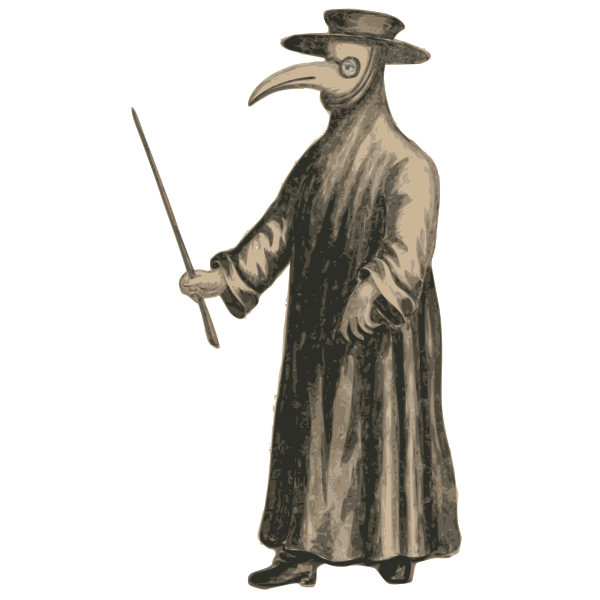
“I didn’t wear the mask!” I cried, crouching down to the cobblestones and holding my hands over my head to protect me from my master’s vicious blows.
A woman’s desperate cry saved me. “Doctor, come quickly!”
My master, the plague doctor, dragged me to my feet. “Don’t you dare presume on my goodly nature again, urchin!” he snarled, placing the beaked mask over his head. I helped him into his leather boots and waxed linen cloak and trailed after him as he marched towards yet another patient, his long stick tapping the stones.
I bit my lip to prevent me from crying out. Goodly nature? I was convinced I was assistant to the devil instead. I’d only been scraping out the old plants from inside his mask and that had inspired his thunder. His temper was not improved by donning his morbid costume either, as he always grew too hot. I was constantly the recipient of his ire. With both my parents dead of the plague, I had little choice but to work for this harsh villain to eat and gain a rough roof over my battered head.
It was the late summer of 1665, and the sun beat down relentlessly on a dry and scorched London. There had been no rain for weeks and plague deaths had risen quickly. My master was in high demand and as his assistant, I was kept busy both attending to his needs and with tending to the dying and dead.
My master inspired fear and awe wherever we went. People would draw back and pray, crying that the plague and imminent death was upon them. I knew he enjoyed the effect, marching about in his mask, with those glass eyes and long beak suggesting a vicious hawk ready to tear meat.
We entered a small cottage where the woman who had cried for help gestured towards the patient lying on filthy straw. Even though I had seen the signs before, I couldn’t help feeling a mix of sorrow and revulsion. My master was lucky as the evil stench surely wouldn’t penetrate his leather mask full of herbs, lavender, and spices while his cloak would protect him from the splatters of blood as the patient coughed and sneezed helplessly.
The woman clutched a posy of herbs to her nose, seeking relief from the sickly smell, and I only resisted temptation to ask for it myself as I feared my master’s anger. I looked at her, briefly reminded of my own mother as she tended my dying father. I could see the hint of blue around this woman's nose and lips and knew she would not survive long after her husband.
Meanwhile, my master poked and prodded the patient at a distance with his stick, revealing a painfully thin chest, labouring hard under a woollen tunic.
“Prepare a posset of rosemary and thyme for your man and pray,” my master commanded the woman. She handed over a small coin, obviously a rare and precious item in this abode. I wondered how she had managed to come by that.
My master turned to me. “Set the leeches on him to purge his blood. It might save him.” His tone expressed doubt. He marched away, leaving me in the hovel. He never stayed long when obvious death was near.
I pulled out the jar of squirming creatures, enjoying the woman’s fascinated gasp, and leant in close to the man to apply the bloodsuckers to his bruised skin. His dark eyes met mine briefly.
“Sorry,” he murmured.
I didn’t understand why until, later, I began to cough.

5/17/2026
The Words That Got to Me
“those glass eyes and long beak suggesting a vicious hawk ready to tear meat.” Is a strong visual line and one of the better metaphors in the piece. The ending lands very well: “Sorry,” he murmured. I didn’t understand why until, later, I began to cough." So understated and effective because the reader realises the truth just before the narrator does.
Suggestions / Possible Tweaks
Some descriptions are slightly over-written or melodramatic. Phrases like: “assistant to the devil” “his thunder” “harsh villain” “morbid costume” push emotion too hard instead of trusting the scene. Occasionally the prose explains too much rather than allowing implication: “I could see the hint of blue around this woman's nose and lips and knew she would not survive long after her husband.” The observation is good, but “knew she would not survive” states outright what the scene already suggests.
This is a very enjoyable piece of historical fiction. It is full of atmosphere and momentum. I love the sense of period authenticity you capture. From the very opening line, “I didn’t wear the mask!”, you thrust us straight into the tension and reality of the piece. Combined with a strong narrative and a superb ending, this is well worth reading a second time. My only real comment to ponder is that you have a great feel for setting the scene; you simply need to trust the reader a little more and do slightly less telling us what to think or understand. The story already does that very well on its own.