The power went at 8.03 on the dot. The whole terrace sighed and stuttered into dark, and somewhere a burglar alarm gave up with a choking wheeze. Sam stood in his kitchen with a colander in one hand and a spaghetti waterfall in the sink, steam ghosting round his shoulders, the radio’s last syllable stretched and strangled.
He swore, found the tap, and burned his fingers anyway.
Outside, the rain was the steady sort that promised to go on all night. The streetlamps across Foxglove Lane were dead little moons, and every window along the row became a square of wet black. Sam’s phone was on six per cent and sulking. He dug in the drawer of doom for candles, came up with tealights fused into a lump and a birthday four from an ancient cake. The gas lighter clicked dry.
He remembered the torch.
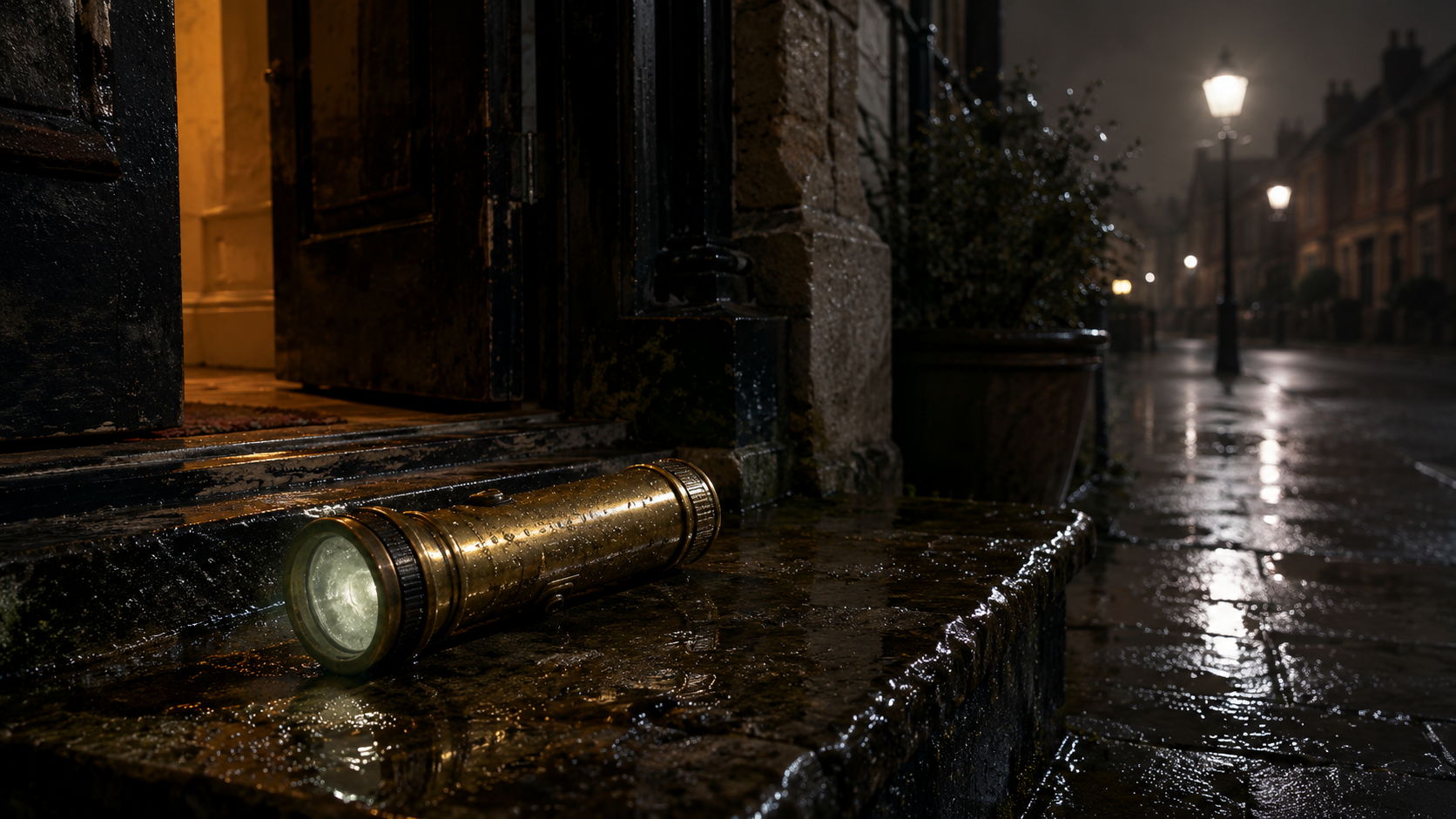
It had come in the post that morning in a crumpled jiffy with no return address, printed label stuck wonky, his name and number scrawled in biro underneath. Inside: a heavy, old-fashioned torch, brass tube and knurled grip, lens thick as a watch crystal. It smelled faintly of machine oil and lavender. There was a note, folded twice, in small precise handwriting.
For emergencies only. Point away from the face. Mind the time.
He had smiled at the eccentricity, turned it over, seen the little door with a clip. No batteries. He shook it and something thudded, a weight running the length of the barrel like a held breath. It glowed slightly when he touched it, as if a finger near a plasma ball.
At 8.08, with the rain insisting, the spaghetti clumping and the lights stubborn, Sam gave up on tealights and thumbed the torch on.
It didn’t click. It woke. A soft ignition sound, not electronic, not mechanical, like a gasp from a sleeper. The beam lanced out clean and pale, not the blue of LEDs nor the yellow of cheap bulbs, but something flat and milky, a winter noon caught in a tube. Where it touched, edges sharpened. His kettle became a sketch inked by a meticulous hand. The steam flattened into layers like tracing paper.
He walked with it, and the beam made the kitchen new. The little crack in the tile by the bin was a fault line. The smudge of chocolate on the fridge was a bruise. He lifted the torch and the light washed up the hallway, across the photographs. Jess grinning into sun on a Cornish cliff. Jess in a paper crown. Jess’s absence like a nail he’d forgotten to pull.
He lowered the beam before it reached the bedroom door.
At 8.12 he tried the switches again, out of habit. At 8.13 he pushed the curtains aside and saw the lane like a drowned painting. The beam found the map of raindrops on the glass. In the house opposite, old Mrs Dalrymple’s net curtains made a lace glacier. Next door, Tom’s bike leaned in the hall like a resting animal. The light made everything too exact, right up until it fell on the face.
Not a face. A reflection. His own, of course. Except his eyes were darkened a shade, as if something had been taken out and not returned.
He shut the curtains.
At 8.15 the shouting began. Two doors down, a little girl’s shriek, the cut-off kind that continues in the ears. He swung the beam through the kitchen window, across brick and wet air, saw figures silhouette in a second-floor rectangle. Tom appeared in his own doorway, phone held high like a talisman. His mouth moved. Sam pointed the torch aside so he wouldn’t blind him, and Tom pointed back, frantic. He mimed calling. Sam held up his mobile, shook his head. Tom mimed a sobbing cradle. He meant the baby.
Sam went to the front door. The beam made the yale lock look at him like a golden eye. He opened it and the rain shook itself onto the mat. Tom’s face was grey in the milky wash, pupils pinprick tiny. The baby was not in his arms. Tom’s hands were empty, stupidly, as if still expecting the weight.
“Ellie,” he said, voice a rattle in the light. “She just, she, she—”
“What happened?”
“I was feeding her, and the lights went, and then—” Tom’s chest hitched. “She went still. I thought she’d fallen asleep. She’s cold.”
Sam raised the torch a fraction, and Tom flinched. The beam slid off him, down Foxglove Lane, turned the rain into threads. On Mrs Dalrymple’s step something gleamed. A tea-tray lay scattered, a cup on its side. A pair of slippers with nobody in them. The front door was ajar as far as the chain.
At 8.17, somebody screamed in No. 11. The scream ran up thin and failed. It sounded like a wire snapping.
“Ambulance,” Sam said. He held his phone up again and it showed four per cent and the circle of no service. He wanted to laugh.
Tom swallowed. “I think the lines are down.”
The note had said, Mind the time.
At 8.19, Sam walked into the rain with the torch. It pressed a tunnel through the weather. Drops that entered the beam flattened, hung, slid sideways, and winked out like fish in air. He stepped over the tea-tray and called through the gap in Mrs Dalrymple’s door. No answer. He knocked. The chain rattled once, politely, as if to say the house was empty and would prefer to remain so.
He turned the beam into the hall. On the patterned carpet, a damp footprint that dried as he watched. No, not dried. Vanished. The pattern knitted itself back together like skin.
Sam thought of Jess on the cliff, hair in her eyes, shouting that he had to come and look. He had not gone then. The memory raised the sort of regret that has sharp corners. He raised the torch instead.
At 8.22, the light showed movement in No. 11’s upstairs window, a fluttering shadow like a moth under a lampshade. He half ran, shoes chewing water, and the beam snagged on the shape of someone kneeling. As it touched, the shadow went still and came into focus. The kneeling man was Mr Crosby, who taught PE and favoured shorts year-round as a moral stance. He was on the carpet with both hands on his chest, eyes wide as coins. He saw Sam’s beam and bared his teeth in something like thanks, then toppled sideways as if a string had been cut.
The beam did not soften him. It articulated each grey hair.
Sam’s thumb moved without his say-so, as if the torch had a gravity of its own. He tried to angle the light away, up towards the ceiling, the corner where damp bloomed like continents. A tickle ran through his wrist, a static prickle with intention. The beam wanted.
For emergencies only.
At 8.24, the radio in the kitchen, still tuned to the local station though it was dead, coughed a fragment into the house, a breath of a woman saying, If you are using borrowed light—
The torch got heavier. He realised then what it weighed. Not batteries. Not a coil. A measure. He could feel the balance of it, the see-sawing of something pouring from one end to the other. The seconds were running.
He turned it off.
The night returned like a hand over the face. Rain became ordinary rain. The world lost its too-precise edges. Foxglove Lane breathed.
Tom was on his knees on his step, sobbing softly, not theatrical, just a human sound. In No. 11 the silhouette was a shape again, not a person. Mrs Dalrymple’s chain hung at the same angle. The slippers waited for feet that would not fill them.
Sam stood in the dark with the brass tube in his hand and told himself the storm would pass, the power would come back, the baby would cry. He felt the lies wake and stretch.
For emergencies only. Mind the time.
At 8.27, a new light arrived at the end of the lane. Not a torch. Headlights. A slow car nosed into the terrace, careful of puddles, wipers beating a gentle metronome. Relief lanced Sam and he waved both arms, the stupid dance of rescue, and the car turned its beams towards him.
The driver was a woman with a face like he had met her somewhere and forgotten. She lowered the window and rain made a bead curtain. “Are you all right?” she said.
“No,” Sam said, and laughed. It seemed the only reasonable answer. “There’s a baby. There’s— he’s—” He gestured at Tom. Words ran thin.
She looked at the torch in his hand and the relief in her face recoiled. “Who sent you that?”
“I don’t know,” he said.
“Put it down,” she said. “Please.”
He didn’t. The weight of it had found the groove of his palm, as if his hand had been waiting for this exact thing. “What is it?”
“An old debt,” she said. “We used to borrow from the dark. Someone decided the dark should start charging.” She leaned across to unlock the passenger door. “Get in. We need to take it back.”
“And the baby?”
“If you use it again, there’ll be no baby to save,” she said, and her voice cracked on the word. “It takes minutes. Yours, if you’re lucky. Anyone’s, if you’re not.”
At 8.29, the street went quieter, a hush that was not weather. The brass tube grew warmer against his palm, eager. He thought of Jess in the paper crown, mid-laugh, candlelight skating along the edge of her jaw. He thought of the last row, of the turn of her shoulder as she left, and the two minutes between her crossing and the lorry that didn’t brake. He thought he would pay any price to buy those minutes back.
He turned the torch on.
The woman in the car made a small, sick sound. The beam reached across the lane and found the kitchen clock through his window. The second hand was a blade. It began to move, fast now, a clean biting sweep, and the weight in the torch shifted towards empty.
He pointed the light at his own chest.
The brass burned. The beam climbed his ribs and in its wash he saw the thinness of himself, the scaffolding of bone, the soft visitor that had been his heart beating like a winged thing in a shoe. He thought: Jess. He thought: Mind the time. He thought a small, stupid prayer addressed to no one in particular.
At 8.30, somewhere in No. 9, a baby began to cry.
Sam smiled. It felt like finishing a job.
The beam thinned to a thread, then to nothing. The brass cooled. The street drew breath.
On his step, where the rain had not managed to wash it away, a wet footprint dried. Not dried. Vanished. The pattern knitted itself back together like skin.
Tom would later tell the story wrong, as people must. He would say a man with a strange torch stood in the rain and then wasn’t there. He would say the woman in the car left without her lights. He would hold his daughter close when he told it, and he would be grateful without knowing to whom.
The torch lay on the mat, very light now, like a spent shell. The note in Sam’s kitchen drawer said nothing else. It didn’t need to.
For emergencies only. Mind the time.
Entry from the Encyclopaedia Magica 452nd Edition
Borrowed Light (artefact)
Category: Temporal-Thaumic Device
First documented use: 1873, Norwich blackout
Known aliases: The Debt Lamp, Foxglove Torch, Saint Oswin’s Lantern
Description:
A brass hand-torch of pre-electrical design, approximately 28 cm in length, weight variable by up to 1 kg depending on recent use. The lens emits a distinctive pale-milk luminescence unlike any known fuel or filament. The interior houses no batteries or wiring; instead, it contains a sealed glass ampoule that warms perceptibly when activated. Users often report a faint scent of lavender and machine oil.
Function:
The torch draws light in the literal and metaphysical sense, converting the living minutes of nearby organisms into illumination. Each second of use equates roughly to one minute of biological time removed from a proximal host. Directional use can focus the drain on a single target, often resulting in paralysis, cardiac arrest, or rapid cell desiccation.
When turned upon the self, the process reverses: stored minutes are released into the nearest viable organism. This act leaves the user hollowed, time-stripped, or entirely erased, depending on the energy transferred.
Limitations:
The device functions only in total darkness. Artificial light sources inhibit the draw. Attempts to dismantle the ampoule result in spontaneous glass liquefaction and the loss of two minutes from all witnesses within three metres.
Origin theories:
1. Constructed by members of the Victorian “Order of Borrowed Dawn,” a society devoted to manipulating temporal residue.
2. A relic of a pre-human civilisation whose technology equated illumination with existence.
3. An unlicensed prototype from the short-lived Ministry of Measures project (defunded, 1901).
Warning inscription (partial):
For emergencies only. Mind the time.
Status:
Contained—temporarily. Current location: undisclosed following the Foxglove Lane Incident (2024).
Three unconfirmed replicas are rumoured to circulate on the private market. Users are advised that every spark costs someone’s tomorrow.

7/3/2026
The Words That Got to Me
steam ghosting round his shoulders *This is excellent. Very visceral and vivid. drawer of doom *We all have one, just not necessarily to such epic proportions! a winter noon caught in a tube * another unique metaphor the night returned like a hand over the face. * I LOVED this one!!! the lfelt the lies wake and stretch * Wowww. So good!
Suggestions / Possible Tweaks
Where it touched, edges sharpened. The memory raised the sort of regret that has sharp corners. *These are too similar. I love them both so much; I honestly do. When I read the first one, I savored it because it was so excellent. But then, when I read the second, because it was so similar, it reminded me of the first and, as a result, kind of diluted its impact for me. Ditto for this: and stuttered into dark, a stuttering shadow like a moth under a lampshade. *"stuttering" images conjures a FANTASTIC mental image for us. But it's so unusual and especially good that it loses its efficacy when it's repeated in the same story.
Annnd just like that, a flashlight (read: torch) will never be the same in my hands. Whose life will I be cutting short with its use, I'll wonder. Terrifying and chilling...and so well done!! Definitely memorable. xoxo