Back to Stories
Romance

Surviving Youth

A short tale.

Tim MargettsMay 21, 202637 views
Surviving Youth

The rain arrived like a confession.

Not the honest kind — not the cleansing absolution priests and widows pray for — but the slow, silver rain that makes every streetlamp appear haunted and every memory return wearing funeral clothes.

I saw her again beneath the railway arch on Mercer Street at half past midnight, where the city exhales steam through iron lungs and the last taxis drift by like tired ghosts. She wore black, naturally; some women understand instinctively that colour is a vulgarity after midnight.

God help me, she looked like something civilisation had failed to destroy.

There are faces one admires and faces one remembers, but hers belonged to the rarer species that alters the atmosphere around it. Men lowered their voices near her. Even the rain seemed to hesitate before touching her skin.

“You disappeared,” I told her.

“No,” she said softly. “You merely survived me.”

That sentence — simple as it was — entered my bloodstream like opium.

You must understand the age we inhabit: an age of illuminated screens and spiritual starvation, where people speak endlessly and confess nothing, where desire is marketed like perfume and loneliness arrives algorithmically tailored to the individual. Ours is not an era that permits grandeur of feeling. Passion embarrasses modern people. Devotion terrifies them.

But she possessed the ancient cruelty of those born to be loved excessively.

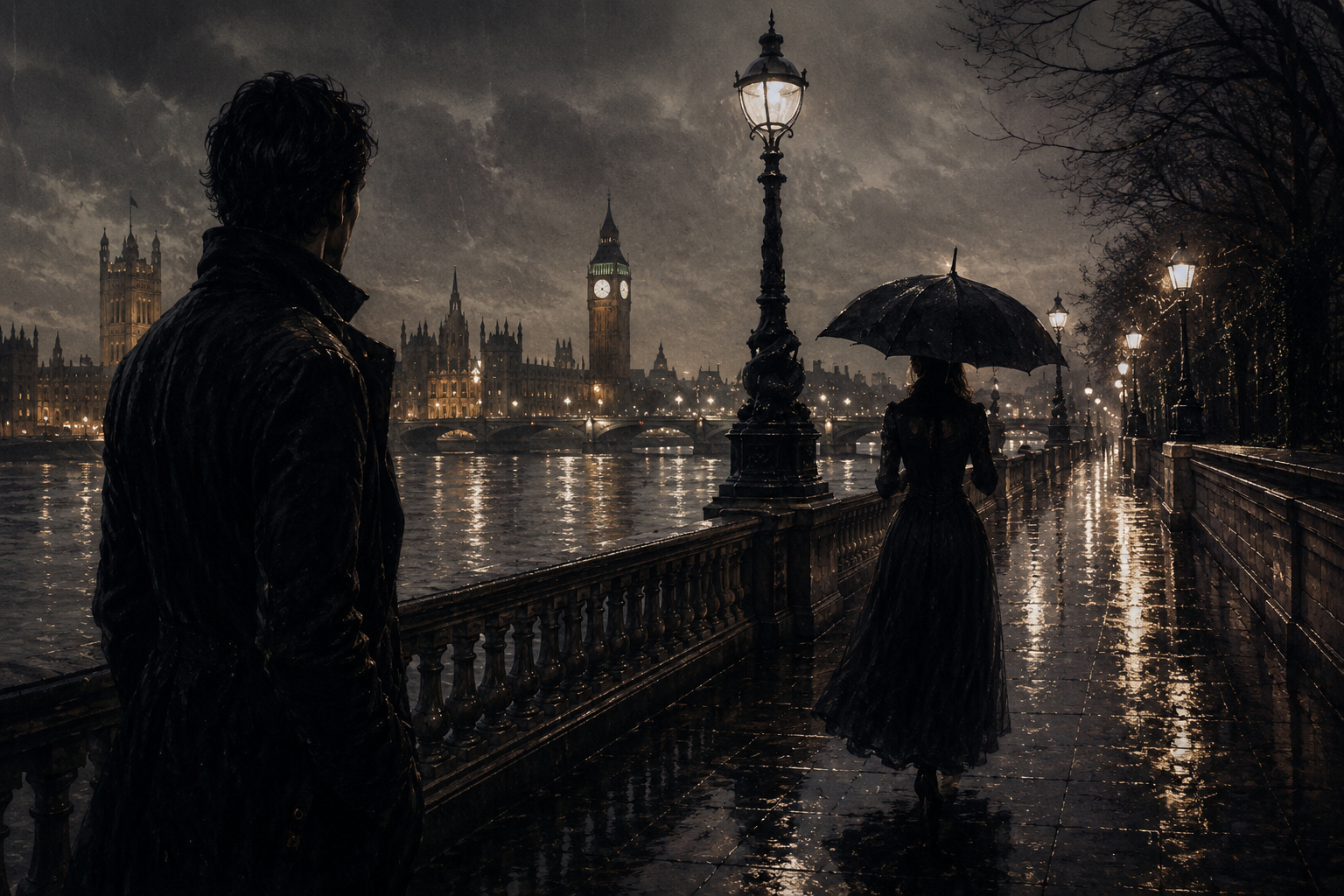
We walked without destination through the drowned streets while London glittered around us like a kingdom submerged. Somewhere in the distance, sirens sang their mechanical lament. A drunk laughed. A church bell answered no one.

She told me she had married.

I felt the words physically, as though some invisible hand had reached delicately between my ribs.

“Do you love him?” I asked.

Her smile then — Christ.

There are smiles that invite affection and smiles that promise sin, but hers belonged to that fatal third category: the smile of someone already standing ankle-deep in the ruins of their own life.

“He is kind,” she replied.

And because I understood her perfectly, I nearly hated her for it.

Kindness. What a miserable substitute for worship.

The rain thickened around us. Her hair clung darkly against her throat. I noticed she still wore the silver ring I bought her years ago in Prague after we spent our last money on wine and a hotel room with no heating. We had been magnificent then — hungry, arrogant, immortal. We believed suffering made people beautiful.

Perhaps sometimes it does.

Or perhaps it merely teaches them how to speak beautifully about their wounds.

By the river she stopped walking. The city lights trembled across the Thames like broken promises.

“I used to think you would die young,” she murmured.

“So did I.”

“And now?”

Now.

Now I wake to alarms and unanswered emails. Now I purchase decent coffee and pretend this constitutes a life. Now I pass strangers in supermarket aisles while carrying entire cathedrals of grief silently inside my chest.

Now I understand that surviving youth is a tragedy Byron forgot to mention.

She touched my face then with unbearable gentleness, like someone handling a relic from a lost civilisation.

For one impossible second, I believed all old romantic lies again:
that love could interrupt history,
that ruined people could be restored,
that the heart was something nobler than an animal wound.

Then she kissed my forehead — not my mouth, never my mouth — and stepped backwards into the rain.

No final declaration.
No dramatic farewell.
Only absence unfolding itself quietly.

And because this is the modern age, her last words to me arrived twenty minutes later as a notification glowing coldly against my phone screen:

I did love you. I simply feared becoming you.


                                           ©Tim Margetts 05/2026
Reviews (4)

Sign in to leave a review

Katharine

5/22/2026

The Words That Got to Me

I wrote a whole review and comments and hit submit review and it didn't. Now everything's gone. I don't know why. If I can, tomorrow, I will write it again.

Tim Margetts

5/22/2026

Got to love random glitches, Katharine. :)

Katharine

5/23/2026

The Words That Got to Me

Of course, the first sentence, "The rain arrived like a confession." God help me, she looked like something civilization had failed to destroy. Now I understand that surviving youth is a tragedy Byron forgot to mention. She touched my face then with unbearable gentleness, like someone handling a relic from a lost civilisation. For one impossible second, I believed all old romantic lies again: that love could interrupt history, that ruined people could be restored, that the heart was something nobler than an animal wound. But she possessed the ancient cruelty of those born to be loved excessively. No final declaration. No dramatic farewell. Only absence unfolding itself quietly. I did love you. I simply feared becoming you. Really, all of them got to me.

Suggestions / Possible Tweaks

the only analogy I kept rereading, trying to understand, and still don't really get, is "For one impossible second, I believed ... that the heart was something nobler than an animal wound.."

Tim, this piece is truly special. The words chosen, and your placement of them, throughout, are magical. I do believe you are a word genii. You make the beautiful English language "sound" as it is meant to sound. I would dearly love to hear you read this aloud. The protagonist speaks of the age of illuminated screens and spiritual starvation, where people speak endlessly and confess nothing, Passion embarrasses modern people. Devotion terrifies them. But as he and the girl he hasn't seen in years walk the wet streets he hopes maybe feelings could be rekindled... Then she says she is married. I hated to see your protagonist's hopes rise and then be so swiftly dashed. And on a cell phone, twenty minutes later, the final blow, too. That, should have cured him. There is much that I have not commented on, but it is all exquisitely written, and our hero is definitely let down, and I hope he IS angry. As he said, she chose kindness, when she could have had worship. Terrific writing, Tim! I may add more to this in the morning. I don't feel that I have given it justice as it is a fabulous piece.

Tim Margetts

5/23/2026

Thank you so much for this, Katharine—genuinely. You’ve understood the piece exactly as I hoped someone might. The tragedy for him is not simply losing her, but surviving long enough to become the sort of man who now understands why she chose “kindness” over worship. That final message was meant to feel coldly modern and almost cruel in its timing — intimacy reduced to a notification. You asked about the “animal wound” line. What I meant there was that, for one brief romantic second, he wanted to believe the heart was something spiritually noble and transcendent — before falling back into the darker suspicion that human love may ultimately just be an instinctive place of injury we endlessly carry around with us. Your comments about the musicality of the language honestly meant a great deal to me. I do post some of my poetry on TikTok and Facebook Reels. Marbe, I should make one for this story.

Tim Margetts

5/23/2026

As you asked, I did this for you. Sorry I got tongue tied on a couple of the words. https://www.facebook.com/share/v/18ydHMxXPc/

Katharine

5/23/2026

what a delightful treat!, Tim! That was wonderful! I am so glad to hear your voice which gives even more power to the poem! Thank you very much! I have played it twice, already! Katharine

The Words That Got to Me

London glittered around us like a kingdom submerged. The city lights trembled across the Thames like broken promises. What a vivid depiction of our Capital city. It made me think of Blake’s poetry about London.

Suggestions / Possible Tweaks

Against a phone screen didn’t quite sit right- perhaps ‘on’ would be better.

I loved this story- it was melancholy, heart-breaking, sensitive and beautifully written.

Tim Margetts

5/24/2026

Thank you, Rachel. I am pleased you enjoyed it.

The Words That Got to Me

God help me, she looked like something civilisation had failed to destroy. *EEEEYIKES!!!! That is brilliant. Vivid and SO taut and perfect!!! The city lights trembled across the Thames like broken promises. *I will think about this analogy every time I see lights reflected in water now.

Suggestions / Possible Tweaks

handling a relic from a lost civilisation. *I think the word 'civilisation' is too unusual to use twice in the same piece.

Wow. Very dark. Haunting. And so painful. I guess I feel a little disdainful of our narrator, though, that he couldn't grow beyond her. I hate that she broke him. But it makes complete sense, after reading this line: Kindness. What a miserable substitute for worship. He is what I refer to as "pet puppy material." He continues to see her as a g-ddess yet still, oddly, a part of him does understand that she's not exactly flourishing, either, as he thinkgs: the smile of someone already standing ankle-deep in the ruins of their own life. I feel like he attributes it to this principal of their former life: We had been magnificent then — hungry, arrogant, immortal. We believed suffering made people beautiful. Neither of them has grown, but just for different reasons. I do respect the writing talent behind this work. It's vivid ad evocative (your calling cards), and these characters are drawn to perfection. It's just that in Real Life, they're the variety who completely piss me off: a faux-mysterious vixen who's trying to telegraph a deep, elusive soul but who's actually nothing more complex than a self-serving user. Meanwhile, he's a lugubrious man-child who became so enmeshed in her mind-games that he can't save himself. Still, I've always maintained one can learn as much from a bad example as a good one. Tremendous writing illustrating a most unsatisfying couple! xoxox

Tim Margetts

5/24/2026

The tragedy of incompatible souls. I wanted to capture the melodrama of the old romantics with their overdone and very fallible personalities, relocated within a modern-day setting. Inspired by the ilk of Jane Eyre, etc., though I could never hope to compete with the mastery of the Brontës