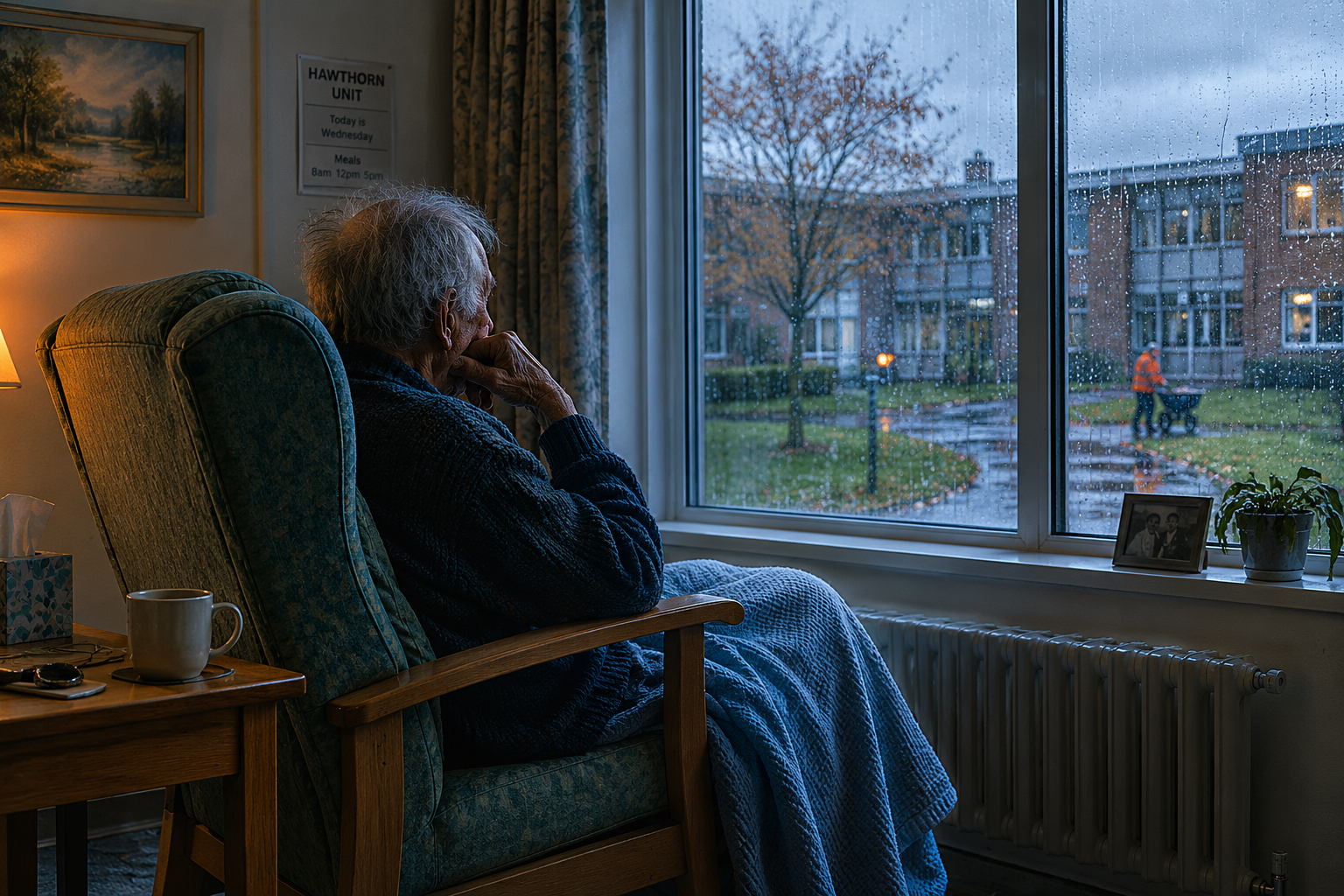
The spoon was yellow.
Arthur had noticed this before the girl put it down beside his porridge, before the bowl touched the wipe-clean table, before the steam reached him with its smell of oats and milk and something faintly metallic from the kitchen. It was not the yellow of buttercups or summer paint. It was institutional yellow. Plastic yellow. The yellow of things made difficult to break.
He kept his hands in his lap.
“Morning, Arthur,” the girl said.
She was new. Not completely new. Three weeks, perhaps four. Long enough for the others to have stopped watching her quite so closely. Young enough to still bend when she spoke to him, as if age were a country reached by crouching.
He did not answer.
There were rules for mornings. Rules helped. The curtains were opened at seven. Tea at half past. Tablets in the little paper cup. Breakfast at eight. No sudden movement. No music before ten unless Frank had been up in the night, in which case the radio stayed off because Frank would shout at weather reports.
Arthur knew these things. He held them carefully.
The girl smiled and pushed the bowl a little nearer.
“Bit hot,” she said. “Give it a minute.”
The spoon lay on the right-hand side of the tray.
Yellow.
Arthur looked at it and felt, far away in the machinery of himself, the first wrong tooth catch.
Not now, he thought.
He closed his eyes.
That had once helped. In the earlier years, when he still believed the body could be reasoned with, he had learned to shut out the world at the first sign. No faces. No light. No movement. Breathe through the nose. Count the tiles. Press thumb to finger, finger to thumb, prove the present by touch.
But the present had never been the problem.
The problem was all the other presents.
“Arthur?”
The girl’s voice moved closer.
The spoon clicked against the tray.
That was enough.
A station platform. Rain under the glass roof. His school blazer dark at the shoulders. A payphone ringing. Ringing. Ringing. A girl with wet hair laughing as she tried to fold a map in the wind. His own hand not lifting the receiver. His own feet turning towards the stairs. The train doors sighing shut.
Then another life came at him sideways.
Not shown.
Remembered.
He was sixteen and thirty and forty-two. He was standing beside her in a kitchen too narrow for two people. He was watching her sleep in a hospital chair. He was hearing her say, You always do this, Arthur, and knowing exactly what she meant. He was carrying shopping in the rain. He was lying about money. He was touching the small white scar under her chin. He was losing her in November. He was old enough to know the shape of her absence.
Then he was back in the dining room with porridge cooling in front of him and the young carer’s hand on his shoulder.
He had not screamed. That was something.
He had bitten the inside of his cheek hard enough to taste blood.
“Arthur, love?”
He opened his eyes.
The girl was not the girl from the station. Of course she was not. They were never who they had been. They were only themselves, innocent as stones.
The yellow spoon trembled on the tray.
No.
His hand was trembling.
“Do you want me to get someone?”
He wanted to ask her name, but names were dangerous. Names made doors. Names made rooms behind doors. Instead he looked past her to the reinforced window, where the morning had flattened itself against the glass.
Outside, a gardener in orange waterproofs pushed a barrow along the path.
Arthur watched him go.
For one clean second, nothing happened.
Then the man turned his head.
Only slightly.
Only enough.
Arthur saw the side of his face, the grey beard, the red mark above one eyebrow, and inside him, something vast and exhausted opened its eye.
Arthur did not remember falling.
Afterwards, there were only pieces.
Rubber soles squeaking across lino.
Someone saying his name from very far away.
The taste of iron in his mouth.
Then the quiet room—Not his room. The other one.
The one with soft chairs and the landscape paintings nobody looked at properly. A place designed for calming men who no longer understood where they were. The windows only opened a few inches. Arthur had checked once.
He sat with a blanket around his shoulders, though he was not cold. The attack had passed through him but left its weather behind.
A nurse with a beard brought tea and set it carefully on the side table.
“You gave us a fright there.”
Arthur nodded.
The nurse lingered.
“You know where you are today?”
Arthur almost laughed at that.
Instead, he said, “Wednesday.”
“Close enough.”
The nurse smiled, relieved. People enjoyed answers that resembled sense.
When the door clicked shut again, Arthur leaned back and closed his eyes carefully, not fully, only enough to dim the room.
The station returned immediately.
Not the impossible years afterwards. Those had already begun dissolving around the edges, collapsing inward like burnt paper. That always happened eventually. The emotional truth remained, but the structure weakened. Specifics went first. Dates. Addresses. The names of side streets.
But the beginning stayed sharp.
Sixteen years old.
Rain.
The ringing telephone.
He could still feel the exact moment.
He had been on his way home from school when the rain started suddenly, hard enough to empty the streets. People crowded beneath the station roof in damp coats, carrying the smell of cigarettes and wet wool with them.
The payphone had started ringing behind him.
Nobody answered it at first. It rang and rang while people ignored it with the stubbornness strangers reserved for public things.
Arthur remembered looking at it.
Not curiosity exactly. Recognition.
As though something inside him had leaned towards the sound.
He had nearly picked it up.
Nearly.
Then the girl dropped her map.
That was all.
A gust of wind caught the paper and spread it across the platform. She laughed — embarrassed, breathless—and crouched to grab at it before it slid beneath people’s shoes.
Arthur bent automatically to help.
Nothing remarkable.
Nothing anyone would remember.
Even now, more than sixty years later, he could still recall the moment the phone stopped ringing, and his hand touched the wet paper map.
The attack had begun before he even understood what was happening.
Not pain. There was never pain. More, an intense pressure.
As though another life had struck his own at enormous speed.
He remembered gripping the edge of a bench because suddenly he was elsewhere and elsewhen and older than himself by decades.
Not visions… Memory.
That was the horror of it. Memory arrived with certainty.
He remembered answering the phone. He knew the smell of the flat even though he had never lived there. Knew the rhythm of the woman’s footsteps. Knew which floorboard outside the bedroom clicked in winter.
He remembered loving her.
Not vaguely.
Not theoretically.
Completely.
And alongside the love came all the small ruins attached to it: the boredom, the tenderness. The repeated arguments about money, and even her habit of touching his wrist while half asleep.
Years compressed themselves into seconds.
When it ended, he was on the platform floor with strangers staring down at him.
Someone had asked if he was epileptic.
Arthur remembered that clearly because he had not known the word.
The girl with the map had knelt beside him.
“Should we call someone?”
He had stared at her.
The force of recognition had been so immense he almost said: You already did.
Instead, he vomited on her shoes.
Back in the quiet room, Arthur opened his eyes suddenly.
The tea beside him had gone cold.
Outside the narrow window, the gardener was gone.
For a moment, Arthur could not remember whether the woman from the station had actually existed or whether she belonged entirely to the unrealised life attached to her.
That was happening more often now.
The boundaries softened with age.
He rubbed his thumb slowly against the first finger of his left hand.
Grounding.
Present.
Real.
Though even after all these years, Arthur was no longer entirely certain what those words meant.
By his thirties, Arthur had learned the difference between surviving an attack and recovering from one.
Recovery implied restoration.
There was no restoration—There was only continuation with additional weight.
He worked then, though the jobs changed often. Warehouses. Deliveries. Night shifts where possible. He preferred occupations that allowed silence and avoided the danger of familiarity. Familiarity was how the unrealised entered him. Repetition. Recognition. The mind linking one thing to another before he could stop it.
He rented a small flat above a betting shop for nearly eight years because nobody asked questions there.
The windows shook whenever buses passed.
He liked that. Constant noise helped anchor the world.
By then he had rules.
No pubs.
No photographs.
Avoid old songs whenever possible.
Never let strangers become regulars.
And most important, leave immediately if recognition arrived too quickly.
Because sometimes the attacks announced themselves early.
A sensation like standing on rotten floorboards. The feeling that another existence had noticed him back.
The motorway incident happened in August.
Heat pressed against the traffic in visible waves. Arthur had been driving north after a delivery, one elbow resting against the open window, the radio murmuring low enough to become texture rather than sound.
He was tired but stable.
Stable mattered.
Three uneventful weeks could almost convince him he was normal.
Then the silver convertible drifted briefly level beside him.
Nothing dramatic.
Just another car suspended for a few seconds, matching his speed.
He turned his head automatically.
The woman driving was perhaps forty. Dark glasses. One hand at the wheel. Hair caught repeatedly by the wind and blown across her mouth before she tucked it back again with absent irritation.
Arthur saw her face for less than two seconds.
The impact nearly killed him.
His hands locked on the steering wheel.
A flood of impossible recognition tore through him so violently he thought, with absolute clarity: This one is too big.
Then the memories struck.
Not sequentially.
All at once.
Rain on conservatory glass.
A hallway painted badly three different shades before settling on cream.
The smell of wine on her breath after funerals.
Her standing barefoot in a doorway saying, “Don’t start this again.”
Christmas lights failing year after year in exactly the same section.
Her hand squeezing his during a hospital consultation.
A son.
Jesus Christ.
A son‽
Arthur saw him at six, sixteen, twenty-three. Saw himself teaching the boy to shave. Saw the scar on his chin from falling against a radiator. Heard an argument about university money so vividly he nearly answered aloud.
Then worse: the ending.
Not death.
Separation.
The cold collapse of accumulated years. Two people who had once known each other better than anyone alive reduced to careful voices in neutral kitchens.
The emotional force of it was catastrophic because none of it felt hypothetical.
He did not imagine loving her.
He remembered it.
The horn behind him screamed.
Arthur realised the car had drifted across lanes.
Tyres struck the rumble strip hard enough to shake his teeth.
The silver convertible pulled ahead, oblivious.
Gone.
Just gone.
While inside Arthur, an entire marriage was disintegrating in real time.
He managed to reach the services six miles later.
He did not remember parking.
Only the toilets. The locked cubicle.
Forehead against metal partition. Vomiting until nothing remained.
And beneath the physical shock, the deeper horror spreading slowly through him:
He missed them.
Not abstractly.
Specifically.
The woman.
The son.
Even the divorce.
He missed arguments that had never happened. He grieved years that had never existed.
Arthur stayed in the cubicle nearly an hour because he understood something new then, something worse than before.
They were not fading. They were accumulating.
There was no room left inside him for all these people.
Arthur was sixty-eight when he finally confused memory with evidence.
Until then, despite everything, some final structure inside him had remained intact.
He knew the difference.
Not intellectually—the recollections had always felt real—but morally. Somewhere beneath the accumulation, he still understood that the unrealised belonged only to him.
Other people were innocent. Even when he remembered otherwise.
Especially then.
The attack happened in a supermarket.
Of all places.
Bright lights. Reduced bread. Tannoy announcements dissolving into static overhead. Arthur standing beside freezers holding a basket containing milk, tea, and soup he would later leave warming in the manager’s office.
He saw the man reaching for peas.
That was all.
Mid-fifties perhaps. Thick fingers. Wedding ring. Grey coat with one button missing near the stomach.
The recognition hit instantly.
Not one life… Many.
Fast. Violent. Layered over one another so densely Arthur physically staggered.
The man shouting in a kitchen.
The man drunk.
The man striking a child.
The man with Elaine pinned against a wall.
The man older and softer and apologising beside a hospital bed.
The man dying bitter and alone.
Arthur saw bruises.
Fear.
Years of humiliation.
One particular unrealised winter evening where the man leaned close enough for Arthur to smell whisky before whispering:
“No one believes you anyway.”
The emotional certainty was absolute.
Arthur did not think.
That was the horror. For one catastrophic moment, reaction outran reason.
His basket hit the floor.
The man turned, startled, just as Arthur struck him.
Once. Then again, and again.
Hard enough to smash him against the freezer doors.
Shoppers screamed.
The recollections intensified immediately, feeding the violence: another shove, another memory, another impossible history collapsing into the present.
Arthur heard himself shouting.
Not words from this life.
Words from elsewhere.
Accusations no one there understood.
Then blood. So much blood.
Enough for reality to return all at once. The man on the floor staring up in terrified confusion.
A crying child nearby.
Frozen vegetables scattered across white tiles.
And worst of all: the complete innocence in the stranger’s face.
Arthur stepped backwards. The false histories were already receding, leaving only emotional wreckage behind. He understood immediately.
This man had never touched Elaine.
Never known him.
Never done any of it.
Hell, Arthur didn’t even know an Elaine. Not in this version.
People were yelling now. Someone pulled him away.
The man on the floor kept saying: “What the fuck is wrong with him?”
Arthur could not answer because suddenly another recollection surfaced — not from the stranger this time, but from himself.
A different path.
One where he had done this before.
Not here.
Not this man.
But violence.
Fear.
Loss of control.
Arthur made a sound then.
Not crying.
Recognition.
By the time police arrived he was sitting calmly beside the automatic doors with blood drying across his knuckles.
He remembered noticing the rain outside.
How ordinary it looked.
One officer crouched carefully in front of him.
“Sir? Can you tell me your name?”
Arthur looked past him towards the shoppers gathering in uncertain clusters near the tills.
Every face suddenly seemed dangerous. Not physically. Associatively.
Any one of them could open another life inside him. Any one of them could contain unbearable emotional consequence.
“I can’t do this anymore,” Arthur said quietly.
The officer glanced towards his colleague.
“Do what?”
Arthur looked at his own shaking hands.
For the first time in his life, he realised the true scale of the danger.
It was not that the unrealised lives might destroy him.
It was his fear that one day he might begin acting on them. And, God help him, now he already had.
They moved Arthur to Hawthorn Unit on a Thursday in late October, around a month after the spoon incident.
Two attendants came with him in the transport van, though only one spoke during the journey. A young man with tired eyes who kept attempting conversation in careful, professionally harmless ways.
“You comfortable there, Arthur?”
“Need the window cracked?”
“Nearly there now.”
Arthur answered politely when required.
He had learned long ago that people preferred manageable forms of strangeness.
Outside, rain drifted across the motorway in pale threads. Service stations appeared and vanished. Petrol stations. Retail parks. Wet fields bordered by skeletal trees.
All of it looked temporary.
Arthur sat with his hands folded tightly enough for the knuckles to ache. Transfers were dangerous.
New places meant new associations.
New voices.
New objects.
New opportunities for collision.
He had tried explaining this once to a consultant with rimless glasses and a soft Scottish accent.
“You’re describing intrusive experiential displacement,” the man had said while writing notes.
Arthur had almost smiled. Such elegant words for drowning.
The facility stood beyond a village whose name Arthur immediately forgot. Red-brick buildings connected by covered walkways. Security fencing discreet enough to pretend otherwise. A place designed to resemble care rather than containment.
Automatic doors sighed open, and warm air smelling faintly of bleach and boiled vegetables touched his face.
A woman at reception smiled.
“Welcome, Arthur.”
He nodded.
The corridors inside were softly lit. Carpet instead of lino. Framed prints of beaches and forests chosen specifically, Arthur suspected, because nobody could feel strongly about them.
One resident shuffled past, muttering at the floor.
Another sat beside a television displaying a quiz show with the sound muted.
Arthur watched everything carefully.
Not out of curiosity.
Defence.
The nurse leading him spoke gently as they walked.
“Your room’s at the end here. Nice and quiet.”
Quiet.
As though silence had ever helped.
The room itself was small but clean. Bed. Wardrobe. Narrow bathroom. A single reinforced window overlooking winter trees stripped almost bare.
On the bedside cabinet sat a digital radio.
Arthur stopped walking.
Instantly, deep inside him, something shifted. Not yet an attack.
Only alignment.
Like distant machinery turning towards him.
The nurse noticed.
“Would you like music on sometimes? We can tune it for you.”
Arthur stared at the radio.
Black plastic.
Scratched near the volume dial.
One corner repaired with yellowing tape.
Ordinary. Completely ordinary.
Then the nurse pressed the power button.
Static burst briefly into the room. And Arthur remembered her singing.
The force of it bent him sideways.
Not the woman from the station. Someone else.
Not Elaine. Why did so many of these attacks recall a woman he had never known?
This was someone older.
A voice beside an open window during summer rain.
Half singing, half humming while turning pages of a book.
Forty years arrived instantly:
shared cigarettes,
arguments in supermarkets,
her reading aloud in bed,
her hand shaking after a diagnosis,
the unbearable intimacy of ordinary evenings.
Arthur gripped the doorframe.
The nurse was saying something.
Too far away.
Another memory struck. This time not love.
A funeral.
Dark coats.
Wet soil.
A son crying silently beside him.
Then another.
Himself alone in a flat filled with unopened letters.
Then another.
Her alive again, furious with him over something trivial and beautiful and completely lost.
The recollections came faster now, overlapping, contradictory, relentless.
Not one life.
Hundreds.
The radio hissed softly between stations.
And suddenly Arthur understood the final cruelty of it all.
The triggers no longer needed meaning.
Association itself had broken down.
Anything could open everything.
A face.
A cup.
A sound.
Static.
His knees gave way slowly. The nurse caught one arm before he hit the floor.
“Arthur? Arthur, stay with me.”
But there was no single place left to stay.
Not anymore.
Inside him entire histories were collapsing into one another, years grinding against years until identities blurred and dissolved.
He saw himself young.
Old.
Cruel.
Kind.
Married.
Alone.
He remembered children who had never existed with such clarity he could recall the weight of them asleep against his chest.
He remembered deaths.
Hundreds of deaths.
Not dramatic ones.
Hospital rooms.
Telephone calls.
Quiet endings.
An impossible accumulation of grief pressed against the limits of a single human mind.
The nurse’s face hovered above him, frightened now.
Arthur looked at her and, for one terrible moment, recognised her too.
Not from this life.
From another.
A daughter.
The certainty hit him with enough force to stop his breathing.
“My God,” he whispered.
Tears slid suddenly down his face.
The nurse tightened her grip on his shoulder.
“It’s alright, Arthur. You’re alright.”
Arthur made a weak sound that might once have been laughter.
No, he thought.
That was precisely the problem.
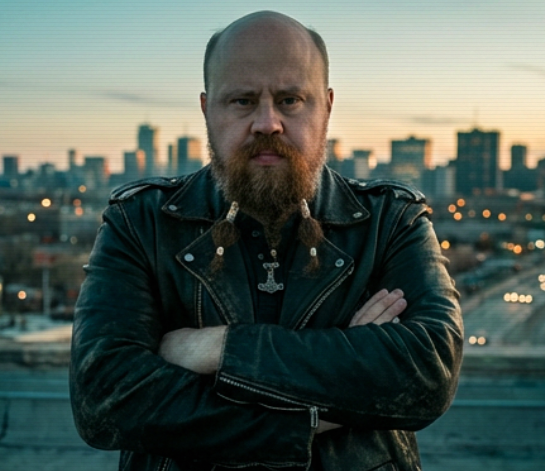

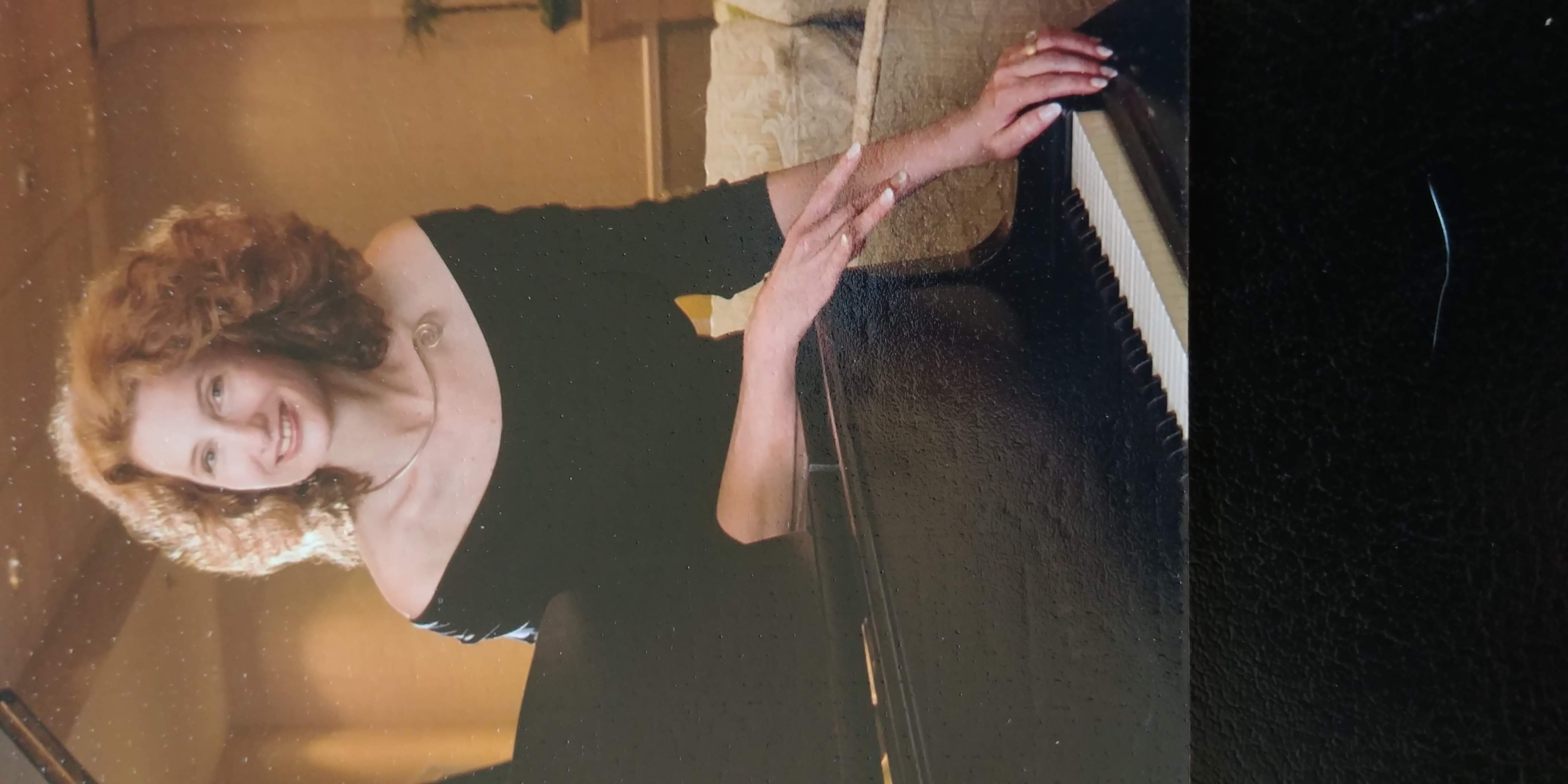
5/29/2026
The Words That Got to Me
An impossible accumulation of grief pressed against the limits of a single human mind. he remembered hundreds of deaths... children who had never existed, and more confusion (which didn't hold a candle to mine :)
pobrecito!-- What a horrible mental illness. Tim, I hope you won't throw up your hands and be put out with me, because I am truly trying to understand, but Is the point of the story that HE finally understood the problem? and if so, was it that he had really led another life (or two?) and had a daughter, and a son? etc? I mean, surely he already knew he was mentally ill? Or maybe it was that he wasn't all right, but surely he knew that. I could never figure whether any of the people and things he "remembered" had really happened or were made up? He certainly didn't seem to know; however, people looked familiar, and he remembered certain things, but then said, they never happened. It was all just too confusing to me, I'm afraid. But, I have to ask you, at the end when you said, the certainty hit him... is it that he realized he had really led different lives? or that he imagined all of them? Had any of his "recollections" ever really happened? I'm sorry to still be in the dark after all that long story, but I fear I am. I started to just delete all this, and maybe I should have, but I really want to understand not only the story but your meaning, if you don't mind. Your imagination and originality are definitely at play, here, Tim. I CAN say that with certainty! Thanks, in advance, for your understanding and kindness. Katharine