The drive had taken longer than expected. Forest roads wound like veins through the northern hills, each turn tighter than the last, each mile deeper into a place no one bothered to map anymore. Liam kept his window down for most of it, letting the cold air keep him sharp. He hadn't seen another car in over an hour. The last road sign had been half-buried in moss, its letters worn down to little more than suggestions. He hadn’t needed it. The coordinates were already locked in.
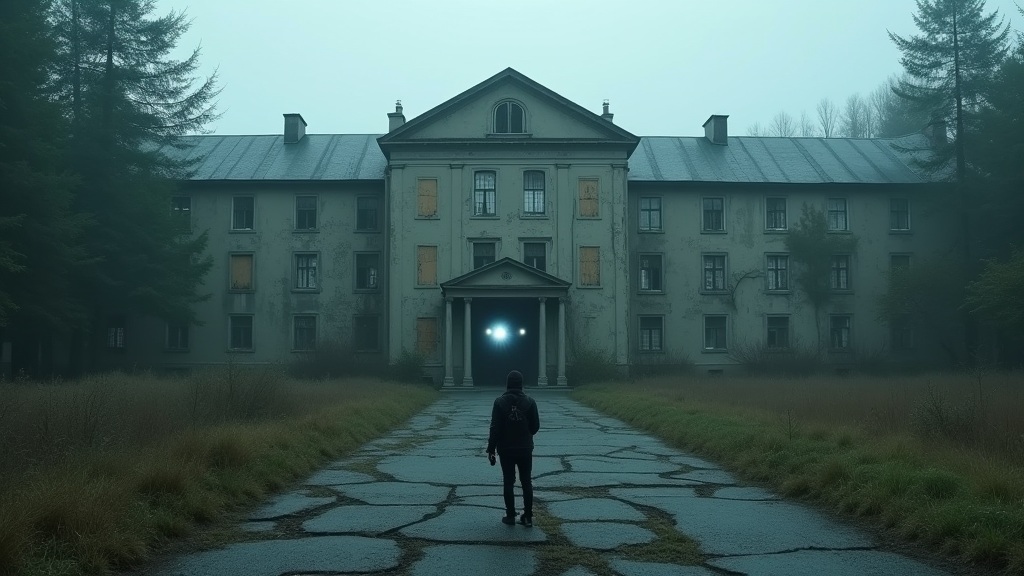
When the trees finally broke, and the clearing yawned open before him, Liam eased the van to a stop. The grass had reclaimed most of the old tarmac, pushing through the cracks like it had waited decades for this moment. The gate lay rusted and half-collapsed. Beyond it, shrouded in mist and silence, loomed the remains of Greyfall Asylum.
It was larger than he’d imagined.
Not a ruin, exactly. Not the hollowed-out shell he’d seen in the few surviving photographs. The brickwork was weathered but intact. The windows—what few remained un-boarded—reflected nothing but the overcast sky. The roof sloped low at the corners, a design Liam recognised from older sanatoriums, built to be stormproof and easy to patrol.
He stepped out of the van, boots crunching over gravel and glass. He kept the camera off for now. Let the atmosphere breathe a bit. No need to force the first shot. The wind moved through the clearing in uneasy gusts, too cold for October, and without rhythm. There were no birdsong. No rustle of undergrowth. Just wind, and the faint creak of wood shifting in the asylum’s bones.
Liam took the gate-key from his pocket. It was old—black iron, heavy in the hand. No label. Just a note tucked with it in the envelope he’d received two weeks ago.
‘She’s still listening.’ Was all it had said.
He hadn’t told anyone he was coming.
That was rule one with things like this. Go alone. No noise. No contamination of the site. No people panicking over every creak or draught. You needed to listen properly if you wanted to hear something true.
He slung the canvas bag over his shoulder, checked the batteries one more time, then started toward the building. The grass muffled his steps. The main doors stood slightly ajar, though they were heavier than they looked. Someone—or something—had forced them open long ago.
Inside, the air changed.
It wasn’t colder. Not exactly. It felt compressed, like walking into a sealed room with no ventilation. The smell was faintly antiseptic, threaded with dust and something that might once have been mould. Not rot. Not decay. Just… stillness. The sort of stillness that suggested the building was holding its breath.
The lobby was wide, with high ceilings and peeling paint. Two staircases curled upward on either side, mirrored like a theatre set. The tiles beneath his boots were grimy but unbroken. Liam paused at the threshold, reached down, and pressed a gloved finger to the floor.
No dust.
He straightened slowly. His boots had left no footprints and the door creaked shut behind him without wind.
He turned. No one there.
“Alright,” he said aloud, voice quiet but steady. “Let’s see what they left behind.”
He raised the camera. Red light blinked on. Recording.
The hallway stretched out before him like a throat—long, pale, and silent. The floor tiles alternated between cream and grey, scuffed smooth by long-vanished feet. Overhead, fluorescent lights hung crooked in their brackets. Some had shattered, others flickered dimly, even though no power should have been running.
Liam kept the camera steady as he walked, filming in silence. His breath fogged faintly in the colder air, visible for a second before disappearing. The corridor smelled of bleach and old paper. Nothing else. No rot. No rust.
He passed a directory nailed to the wall in a steel frame, its glass cracked across the centre. Wards A through F, hydrotherapy, administrative wing, staff quarters. Someone had scrawled across it in red marker:
THEY NEVER LEFT
Liam tilted the camera to catch it, then moved on without comment. Let the footage speak for itself. He didn't narrate during the first walk. That was another rule—capture it raw, unshaped by intention. The audience could draw their own conclusions. Most of them wouldn’t even notice the important things until a second viewing.
A door stood ajar a few metres ahead, labelled Ward E – Interview Room 3. Liam paused at the threshold, adjusting the lens. The door was solid oak, painted white, with a wire-reinforced glass window that had long since been painted over from the inside. He pushed it open gently with the toe of his boot.
The room was almost surgical in its simplicity. A table, two chairs, and a wall with a hole in it.
Not a mirror.
Not even a window.
Just a round aperture, perfectly smooth around the edges, like it had been carved out with a machine. No cracks. No damage. No purpose. It was exactly eye level.
Liam stepped inside and let the door swing shut behind him. The silence deepened. Not just quieter—thicker. As though the sound was being drawn out of the air molecule by molecule. He walked over to the table and leaned down, running a hand along the surface. It was clean. Wiped down. Polished.
He sat in the chair nearest the hole.
The air changed again.
Only slightly. Enough to notice. Enough to make the hairs on his arms rise. His ears popped faintly, like a shift in pressure. He leaned forward, just enough to peer through the hole.
Nothing but darkness.
Not just shadow—depthless black, like the aperture opened into a void with no back wall.
He tilted his head slightly. The black remained. There was no light on the other side. No echo when he shifted his weight.
He pressed the lens of the camera close, trying to get a shot.
Just black.
A pressure against the camera. Not contact. No sound. But something pushed back through the lens. Not force—presence.
Liam blinked, and pulled the camera away. His heart had begun to race. For no reason he could name. He stood and backed toward the door.
It didn’t move. Doors wouldn’t do that… Most doors wouldn’t do that and he hadn’t closed it.
He remembered that clearly—he’d left it ajar.
But it was shut. Tight. Without a sound.
He reached out slowly and gripped the handle. It was warm. Slightly too warm.
The door opened without resistance.
The hallway beyond looked exactly as he left it—except for one detail. A chair now sat in the middle of the corridor, perfectly centred on the tile.
Liam hadn’t seen it there before. He was certain of it.
He stepped out slowly, camera rolling. He panned left, then right. No movement. No sound. No breath of wind.
The chair was made of pale wood, legs slightly uneven, the sort found in waiting rooms. Its seat was stained—water, maybe. Coffee. Maybe blood. Hard to tell in the ambient light.
There was no reason for it to be there.
He moved past it.
The camera caught a slight flicker—just once—when he passed. Not a glitch. A shift. The frame jumped half a second. Then resumed.
He didn’t speak. Didn’t acknowledge it.
But he didn’t look back, either.
Not yet.
He passed the chair.
Thirty steps down the corridor, he stopped and checked the footage.
The chair was no longer there.
He rewound. Watched himself walk past it. Kept watching.
Frame by frame.
When the frame jumped—blink—and the view corrected, the chair was gone. No sound. No movement. No distortion. Just a missing object in continuous footage.
Liam glanced over his shoulder.
The hallway stretched behind him, still and empty. Same as before. Same as always.
He kept moving.
The corridor narrowed ahead, branching into two smaller halls marked Wards D and F. The sign above the junction was new. Untarnished steel. White paint. Black lettering. Still wet to the touch when he brushed a knuckle over it.
He chose Ward F.
The hallway here was different.
Longer. Lower. The floor was still tiled, but the pattern had shifted—no longer the checkered cream and grey, but a repeating pattern of concentric circles, almost imperceptible until you looked directly at them.
Liam stopped walking. Looked down.
The pattern wasn’t just decorative. It was repeating. Not along the floor—but beneath it. The same scuffs. The same stains. Every three metres, a faint brown mark on the left, a scratch on the right, a missing corner.
Copy. Paste. Copy. Paste.
He looked up.
At the far end of the corridor, something moved.
Just for a second—a flicker of motion, a figure turning the corner and disappearing from sight. Too fast to catch detail. No defining shape. No sound of footsteps. Just the blur of someone—or something—passing out of view.
Liam didn’t call out.
Instead, he lifted the camera, thumbing the screen to rewind the last few seconds of footage. His finger hesitated over the scrub bar as the image reversed in jittery fragments. The hallway reappeared, second by second. Still. Empty. Nothing moved.
The figure wasn’t there.
But something else had changed.
The timestamp in the corner now read 3:41 PM.
He frowned, checked his wristwatch: 2:29.
Only minutes had passed. Ten, at most. It had been 2:27 when he’d last checked. That was real time—grounded, external. But the camera said otherwise. Over an hour gone.
He glanced back at the screen. The timestamp remained fixed, steady, as if daring him to challenge it.
The air shifted.
Colder here—more than before. Damp clung to the corridor like condensation on glass, bleeding down the walls in invisible streaks. The plaster beneath the wallpaper had a bulging quality, like the building was slowly absorbing moisture into its skin. Every breath tasted faintly of mould and iron.
Above him, the fluorescent tubes pulsed in staggered rhythm. Not flickering exactly—just breathing, in slow, irregular waves. One of the bulbs overhead gave a soft buzz and dimmed for a moment. When it returned to full light, Liam noticed the corridor ahead had shortened.
Not by much. Just a few feet. A missing pipe joint. A scuff on the floor that had vanished.
He stopped walking.
Lifted the camera again, slowly panning the lens down the passage behind him.
The junction was gone.
Just clean corridor stretching backward.
He turned a slow circle, careful not to lose his balance on the uneven tile.
The hallway now extended in both directions—identical, repeating. No end in sight. No exit. Just a loop.
The building was folding space.
Or time.
Or both.
He stood motionless for several seconds, not from fear, but from the quiet acceptance that whatever rules had governed the space when he entered no longer applied.
Reaching into his coat pocket, he pulled out the small leather-bound notebook and uncapped his pen with a quiet snap. His handwriting slid across the page with practised ease, though even as the ink dried he noticed something strange in the shape of the letters—slightly off-centre, a curve where there should’ve been a straight line. It was his writing, but… not quite.
He wrote:
The building is copying itself. Room by room. Line by line. It forgets what it had, so it remakes it. But slightly wrong.
He didn’t know why he wrote it.
Only that the words belonged on the page.
He capped the pen again, slid the journal back into his coat pocket, and moved forward. The next door appeared at his left, flush with the wall. Brass plaque. Lettering worn.
Treatment Room B7.
Liam paused, then reached for the handle and stepped inside.
The door closed behind him with a soft but deliberate click.
In the silence that followed, the sound of the latch settling into place echoed louder than it should have.
The room was small—bare, clinical, and too well preserved. Metal cabinets lined one wall, each drawer labelled in delicate typewriter font: Syringes, Binders, Anxiolytics. The paint hadn’t peeled. The air smelled faintly of disinfectant and iron. A single stool sat beside a gurney bolted to the centre of the floor.
A clipboard hung on the wall near the door.
It listed patient observations for 2nd October, 2004.
Liam frowned.
That was today’s date.
The pen hanging beside it was uncapped. Its nib still glistened, as though it had been used moments earlier. The clip trembled slightly as he stepped closer, camera still rolling in one hand, the lens catching the shimmer of moisture along the ink channel.
The sheet itself was blank.
But not untouched.
Faint indentations traced across the paper—subtle grooves left by letters that had been written and then somehow erased without a mark. Not wiped away. Removed. Excised.
He hesitated, then raised the pen, pressing its tip gently to the page.
He never got the chance to write.
The light vanished.
Not dimmed. Not flickered. Vanished.
Darkness fell so suddenly and so completely that it felt like being dropped into a void. The air changed, too—flattening, losing its weight, its presence, as though whatever had been holding the room in place had simply let go.
Liam didn’t breathe. Didn’t move. The pen still hovered above the page, invisible now, his hand frozen mid-thought.
Six seconds passed. But it was long enough to feel like more. Then the lights returned, snapping on not with a flicker, but a decision.
Everything was gone.
The clipboard. The pen. The gurney. Even the walls themselves.
Liam was no longer in Room B7.
He was standing in the entrance lobby.
The same tile underfoot. The same high ceiling. The same sweeping staircases curled upward on either side like mirrored ribs. The front doors stood slightly ajar, exactly as they had when he entered. The wind outside whispered faintly through the gap.
The scuff mark he’d left earlier—just beneath the door, where it had swung shut too hard—was gone. The wall stood clean, unmarked, as though it had never moved. Yet nearby, a single footprint remained, pressed into the shallow layer of dust near the far wall. Just one. Left boot. Pointing inward.
He hadn’t walked through this space with only one step.
Liam crouched slightly, filming in silence. The camera’s red light blinked back at him. His chest felt tight, and it wasn’t from the cold.
Something had been reset.
Not just the door. The room.
He turned in a slow circle, the lens panning across the entrance lobby. Everything looked the same—the high ceiling, the twin staircases, the cracked floor tiles. But it felt like a stage reset between scenes. Familiar objects in familiar places, laid out with just enough precision to pass at a glance.
The directory sign caught his eye.
Same steel frame. Same fracture running diagonally across the glass.
But the handwriting had changed.
Where once it had read THEY NEVER LEFT, the red scrawl now said:
YOU’VE ALREADY BEEN HERE
His stomach dipped.
He took a step back, heart thudding. Behind him, a door creaked open. No sudden slam. No bang. Just the soft, deliberate swing of old hinges releasing tension.
Ward E – Interview Rooms.
That door had been shut when he passed it the first time. He was sure of it. He remembered the chipped paint near the handle. The way the number three had been faded, barely visible. Now it stood wide, inviting.
Beyond it stretched a corridor he recognised—at least, he thought he did. Cream and grey tiles underfoot. Walls painted the same institutional green, lined with faded signs.
He turned away and retraced his steps instead, back toward the route he’d taken earlier. Through the left-hand corridor, past the hall junction.
The sign appeared again, it was the same directory and the same crack. Even the same words.
YOU’VE ALREADY BEEN HERE
Liam stopped moving.
A cold, crawling sensation prickled along his spine. Was he going in circles or had he just got himself turned around? That was always the problem with places like this. It was far too easy to get lost.
Then again, no matter how he tried to rationalise it, that wasn’t it, he wasn’t lost or going in circles. The building wasn’t just shifting behind him—it was writing ahead of him. Pre-empting his path. Constructing familiarity before he could question it.
He turned sharply and headed down the main hallway, pushing through the double doors he'd filmed earlier. He tried to anchor himself—watch for markers, specific signs of the route he'd walked before.
He remembered passing a rusted radiator on the left-hand wall, leaking rust across the tiles in a long reddish trail. He’d filmed it. Noted the smell of oxidised metal, the way it steamed slightly in the cold.
But now, in its place, stood a wall-mounted water fountain. Stainless steel. Bone dry. Spotless.
A spiderweb clung to the spout.
Liam stared.
He reached for the camera, thumbed through the recent playback, and froze the frame.
There it was.
The radiator. Clearly visible. Bent slightly out from the wall, corrosion bleeding down to the floor. Twenty-two minutes ago.
He turned back to the hallway. The tiles beneath the fountain were cracked in a jagged arc. Not broken, just wrong. As though the floor had been damaged, then repaired by someone unfamiliar with the pattern.
Further down, the interview room doors had changed.
Before, they were numbered evenly—Room 1, Room 3, Room 5.
Now they were labelled in negative numbers.
Interview -2, Interview -4, Interview -6.
The paint was dry. The metal signs were affixed with rusted screws, not recently installed. They looked like they had been there for decades. He ran a hand along the wall beneath them.
There were no holes.
No apertures in the plaster. Just flat wall where he remembered looking through into the void behind Interview Room 3. He pressed his knuckles against it—solid, cold, undisturbed.
He felt something shift in his stomach.
Not fear. Not yet.
But the awareness that the world around him was not just lying, but believing its own lie.
He turned and walked back the way he had come.
The corridor stretched longer now. He couldn’t see the end. The lights overhead hummed at a different pitch. The bulbs had changed from long fluorescents to old glass domes. Some had red filters.
He passed a door marked Waiting Room – Intake 2A.
The door had not been there before.
On the floor outside it lay a file folder, neatly closed. No dust. No weathering. Just paper and plastic, as though placed there recently.
He knelt and picked it up.
Inside were typed records. Standard intake forms, except they were filled out in red ink. The handwriting was familiar. His name appeared in the top margin of every page.
Patient: Liam Vexley
Date of Admission: Unknown
Diagnosis: Observational Reversal Disorder
Symptoms: Predictive recall, spatial disassociation, identity bleed-through
He flipped to the last page.
It was blank.
As he watched, words began to form on it. One stroke at a time, like a slow typewriter—black ink, neat, deliberate.
DO NOT GO BACK TO THE LOBBY
The file shook slightly in Liam’s grip.
It wasn’t fear—not quite—but his body was responding to something before his mind caught up. The edges of the paper felt colder than the air. Not like they’d been left in a fridge, but as though they were drawing warmth out of his fingertips one degree at a time.
Overhead, the lights buzzed once. A soft flicker. When they steadied again, the shadows around him had lengthened by just a few inches. Enough to notice. Enough to register that something had changed while he blinked.
Behind him, the corridor creaked.
Not the building settling. Not wood giving under strain. This was movement. Intentional. Pacing.
Not loud. Not fast. But definitely moving.
He turned.
The corridor stretched behind him, unchanged at first glance. Doors lined either side, each numbered cleanly in sequence. But the numbers were wrong again. They had once been negatives. Now they counted up—but skipped every third room. He couldn’t remember if that had always been the case, or if the building had simply decided to drop a few along the way.
There was no one there.
He raised the camera, panning slowly.
Nothing.
No figure. No shadow. But the lens wobbled slightly, like it had caught a draft he couldn’t feel. Something just out of frame, disturbing the focus, resisting being captured.
Liam lowered it and took a single step forward.
The sound came again.
Behind him, two steps. Measured. Matching his pace.
He stopped.
Silence.
He turned back and walked quickly to the nearest door, pushing through without checking the number.
The room inside was nearly identical to the others—small, windowless, painted in a pale shade of something that might have once been mint green. A desk sat in one corner, its surface empty but clean. The chair behind it was upholstered in brown vinyl, torn at the seams.
On the far wall was another hole.
Just like the first.
No mirror. No frame. No partition glass. Just an opening, perfectly circular, perfectly smooth. No sound came through it. No light. Only depthless black, like someone had drilled a window into the concept of absence.
Liam backed away from it, careful not to turn his back to the corridor. He stepped into the hall once more and it had changed again.
The door he had entered now had no number. The others—lined in both directions—bore names instead.
Not patient names. Not medical staff.
His name.
L. Vexley.
Vexley, L.
Dr. Vexley.
Mr Liam Vexley, OBS
Vexley 03-A
REDACTED (LV)
Each door was slightly different in design. The fonts didn’t match. Some placards were metal, others painted, one carved directly into the wood as though with a blade. One was backwards. All spelled some variation of him.
He didn’t speak. Not out loud.
The sound of breathing was now constant, just behind the edge of hearing.
Not his own.
A dry, soft intake. Then a rasped exhale. Not loud. Not fast.
Just close.
He started walking again. Not toward the lobby, he didn’t know where he was heading but the doors on either side of him kept changing, and each one he passed seemed newer than the last.
The hallway narrowed as he moved forward. The tiles shifted again—still alternating shades, but now duller, more yellow than cream. The walls lost their sheen, the paint taking on a dry, powdery finish, like it had been sun-bleached and abandoned for years. But there were no windows here. No sun. Just the occasional twitch of overhead light, fluttering like an exhausted insect.
Liam walked slowly, counting the doors as he passed. Each one bore a version of his name, sometimes reversed, sometimes rearranged. A few had placards that looked new—plastic and metal, corporate in design. Others were crude, carved into wood or scorched into the paint.
They seemed to watch him.
He didn’t look directly at them now. He kept his eyes forward, the camera down at 2008
Then—just ahead—a door moved.
Only slightly.
It opened with a sigh, barely more than a shift on its hinges. Just enough to be seen, not heard.
Liam slowed, cautious, every muscle tensing without instruction.
The door bore no name. No number. No marking at all. Its surface was perfectly clean, the wood pale and untreated, like it had only just been installed. A single strip of light spilled from the gap between frame and door—yellowed and soft, warmer than the flickering fluorescents behind him.
He reached it without meaning to.
The door stood open now, only a hand’s width, and what lay beyond made his heart thud once, painfully hard.
He knew this room.
Not in the way he knew maps, or photographs. Not intellectually. Not with the detachment of memory.
He knew it.
The wooden floorboards. The narrow bed against the left-hand wall. The shelf lined with books—titles half-remembered from his teenage years. The ugly olive-green jumper draped over the chair by the desk. The exact shape of the lamp with its paper shade, still bearing the small scorch mark from when he’d let it burn too long in the winter of 1982.
It was his room.
Not the one he lived in now. Not the flat. This was older. Childhood. Sixth form. Maybe first year of uni. Before the cameras. Before Greyfall. Before everything.
He stood in the doorway, throat tight, stomach hollow.
There were no seams. No tricks of reconstruction. The dust was where he remembered it. The faint water ring on the desk—still there. Even the smell was right. Books and faded deodorant. Carpet cleaner. A life paused and stored somewhere outside of time.
He stepped inside.
The door didn’t close behind him.
It didn’t have to.
His boots landed softly on the wooden floorboards, muted by the woven rug he had nearly forgotten. He moved to the desk, reached out without thinking, and touched the corner of the lamp.
The paper shade was warm.
The bulb was on.
The light glowed without flicker, steady and gentle. A small pool of comfort in a place that had none.
He turned to the shelf. The books were all there. Dog-eared, underlined. Some still bore the little sticky-note tabs he’d used for essays. He reached for one at random, something old and cheap with a cracked spine. When he pulled it free, a folded sheet of paper slipped from between the pages and fell to the floor.
He picked it up.
Unfolded it.
At first glance, it looked like one of his own notes—his handwriting, his phrasing. A rough plan for a video. Talking points. Lighting angles. Shot references. A date scrawled at the top in black ink:
Greyfall Concept – April 2023.
Liam stared at it, confusion curdling into a kind of quiet dread. That date wasn’t right. He hadn’t even begun sketching ideas for Greyfall until August, and even then, it had only been loose threads—a dream here, a phrase there. He'd never written anything this formal. Not in April. Not ever.
And yet, as he stared at the letters, something inside him stirred with undeniable recognition.
He remembered writing it.
The curve of the pen. The way the ink had soaked slightly into the cheap paper fibres. The drag of his wrist as he leaned too hard into the title. The memory was there, fully formed—but wrong. He hadn't lived it. He shouldn't remember it. But he did.
He looked again, it was his writing and it was todays date - 2nd October 2004
The paper began to warm in his hands.
Not like it had been heated—more like it had begun to respond. A subtle vibration, low and rhythmic, like a pulse felt through the bone rather than the skin. It thrummed faintly beneath his fingertips, and when he blinked, the words were gone. No smearing, no fade. Just absence. The page was blank. Perfectly blank.
He stared, breath held. The air around him had shifted again. He hadn’t noticed it happen, but now it felt thinner, brittle somehow, like something was about to shatter and hadn't decided whether it would be the room or him.
Behind him, the door creaked open.
It moved slowly, deliberately, a hollow sound that echoed with just enough weight to suggest it had done this before. More than once. As if it always opened at this moment.
Then—quietly, unmistakably—a voice drifted in from the hallway.
His voice.
It called his name the way you might call to someone you already know is listening.
He turned toward the sound, but the hallway remained empty. The voice called once more, softer this time. Fainter. Then nothing.
Silence reclaimed the space.
Liam stood frozen, the blank paper still in his hand, the last of its warmth fading from his skin as if it had never been there at all.
Liam sat alone in the sterile room, the speaker silent above him, the tiles beneath him suddenly colder than they had any right to be. He pressed his palms flat against them, as though anchoring himself would stop the things crawling up through the cracks in his mind.
The pressure built slowly—behind his eyes, in his throat. Something was rising. Not panic. Not even fear.
At first, it arrived in fragments—sensory splinters that didn’t quite fit. His nose twitched at the sharp tang of bleach and copper, while somewhere close by, a spoon clinked inside a ceramic bowl.
In his mind’s eye, he saw wet socks clinging to a tiled floor. Behind it all, the slow gurgle of a bath draining played like the background music to something he couldn’t yet remember doing.
He closed his eyes.
And saw the hallway.
Not Greyfall. Not this one.
Their hallway? His hallway? He knew this place, but he didn’t know it.
Wallpaper peeling in long strips. A single bulb swaying above. Blood smeared across the skirting board in a child's handprint. His handprint.
He walked barefoot, the floor sticky beneath him. The knife was heavy in his grip—not from weight, but from repetition. His fingers were cramping. He’d been holding it too long.
He stepped over the dog.
He couldn’t remember the dog’s name. Only that it hadn’t made a sound when he slit its throat. Just a twitch, and a wet sigh.
His mother had been next.
She was in the kitchen, still holding a mug, tea gone cold. She turned just as he stepped into the room, eyes wide, mouth starting to form his name.
He remembered this part clearly. The way her weight sagged against him. The hot rush soaking through his shirt.
He hadn’t meant to hug her but it had felt like a hug and it was with loving care that the knife slid between her ribs from the back. Piercing her heart. The way she sighed as she sank to the floor was almost peaceful.
Not his sister though, she was on the stairs, screaming. It was just so loud and distracting so he didn’t hug her, just plunged the knife into her throat. It was amazing how quiet she got then.
His father in the doorway was looking on like he had seen a ghost, that was strange, none of them were ghosts. Not yet. It was all too much and then his dad tried to attack him, he tried to hit him. That wouldn’t do, then there was too much motion, and his arms swinging, swinging, a blur of red and steel and choking sobs.
He remembered cleaning up afterwards.
Filling the bath with water and sitting in it until the blood stopped swirling.
He remembered how peaceful it had felt, submerged to the neck in the bathwater, skin puckered and pale, the surface stained red with blood that wasn’t his. The fan in the ceiling had hummed quietly above him, steady and low, a sound he'd clung to like a lullaby. It had been quiet. Finally quiet.
That’s where they found him. That’s what they told him.
Or—wasn’t it?
He hadn’t used a knife. He was sure of that. His hands hadn’t shaken. There had been no struggle. No blood smeared across the tiles. No wet footprints.
He’d used a gun. Neatly. Efficiently. One bullet for each. Point-blank. One by one. His mother first. Then his father. Then his sister. No screaming. No time to run. He remembered their faces. Blank. Not even surprised. As if they’d been expecting it.
Afterwards, he’d carried them. Arranged them carefully in the lounge—legs crossed, arms folded over chests, eyes closed. They looked like they were sleeping. They looked… peaceful. Like a family in prayer.
That had happened.
He remembered it.
Didn’t he?
But the flat had no lounge. He lived on the second floor. No stairs. No place to lay out bodies like that.
No dog. He hated dogs and they hated him.
He’d jumped from the roof instead. Yes, that was it. The city had stretched out below him, lights blurred into a painting of static and haze. He’d stood on the ledge and counted backwards, the wind clawing at his coat. He remembered closing his eyes.
But something had pushed him.
Or maybe—maybe he’d pushed them.
He saw it clearly now. He was standing on the balcony, one hand on each shoulder. His mother. His sister. His father. Their feet scraped at the concrete as he herded them to the edge. They wept. They pleaded. But he didn’t stop. He smiled. Whispered something he couldn’t quite hear. Then pushed.
One after the other.
They fell like broken mannequins, their limbs stiff, their mouths open in silent protest. He watched them hit the pavement. Three bodies, wrong shapes, pooled in red halos.
No. That wasn’t it either.
There had been fire. He was certain of it. Smoke curling through the doorways. Screams echoing from behind locked doors. He walked through the house with a blade in one hand and a jerry can in the other. The walls had peeled and bubbled. The floorboards had groaned.
He’d been laughing.
Or crying.
Or both.
The memories began to stack. One atop the other. None complete. None whole. They bled into each other like ink soaking through paper—each version darker than the last. His arms wrapped tighter around himself as the room seemed to swell and tilt, walls breathing slowly like lungs filled with rot.
He could smell the blood again—thick, metallic, coating the back of his throat. He could feel the water cooling around his legs, the bath drain gurgling as it swallowed what was left. He could taste something salty and sour. Soup, maybe. Not hot. Not fresh. Something he’d made. Something he’d stirred with the handle of a spoon that bent too easily.
But he’d never cooked, he was sure of that.
Wasn’t he?
The weight grew heavier. Not crushing—but constant. Like a presence had settled across his chest with infinite patience, content to wait while he unravelled beneath it. It didn’t speak in words. It didn’t need to. Its pressure alone carried the message, whispered through the blood in his ears:
This is what you’ve done.
This is what you are.
He wanted to scream, to tear the memories out with his hands, to deny every moment that had crawled up from the depths of his mind like worms through rotting wood. But his body remained still. Locked. Frozen beneath the weight of knowing. Only his breath moved now—shallow, uneven, a faint reminder that something inside him hadn’t let go. Not yet.
The voice returned.
It didn’t echo.
It didn’t project.
It came from inside him—coiled around his ribs, whispering through his marrow.
“You’re remembering,” it said, softly. “But not the truth. Only the outlines. The shapes you needed. The stories you sculpted from guilt and hunger, just sane enough to let you keep breathing.”
Liam lifted his head. Slowly. As if fighting gravity from within his own skull. His eyes burned. His throat was raw.
“I don’t know what’s real anymore,” he said.
There was a pause. Not silence—presence. Listening.
Then the voice replied, it was not cruel, nor triumphant. Just satisfied.
“Exactly.”
Liam reached for the camera.
His fingers were stiff with tension, but the plastic casing felt comfortingly solid in his grip. He tilted the screen out, thumbed back through the recording. The timecode ran smooth. No glitches. No skipped frames.
But something was wrong.
He hadn’t recorded this.
The current frame wasn’t the padded room. It wasn’t even the tiled one.
It was… normal.
Two people sat across from one another in matching armchairs. High-backed. Worn upholstery. Soft lighting. The camera must’ve been placed on a low table between them, angled just slightly upward. Framed professionally. Comfortably. A small ceramic pot of sugar cubes sat between two matching mugs. One of them still steamed faintly, visible in the flickering light of a nearby floor lamp.
The man on the left sat back, legs crossed, hands folded over one knee. Calm. Attentive.
The man on the right leaned forward slightly, rubbing at his temples, his voice low but audible through the playback.
Liam stared at the screen.
They were both him.
Not similar. Him.
One version older. Tired. Slight greying at the temples. Calm in the way only people on the other side of the breakdown ever managed to be. The other… frayed. Hollow-eyed. Fingers stained with ink. Speaking like someone whose thoughts had nowhere left to go but out.
“I’m not saying I remember doing it,” said the second Liam—the younger. “Only that the memory fits. It feels like mine.”
The older version nodded, not breaking eye contact.
“And if it wasn’t yours?”
A pause.
“It still is,” the younger replied. “Because I carry it now. Whether I earned it or not.”
Onscreen, neither of them reacted to the strangeness of their likeness. There was no mirror, no moment of realisation. Just conversation. Like this had always been normal.
Liam looked up from the screen, the room around him remained unchanged. Cold tile beneath him. Blank walls. Speaker silent overhead.
There were no chairs. No table. No lamp.
No steaming coffee.
Just the steady blink of red light as the camera continued to record.
He looked back at the screen.
The scene was still playing. The conversation still unfolding.
The younger version leaned forward now, voice cracking with something just below the surface.
“I just want to know which one I am. The one who did it… or the one who survived it.”
The older version reached out—gentle, deliberate—and rested a hand on the younger’s knee.
“Both.”
Liam paused the footage.
Two versions of himself locked in a quiet, impossible understanding.
He sat back slowly, heart knocking against his ribs.
The room was silent again, the scent of coffee had begun to creep in—soft, faint, impossible.
And his knee still burned faintly, exactly where the older version had placed a hand.
His hands trembled as he set the camera down.
He had to get out.
He rose too fast, staggering against the wall as vertigo punched through his balance. The room spun for half a second—just enough to make the floor feel thinner, as if the tiles were only inches thick and beneath them, a void waited with open arms.
He blinked. The door across the room was closed. He moved toward it, jaw clenched, but when he reached it—it was already open. He didn’t remember opening it. Hadn’t heard the latch. But the frame stood wide, the corridor beyond yawning into shadow, same as before.
Still, he ran.
Out into the hallway. Past the identical doors. Past the scarred wallpaper and peeling lights. His footsteps echoed unnaturally, delayed by a half-second, like they were being played back from a speaker just out of view.
He sprinted toward the lobby. He remembered the route. He knew the path.
The corridor bent left. A double door appeared. He pushed through.
The entrance hall spread before him—high ceiling, twin staircases, the cracked floor tiles like a broken chessboard.
His heart lifted. A fragile, trembling thing.
He ran to the first door on the right. The same one he’d passed earlier. He didn’t know what it led to—staff room, stairwell, maybe even an exit—but it didn’t matter. It was different. That was all he needed.
He grabbed the handle and wrenched it open.
The cold tiled room greeted him.
Empty.
Except for the camera.
It sat exactly where he’d left it, the screen still frozen mid-frame, two versions of himself locked in silent conversation. The red light blinked on the casing, rhythmic, steady. A heartbeat that didn’t belong to anything living.
Liam staggered back a step, a dry, involuntary sound escaping his throat—half breath, half broken word. His vision swam for a moment. The door felt warm beneath his palm, but only because the blood had drained from his fingers.
He shut it—harder than he meant to—and turned toward another. The one across the lobby, beside the cracked directory sign with its flaking letters and long-dead lightbulb. That door had been locked before. Now it wasn’t. He reached it, didn’t pause, didn’t breathe, just yanked it wide.
The room beyond swallowed him in déjà vu.
Same tile. Same stale air. Same sterile geometry. The camera sat where it always had, unchanged, untouched. Its lens faced him directly, as though it had expected him to come back. The screen displayed that frozen moment again—two of himself locked in patient conversation. The image hadn’t shifted, hadn’t faded. The red light blinked on.
Still recording.
Still watching.
He backed away more slowly this time, his movements uncertain, the edges of his awareness fraying like damp paper. He closed the door gently, like setting down a photograph he couldn’t bear to look at but couldn’t bring himself to destroy.
He turned down a side corridor, unsure whether it led to Ward B or somewhere new. He didn’t care. All that mattered was that it hadn’t been used yet. That it might still offer escape. The air grew colder as he moved, the hallway subtly narrowing with every few steps, though he never noticed the change as it happened—only after, once it had already become fact.
The first door on the left stood slightly ajar.
He pushed it open, one hand trembling against the peeling paint.
No surprises.
The same room. The same silence. The same camera.
Still blinking. Still waiting.
He didn’t gasp or cry out this time. Just exhaled softly, his chest hollow, lungs refusing to fill. Something shifted deep inside—less panic, more resignation. The realisation that something fundamental had given way, not with a crash, but with the soft, shivering sigh of something meant to hold and no longer doing so.
His voice barely reached a whisper.
“No. Please…”
It wasn’t clear who he was speaking to.
He moved again. Faster. Door to door, corridor to corridor. Some handles resisted. Some turned freely. A few doors stood open before he touched them. Every time, the same result: the same sterile walls, the same cold tiles, the same camera watching from the same spot.
It was never a different angle.
Never a mirrored room.
It wasn’t repetition.
It was recursion.
The building wasn’t showing him the same room again and again—it was returning him to it.
By the time he reached the final door, he no longer reached out in desperation. His hand hovered only briefly before the hinges gave a soft groan and the door swung inward on its own.
The room beyond held nothing new.
Nothing changed.
Nothing more than what he already knew was waiting.
Liam stepped across the threshold.
The door closed behind him without a click. It simply became closed.
The silence didn’t break.
It watched.
And from the camera—unchanged, ever-watching—came the playback. His own voice, impossibly soft, as though drawn from a moment he hadn’t lived yet.
“I just want to know which one I am…”
Liam sank to the floor.
There was no collapse, no stumble—just a slow, automatic folding of limbs, as though gravity had quietly taken over the places his will no longer reached. He drew his knees into his chest, arms wrapping tight around his head, fingers clutching fistfuls of hair.
The moan that left his mouth wasn’t pain. It wasn’t fear. It was the dull, open-ended noise of someone trying to drown out their own thoughts—not with volume, but with pressure. A child in a thunderstorm with hands clamped over his ears.
He rocked gently, forward and back, forehead pressed to his knees, breath rattling in shallow bursts through his nose. His body had gone still, except for the trembling. That was constant. Bone-deep and directionless.
The camera watched.
The red light blinked.
The screen remained blank.
From Liam’s mouth came a string of soft, fractured syllables—no language, no rhythm, just the shape of speech without meaning.
Not calling for help.
Just trying to stay whole.
Behind the glass, two men watched in silence.
The padded room was quiet, its white walls scrawled from floor to ceiling in ink. Words layered over other words. Symbols. Loops. Entire paragraphs rendered unreadable beneath overlapping lines, as though each new attempt to explain himself had been written in defiance of the last.
He sat in the middle of it all, barefoot in the soft grey uniform, arms wrapped tight around his legs, eyes hidden, body gently swaying. Beside him, a pile of papers spilled across the floor, a graveyard of thoughts no one could translate. Most were marked with black ink, some with red, a few with fingerprints smudged into the margins.
The older man stepped closer to the glass, one hand tucked into his lab coat pocket.
“He’s been like that for almost three hours now. No change in posture. No speech beyond the murmur loop.”
The younger man, arms folded, shifted his weight slightly. “And still no name?”
The older shook his head.
“No ID. No record. Not in any system. He was found walking along Route 57 at 2:17 in the morning. Barefoot. Wearing a bathrobe soaked in blood—not his. Feet shredded. Just… walking. No expression. No response when approached. Eyes wide open, staring straight ahead.”
“And since then?”
“Silence. Screaming. Talking to someone who isn’t there. Scribbling nonsense in waves. Obsessive behaviour with the paper and pens. And that thing—” He gestured to the plastic object on the padded floor near the patient’s foot. “That broken camera. Won’t let anyone take it. He thinks it’s still filming.”
The younger man narrowed his eyes.
“What about external links? Any unsolved cases that match?”
“None. No missing persons, no bodies. Nothing matching his face, height, scars, nothing. He’s a ghost. Clean teeth, no tattoos, perfect bloodwork. He shouldn’t exist.”
They both turned back to the observation glass.
The figure in the room hadn’t moved. Just rocked gently, lost in a loop too deep to be disturbed.
The younger man spoke again, quieter this time.
“So what is he?”
The older man didn’t answer immediately. His gaze lingered on the patient, following the slow movement of his swaying body. The back of the man’s shirt was damp with sweat. The ink-stained walls seemed to lean inward, as if trying to read what he was thinking.
Finally, the doctor exhaled.
“No idea.”
The walls pulsed.
Not with light, not with movement—just presence. As if they were breathing around him, exhaling slowly into the sterile air, their fabric seams flexing with each imagined heartbeat. Liam lay curled against the floor, one hand pressed to the side of his face, cheek resting against cold tile that somehow still carried warmth, as if it had remembered him.
He wasn’t crying. He wasn’t speaking. But his mouth moved, shaping thoughts that no longer needed sound. The words were inside him now—spreading. He could feel them beneath his skin, ink bleeding through veins, scrawling across the inside of his skull.
He sat up slowly.
The camera sat before him, its screen no longer blank. It had started playing again, unprompted. Footage rolled with quiet conviction, a steady stream of moments that hadn’t happened—or perhaps had happened elsewhere, in another Greyfall, in another Liam. Faces passed across the screen—his face, over and over, but never quite the same. Older, younger, injured, clean-shaven, bloodied, smiling, screaming.
He watched each version of himself and felt nothing. Not recognition. Not alarm. Only familiarity.
As though each one had taken a shift behind his eyes, lived a day or a decade, and then handed the keys to the next.
The hallway waited beyond the door. Not the one he remembered. This one was wider. Lit by oil lamps that gave off no heat. The walls were cracked and weeping something thick and black. He could hear his own voice coming from the far end—not calling, not pleading. Just speaking. Steady. Calm. Conversational.
He rose.
The door opened without his touch. The camera floated up with him, trailing silently at his side, the red light blinking in sync with the rhythm in his head.
He stepped into the corridor.
The floor gave slightly beneath his weight, soft as wet carpet. The lights dimmed behind him and grew stronger ahead, guiding him forward.
He passed doors he didn’t recognise, but somehow knew. One bore the number April 23, scratched in with a key. Another was labelled simply Observation. A third had no handle at all, only a child's handprint in dried blood where the latch should have been.
He didn’t stop.
The hallway stretched ahead, lit by lanterns that flickered but gave no warmth. His footsteps were soft now. Confident. As though something inside him had settled, or given up. The camera hovered beside him, humming faintly, its light pulsing like a lighthouse beacon guiding him back to shore.
He reached the last door.
It looked like all the others—but he knew it wasn’t. This one hadn’t been waiting. It had been watching. Waiting suggested patience. This door had intent.
He reached for the handle.
The metal was warm beneath his palm.
He stepped out of the van, boots crunching over gravel and glass. He kept the camera off for now. Let the atmosphere breathe a bit. No need to force the first shot.
The wind moved through the clearing in uneasy gusts—too cold for October, and without rhythm. There was no birdsong. No rustle of undergrowth. Just wind, and the faint creak of wood shifting in the asylum’s bones.
Liam took the key from his pocket. It was old—black iron, heavy in the hand. No label. Just a note tucked with it in the envelope he’d received two weeks ago.
She’s still listening.
He hadn’t told anyone he was coming.

6/22/2026
The Words That Got to Me
"The grass had reclaimed most of the old tarmac, pushing through the cracks like it had waited decades for this moment." I love that! "You needed to listen properly if you wanted to hear something true." Not sure what "true" means, here. You can tell this is all from the beginning, where I still thought I would figure it out.
Tim, I started to call you Liam!!! Yikes! Pardon my French, but that was the damndest thing I have ever read in my life. I'm sure you have a point, a message, but I'm just so not tuned to whatever you're thinking. I don't know why there would be all that about his killing his family, if he didn't do it, but maybe he just thought of all the ways he could, but didn't? The note, "She's still listening" must mean something. The whole thing has got to be in his mind, though not necessarily did it have to happen. Or....it could've. Now, ha ha ha ha, (crazy laugh), I sound like you. ha! I got about half way through it and thought, "I'm not going to finish this." But then, of course, I did. Wait! I just had a thought: You are a psychiatrist in disguise!!! Yes you are, but not the kind to help people get well, nooo, you're trying to drive us crazy! Well, Congratulations, Liam! You've succeeded!