No one built it.
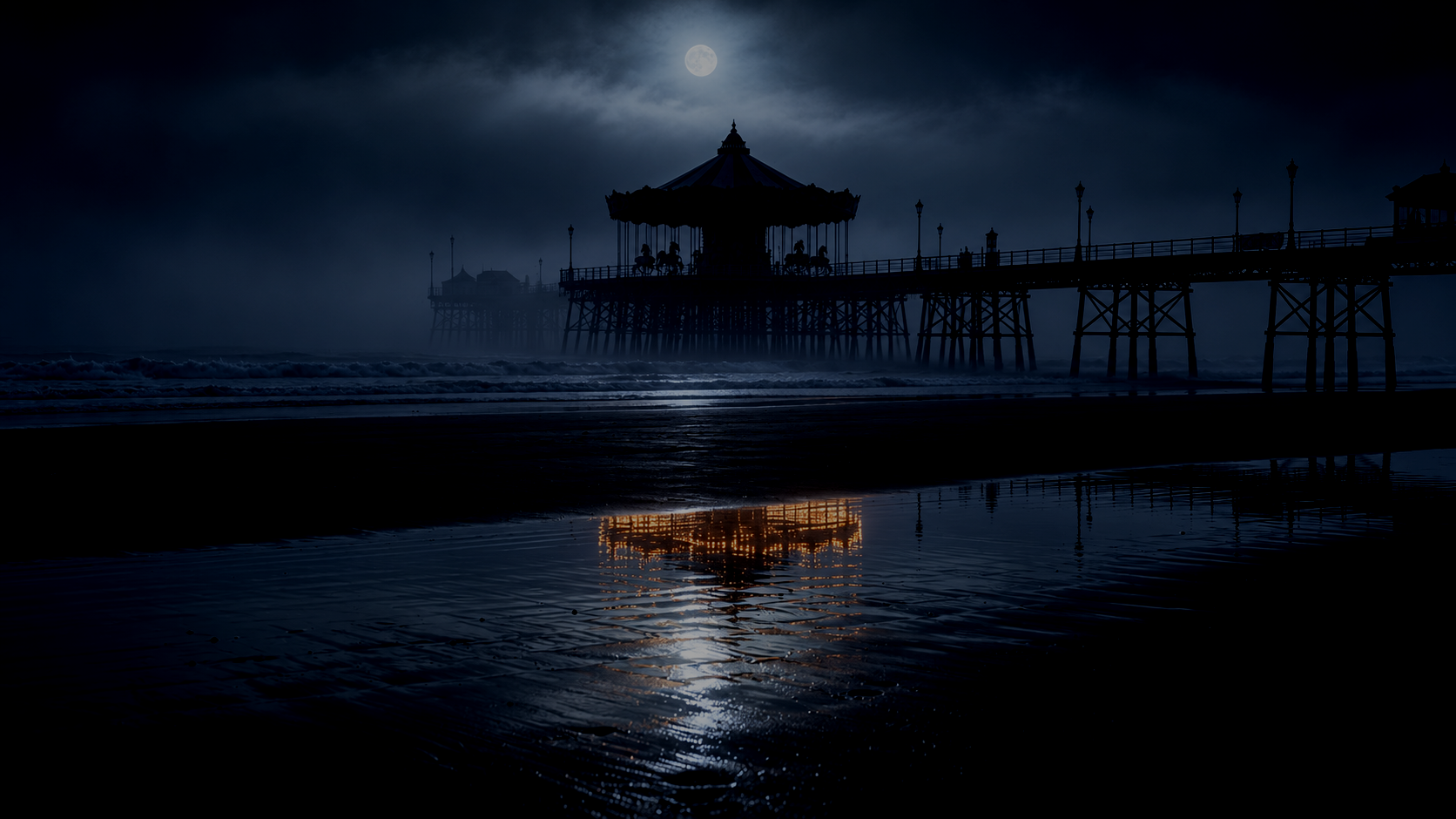
That was the first wrong thing. The carousel appeared overnight, squatting at the far end of the old pier like a tumour that had always been there. Its horses were worm-eaten, its paint scabbed in flakes, and the thing looming atop—the grotesque face—grinned like a guillotined jester from some forgotten freak show. No crew, no cranes, no permits. Just fog. Rot. And the slow drip of something wet hitting timber.
And then the music started.
Faint, at first. A wheezing lullaby, drawn through rusted pipes and broken teeth. It curled across the waves at night like a breath exhaled by something asleep too long. It wasn’t a tune you could hum. It wasn’t even one you remembered hearing—but your body did. Something behind your ribs responded. Something deeper.
They tried to shut it down, of course. The mayor ordered structural inspections. Two men from Leeds turned up, high-vis and hard hats, joking about ghost stories. One of them fell through the boards before he got ten feet. Both legs shattered. Said something underneath the pier had grabbed him. Not caught. Not broken. Squeezed.
The second man didn’t finish his report. Walked off mid-sentence, grey as stone, muttering about eyes in the bolts and mouths in the beams.
By the end of September, no one wanted the job.
The pier was locked. Signs posted. CCTV fitted and promptly ignored. But signs don't mean shit to teenagers, and Matty Briggs was the worst of them—mean, restless, and hungry for likes. He lived a few streets back from the coast, where streetlamps flickered and everything smelled faintly of mildew. His mum worked double shifts and drank the rest. The boy had no leash.
He wasn’t bullied. He did the bullying.
So, when the whispers started—when someone claimed the carousel moved at dusk—Matty saw opportunity. Brought his GoPro. Talked into it like he was hosting his own horror vlog.
“Check out this absolute shit-tip. Probably full of paedos and smackheads.” He kicked a bloated gull corpse into the surf. “Maybe I’ll find Jimmy Savile’s ghost. Ask for a bloody autograph.”
He made it to the carousel just before sunset. Thirty-nine minutes of footage survived. His last moments were a blur—an eerie metallic whine, a sudden glance over his shoulder, the camera knocked askew. Then a wet sound. A crunch. Something like chewing.
Static.
His bike was still chained at the pier gates. Tyre warm. No footprints on the boards. No blood. Just the GoPro wedged beneath a warped plank.
They dredged the bay. Dogs sniffed the beaches. Nothing.
Three days later, the carousel turned.
No wind. No power. It just began to rotate, slow and shuddering, like it was testing old joints. Its gears scraped like bone on bone. Lightbulbs blinked into life—twitchy, uncertain—casting epileptic shadows across the boards. The music returned. Out of tune. Out of time. Familiar in the way disease feels familiar once it’s inside you.
The mayor ordered it torn down. Hired a crane. Next morning, they found the operator dead inside his cab. Both hands severed. A look of bliss frozen on his face like a child on Christmas morning.
The autopsy said the cuts were clean. Surgical. The bones powder-fine where they'd been removed.
No one tried again.
By October, the town had sealed itself off from the sea. Windows boarded. Shops closed early. Children weren’t let out after dark. The fog came thicker every night, and the carousel kept turning.
It didn’t want tourists.
It wanted tribute.
Two more went missing before the month was out—Denny and Liam, twin brothers with too much bravado and not enough fear. The kind of kids who spat at stories and pissed on graves for TikTok likes. They stole a bottle of corner shop vodka, grabbed a Bluetooth speaker, and marched out onto the pier on a dare.
They never came home.
Their mother found Liam’s phone two days later, half-buried in damp sand, still playing the same song on loop. Not one they recognised. Not something they'd downloaded. Just that same lurching carousel tune, wheezing like a dying calliope.
The final image stored in the camera roll was worse.
A selfie, blurred in motion. Denny’s face was frozen mid-scream—except half of it wasn’t there. Flesh torn away to the jawline, teeth and tongue exposed, the eye on that side hanging low like a popped grape. Behind him, something was reaching—a shape in a clown’s gloves, with a snout like a deep-sea fish, and a grin full of razors.
The police dismissed it as a crude fake. But the phone had no editing software. And those gloves—they matched a pair recovered years ago from the body of a drowned party clown whose shoes were filled with sand and teeth.
After that, the pier went quiet.
Only one person broke the silence. Molly Carr.
She didn’t sneak down for thrills, or dares, or content. She went with purpose. With rage.
Her little brother had died on that beach.
They found his remains sprawled like refuse along the tide-line—arms stripped to the bone, fingers gone, ribs cracked open like crab shell. His eyes had been plucked, his tongue cut flush with his gums. The police called it an animal attack. A tragic accident.
But Molly had seen the trail. Blood soaking the shingle, leading back up the beach—toward the pier.
She never forgave the lie.
She didn’t dress up for drama. No makeup. No livestream. Just black boots, black jacket, a crowbar in her grip, and the date circled: Hallowe’en.
She waited until the fog came in thick and low, dragging its belly along the ground like something hunting. Then she walked the pier.
It welcomed her.
The fog tasted like rust and old teeth. The carousel was turning already—slow, laboured, like it was grinding itself awake. Bulbs flickered in sickly pulses. The face atop the ride had changed; its lips had curled into something wider, deeper, hungrier. Its cheeks bulged like something inside was pushing outward.
Molly stepped closer.
The horses were not carved anymore. Their flanks glistened under the lights—flesh swollen and raw, veined and twitching. One let out a wet, choked whinny, its muzzle yawning open in vertical halves to reveal small, pink teeth and a mouldering child’s shoe jammed in its throat.
She didn’t flinch.
The platform juddered beneath her. Something below the planks shifted—thick and slick, like muscle flexing in anticipation. She found the control box. Smashed it open.
There were no fuses. No wiring. Only a wet, veined sac, pumping slow and steady. A heart. Real. Alive.
It blinked when she raised the crowbar.
She brought it down.
Once. Twice. A third time.
On the third blow, the pier screamed.
The sound wasn’t mechanical. It wasn’t even animal. It was human. Thousands of voices, shrieking in harmony, shrieking from inside the timbers, inside the ride, from beneath the waves and above the fog. The horses bucked and twisted. Sparks burst from the carousel canopy. The music blared.
And then he crawled out.
Matty Briggs.
Or what had been Matty.
He spilled from the mouth atop the ride like afterbirth—skin flayed and scrawled with runes, pierced with rusted hooks and clamps. His lips were gone, his eyelids cut off. His grin was permanent, teeth long and worn like tools. He walked like a puppet missing strings, arms twitching, head lolling.
He saw her.
Nail-less fingers reached.
And through a voice box scraped hollow, he whispered, “Just one more turn. Just one more…”
Molly didn’t freeze.
She swung the crowbar again, burying it in his clavicle with a meaty crunch. Bone cracked. Ribs caved. He didn’t stop. Didn't bleed.
He laughed.
More emerged from the ride’s mouth. The twins. The crane operator. Her brother—what was left of him—guts sloshing loose, jaw held on with copper wire, eyes still gouged. They came in droves, moaning and twitching and dragging, arms outstretched.
She ran. The platform splintered behind her.
Then it gave way.
The boards collapsed beneath her weight, and she dropped like a stone into the carousel’s belly.
She landed hard on something that breathed.
Flesh. Heat. Bone. Steam hissed around her, damp with blood and oil. The carousel’s guts were alive—intestines coiled around metal cogs, meat wrapped in steel bands. Jaws opened and closed in the dark, feeding on tubes that carried screaming voices. Not echoes. Voices. Real. Trapped.
She choked back bile.
The heart was there, too—larger now, pulsing fast, connected to wet, thrashing limbs of machinery. And in its shadow, watching, sat a child.
A girl. Six or seven. Her hair came away in clumps. Her skin sagged like wax near flame. Her eyes were grey. Lifeless.
She looked at Molly and said, “It’s hungry. Always hungry. You can’t stop it. But you can slow it down.”
Molly said nothing. Just clenched her teeth, found the crowbar, and climbed the nearest rib.
She drove it into the heart again.
And again.
And again.
The whole pier convulsed. Screams erupted from every crack. Fire burst from the carousel’s mouth. The dead caught light—each of them howling as flame licked their ruined bodies. Matty was the last, his face bubbling, his jaw unhinging, his flesh dripping to the boards like wax.
The ride spun faster and faster, shrieking as it went.
Then silence.
When they found her the next morning, Molly was half-buried in wet sand. Her right arm was fused around the crowbar. Her legs were broken. Her eyes wide and white. She never spoke again.
But every Hallowe’en, she walks—slow and stiff—to the sea.
And watches the place where the carousel had stood.
But sometimes, late at night, when the wind comes in strange, you can still hear it.
That song.
That voice.
“Just one more turn… please.”
They welded the gates shut after Molly Carr.
Triple-reinforced steel bars, rigged floodlights, and a CCTV mast feeding live footage to the council’s emergency control room. Officially, the pier had been condemned. Unstable. Unsafe.
Unofficially, everyone knew what had happened.
The carousel had fed.
After the fire, all that remained were charred boards, twisted metal, and the misshapen corpse of that grinning face—melted down one side like it had wept acid. The horses were reduced to lumps of varnish-cooked sinew, frozen mid-convulsion, as if they’d died mid-scream.
No one ever dared test if it was truly dead.
Ten years passed. And like all good horror stories, it slid from memory into myth. A bedtime tale told to frighten siblings. A ghost story shared on school buses. A cursed location on Reddit lists and TikTok reels.
The fence held. Until the storm.
Hallowe’en again.
The sky fractured with lightning, thunder cracking like bone. Rain lashed the sea in horizontal sheets. And when the tempest finally passed, the pier stood naked once more—floodlights dark, cameras blind, and the gate swinging gently on silent hinges.
The lock lay in the dirt. Unbroken. Untouched.
At sunrise, five university students crossed the threshold.
They were filming a doc: Myths and Mass Hysteria—the kind of disposable content that gets half a million views if someone screams and wets themselves. They were young, smug, armed with battery packs and mockery.
Elliot, the director. Nia, the editor. Marco and Samira, behind the cameras. And Danny, front of house—the face of the doc, with a voice trained for sarcasm and a jawline tuned for thumbnails.
They laughed their way along the planks, pushing into the fog, boots thudding across scorched wood and char.
“Smells like piss and burned glue,” Danny said, waving a torch beneath his chin. “We’re definitely going viral.”
The carousel loomed ahead—blackened, broken, motionless. The face had slumped entirely now, jaw sagging into a permanent leer. Its teeth were cracked but present, like a warning whispered through a grin.
Danny posed for a photo beside it. “Let’s dig up Molly. She’ll be thrilled with the exposure.”
That’s when the music started.
Faint. Drawn out. The same warped tune from Matty’s GoPro. Slower this time. Hungrier. It oozed across the boards like a presence, like breath on the back of your neck. The team paused.
“Is that in the soundtrack?” Nia asked, voice tight.
No one answered.
Then Marco turned. “Where’s Samira?”
The question hung.
She’d been right behind them.
They called her name. No reply.
It was Nia who found her phone on the planks, still recording.
The footage shook wildly for three seconds. Then froze on Samira’s face—wide-eyed, mouth agape—as her body was yanked upward by something too fast and too large to see. A shape. A motion. A shadow. And then she was gone.
No scream.
Only the sound of the carousel wheezing into breath.
Panic began to rise—but Elliot, the genius, refused to stop. Instead, he pushed into the half-collapsed control booth, fingers on rusted levers.
“We can make it turn. Make it light up. This is production value.”
Danny raised his camera. “Go on, mate. Give us one more turn!”
The gears groaned.
The carousel juddered.
Then it moved.
Not just rotated—rose. The whole platform lifted on hydraulic limbs slick with brine and something darker. Boards split. Beneath them was no sea.
Only meat.
A pulsating floor of knotted veins and cartilage, stretching far beyond the pier’s boundaries. Bone spires jutted from the surf like ribs. The structure had taken root—grown beneath the bay like fungus fed on flesh.
Danny turned to run.
Too late.
A tendril whipped from the dark, snagging his ankle. He fell hard, camera flying. The lens caught him as he was dragged backwards, screaming. His shoe flew off. Then his sock. Then his foot—sheared clean by the edge of a waiting maw lined with chewing teeth.
He screamed all the way down.
The crunch was wet. Violent.
Blood misted the camera.
Elliot stumbled backwards, but the pier was no longer a pier. The planks split, curled, peeled back like fingernails, revealing gaping channels of flesh beneath. Bones clicked in rhythm. Lights above sparked into frantic life.
And the gates—those towering steel gates—slammed shut behind them with a clang like a prison door locking forever.
Nia ran, dragging Marco with her. But halfway back, he stopped.
He was moaning.
Blood leaked from his ears, his nose. His skin blistered and split open like overripe fruit. Beneath, something wriggled—worms or nerves, twisting under the surface, feeding on him.
He shrieked and dropped, thrashing. His chest caved in. His body deflated.
Something beneath the pier drank.
Nia didn’t look back.
She hit the gates hard, metal stinging her palms. Locked. Already.
From the fog, a shape stepped into view.
A woman in a long black coat. Hair bleached white. Skin like paper. Eyes empty.
Molly Carr.
She didn’t speak at first. Just watched the carousel spin with that same dead hunger. Its mouth was open again.
Inside, Danny’s face stared out—still screaming, lips raw, eyes frantic, trapped behind glassy flesh like a trapped insect in amber.
Nia turned, sobbing. “Why?”
Molly stepped forward, her voice hollow and dry.
“This town made a deal,” she whispered. “Long ago. Long forgotten. The pier takes what it needs. Always has. Always will. And once every ten years... it remembers.”
She raised her hand and offered the crowbar.
“You can’t stop it. But maybe... you can feed it less.”
Nia backed away, but the boards beneath her began to split. Fingers reached from below—dozens of them—grey and bloodless, grasping at her legs.
She screamed. Molly turned away.
The carousel spun faster, shrieking with glee as the planks snapped open wide and swallowed Nia whole.
Only her voice remained, echoing from the belly of the ride—wordless, endless, begging.
And somewhere in the gears, another face began to form.