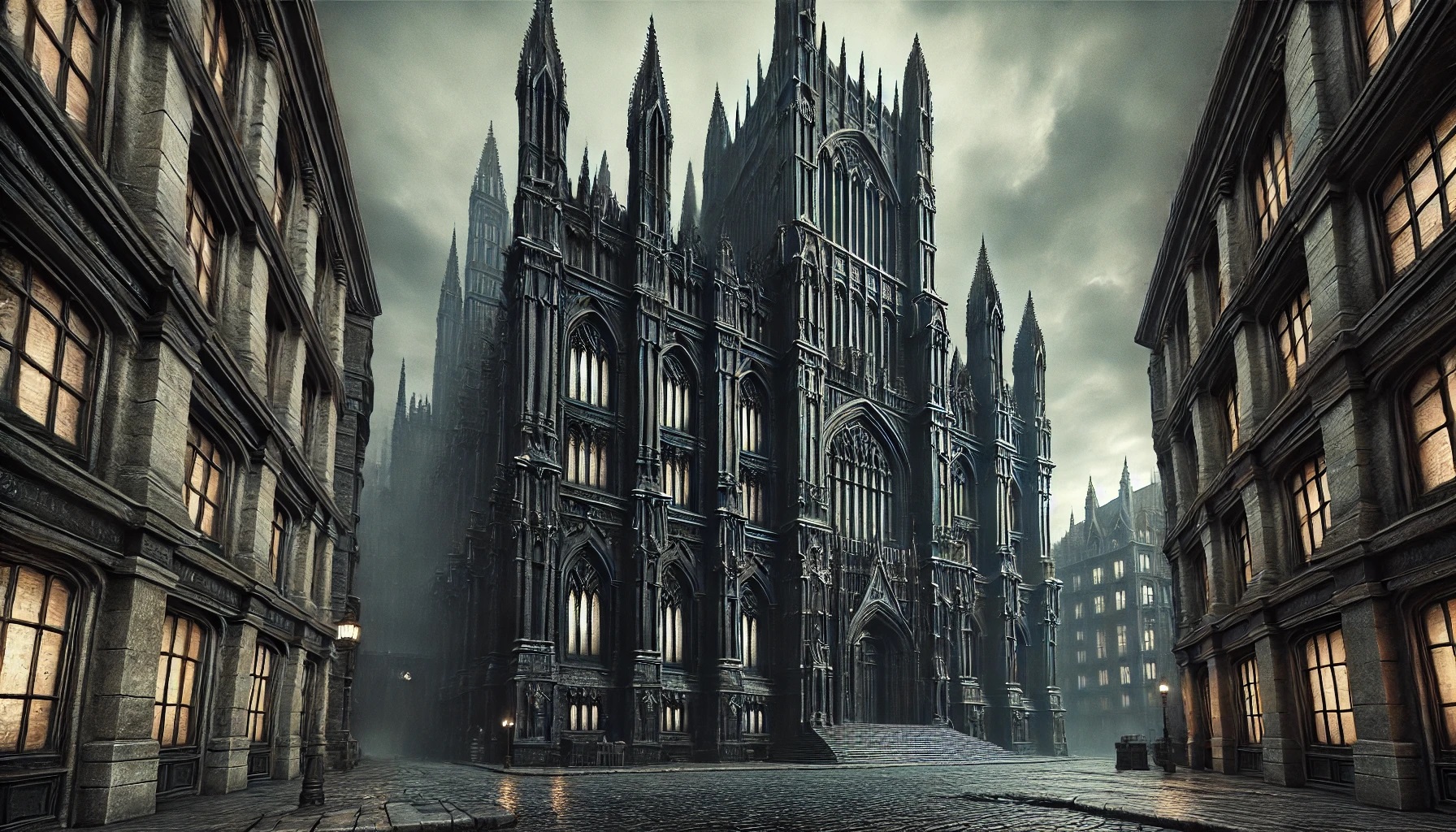
The city of Lorian bore the heavy weight of its reputation.
Its towering spires pierced the sky like jagged needles, casting long, oppressive shadows on the people below. Here, justice was said to be pure, untarnished by human frailty. The Hall of Justice stood as the embodiment of this belief, a monolithic fortress of blackened stone, its narrow-slit windows glared down at the city streets.
At its heart rested the Judicium, an ancient scale forged in an age lost to memory. Its bronze plates gleamed with a muted light, untouched by time. The intricate etchings on its surface pulsed faintly when it was in use. The people believed in its divinity, in its power to reveal the truth without prejudice. To them, it was the perfect arbiter.
Judge Felicia Voss was a senior justice who had spent two decades within the Hall's stone corridors. Her sharp mind and unyielding demeanour earned her a reputation as one of Lorian’s finest arbiters of justice. She carried herself with an air of detachment, her dark robes flowing like shadows as she moved through the halls. Her voice was calm, her judgments precise. But beneath the mask of authority, Felicia’s mind was a battlefield of principles and doubts, a war fought in silence.
The courtroom was unusually crowded that day, filled with an audience hungry for spectacle. On the stand stood Maren Holt, her shoulders squared but trembling beneath the weight of the accusations levelled against her. Her auburn hair caught the sunlight filtering through the narrow windows, casting fiery glints which mirrored the defiance in her eyes.
The charges were severe: treason, conspiracy, and sedition. Felicia read the accusations aloud, her voice steady despite the unease starting to take root in her chest. Maren’s alleged crime was passing information to rebel forces—details easily able to compromise the regime’s hold on Lorian. The evidence was circumstantial at best: fragments of intercepted letters, the testimony of a neighbour with too much to gain, and Maren’s refusal to plead her innocence.
Felicia noticed how Maren’s hands clenched and unclenched as if battling between fear and fury. When their eyes met briefly, Felicia saw not a criminal, but a person fighting desperately to hold on to her dignity.
As the room fell silent, Felicia took the accusation token, a small disk of polished obsidian, and placed it on the Judicium. A hush swept over the courtroom as the scale came to life. Its plates tilted back and forth, the faint hum of ancient mechanisms filling the air. Felicia’s eyes were fixed on the scale, her breath caught in her throat. For a moment, it hesitated, as if weighing something beyond the evidence. With a final decisive shudder, the Judicium tipped decisively against Maren.
A gasp rippled through the audience. Maren’s face betrayed no emotion, but her hands gripped the wall of the wooden stand. Felicia allowed herself a brief glance at the young woman before she delivered the sentence:
DEATH!
Even as the words left her lips, a strange disquiet settled over Felicia. The Judicium’s verdict was clear, yet something about the case gnawed at her—a faint whisper in the back of her mind, urging her to look deeper.
Later, as night fell, Felicia sat in her chambers, staring at the faint glow of a dying fire. The corridors of the Hall of Justice were quiet, save for the occasional echo of footsteps in the distance. She held a cup of tea in her hands, but its warmth did little to chase away the chill. Dangerous questions were growing in the darkest corners of her mind.
Doubts and confusion tangled in her mind. The Judicium had never been wrong before. It was infallible—Wasn’t it? And yet, she couldn’t shake the gnawing feeling. Maren’s case was different. The scale’s hesitation, the flimsy evidence, Maren’s defiant silence—it all felt wrong.
Seeking clarity, Felicia decided to visit Retired Judge Thane, an old mentor who was her guide during her early years in the Hall. She found him in his modest home on the outskirts of the city, a place far removed from the suffocating grandeur of the Hall of Justice.
“The Judicium,” Thane said, his voice heavy with age, “is a tool, Felicia. A powerful one, yes, but still a tool. And tools can be misused.”
Thane’s words lingered in Felicia’s mind as she returned to the Hall. She spent her entire career believing in the Judicium’s perfection. The possibility, however remote, suggested it could be manipulated. It was unthinkable—yet now, it was all she could think about.
Felicia buried herself in the archives, combing through decades of trial records. The hours stretched into days as she pored over the brittle pages, her emotional candle burning low. Her fingers brushed the frayed edges of another unmarked ledger, its leather cover cracked with age. She hesitated before opening it, at every moment half-expecting someone to step from the shadows and snatch it from her hands. The air in the archives felt heavy, thick with the ghosts of forgotten cases.
The pattern was undeniable: the Judicium’s verdicts overwhelmingly condemned those who opposed the regime. The scales were not weighing justice—they were enforcing compliance.
Her search led her to the Judicium late one night. She descended into the lower levels, ones rarely frequented in her normal day-to-day duties, the Hall’s corridors were silent, save for the distant hum of an air conditioner, which whispered like voices of long-dead ghosts. The sound chased her as she walked. The walls carried a faint chill, the kind that seeped into your bones, and the air smelled faintly of old parchment and dust. Hidden in the shadows, she watched as two attendants worked beneath the scale, their movements careful and precise. When one of them adjusted a small lever, the mechanism controlling the scale tipped without anyone in the chambers above to place a token upon it.
Felicia’s stomach churned. The divine instrument made a mockery of everything. Her entire life was nothing more than a facade, its outcomes predetermined by unseen hands.
The discovery left Felicia reeling. She spent her entire career upholding a system built on lies. Exposing the truth would mean the end of everything All her life’s work would mean nothing. The regime would hunt her, and she would likely lose her life.
But could she live with herself if she stayed silent?
As the days passed, Felicia wrestled with the weight of her decision. She found herself standing before the Judicium, staring at its lifeless plates. The scale, once her guide, her anchor in a world of chaos. Now, it was nothing more than a symbol of corruption. She thought of her early days as a judge when she believed in the purity of the Judicium’s verdicts. Back then, the weight of her robes felt like an honour, not a burden. She had stood in that courtroom with pride, convinced she was a vessel for justice. Now, the weight pressed on her shoulders like chains.
In the end, her sense of justice won out. Felicia made her choice.
She spent weeks gathering evidence, missing nothing. She documented every manipulated trial and every falsified verdict. She made copies of records and even sketched the mechanisms witnessed beneath the Judicium.
When she was ready, she stood before the people of Lorian in the central square. The crowd was restless, their murmurs filling the air like the hum of an approaching storm. Felicia raised her voice, her words cutting through the noise with razor-sharp precision.
She revealed everything: the manipulation of the Judicium, the regime’s abuse of power, and the web of lies—how the authorities had been ruthless in condemning countless innocents. Gasps and cries of outrage rippled through the crowd like a gathering storm. Faces once etched with indifference now burned with fury, their voices swelling into a deafening roar. Felicia stood firm, her breath shallow, as she watched disbelief give way to anger, and swiftly turn to action. This wasn’t only a crowd—it was the awakening of a city long silenced. She could see it in their eyes, a collective realisation of their betrayal by the overarching powers, their faith in the hierarchy, twisted into chains.
The first protests erupted before the close of the day. Citizens poured into the streets, clutching banners hastily scrawled with demands for justice. Their voices rang through the narrow alleys and open squares, a chorus of defiance that shook the very stones of the city. Felicia watched from the edges; her heart heavy yet determined. She knew the regime would not relent without a fight.
The authorities responded swiftly, as expected. Armoured guards swept through the streets, their presence meant to intimidate, but the tide could not be turned. For every protester dragged away, three more took their place, until even the guards joined their ranks. The people were no longer afraid; the truth ignited something in them that fear could not extinguish. They marched with torches and banners held high, their chants echoing from the walls of towering buildings, their anger as unyielding as the cobblestones beneath their feet.
The Hall of Justice became the focal point of their fury. Its once-imposing facade now seemed small against the sea of resistance. Protesters surrounded it, their voices rising in unison. When the doors were breached, it wasn’t chaos that followed but a grim purpose. They dismantled the Judicium with their bare hands, prying apart the bronze plates and tearing away its hidden mechanisms. What was once revered as a sacred instrument of justice now lay in pieces, exposed as the tool of oppression it had always been.
The broken remains were carried into the city square and displayed for all to see. Felicia stood among the crowd as they gazed upon the ruins of the Judicium. The intricate etchings on the plates, once symbols of divine authority, now seemed like hollow mockeries of the truth. A silence fell over the square, a heavy stillness as the people confronted the depth of the deception.
From the ashes of the old system, something new began to take shape. The citizens of Lorian, emboldened by their victory, demanded a justice system built on transparency, one where no hidden levers or secret hands could dictate fate. Committees were formed, voices were heard, and for the first time in generations, the people were given a say in how they were governed.
Felicia watched it all unfold from the margins, her role complete. She exposed the truth, but the people justifiably took it upon themselves to reshape their world. It wasn’t her triumph—it was theirs.
Felicia was stripped of her title and exiled from Lorian, but she carried no regret. In the quiet solitude of the countryside, she found a peace, one never known in the city. Her name faded from history, but her actions left an indelible mark on the hearts of those who were witness to her bravery.
The mornings in the countryside were quiet, the kind of quiet that carried the sound of rustling leaves and distant birdsong. Felicia hadn’t realized how much she had missed the simple beauty of life outside Lorian. Each sunrise was a small victory—a reminder of her conviction, even stripped of her title, she had stayed true to herself. As she watched the sunset over the rolling hills, she felt a quiet satisfaction. Justice in the end prevailed, not because of a scale, but because of her unwavering belief in the truth.

7/4/2026
The Words That Got to Me
whispered like voices of long-dead ghosts. *oh my; nothing foreboding HERE... The sound chased her as she walked. *or here... their anger as unyielding as the cobblestones beneath their feet. *this is excellent.
Suggestions / Possible Tweaks
Its towering spires pierced the sky like jagged needles, *I think the spires need some reference to each other, otherwise, the "jagged" isn't effective. Like: The differentiated heights of the towering spires... Judge Felicia Voss was a senior justice with two decades spent in the Hall’s stone walls. *Hmmm. This conjured for me a woman ensconced/held prisoner inside the physical walls. I'm thinking the word "corridors" instead of "walls" fixes that for me...and, after all, Tim, it IS always all about me, right?!! Felicia made her choice. Felicia spent weeks gathering evidence, *Maybe "she" to begin the second sentence?
I like the allegory that sits astride this simple tale of right versus wrong and the questioning of "what's always been." Bucking "The System" takes guts, and it lies within any person to defy convention and be the first to do the right thing. Justice isn't complicated, and the moment we're made to think that it is, that is the exact time when we buck the system. Wonderfully drawn story of courage and honesty and having faith and conviction about what's really right. xoxo.