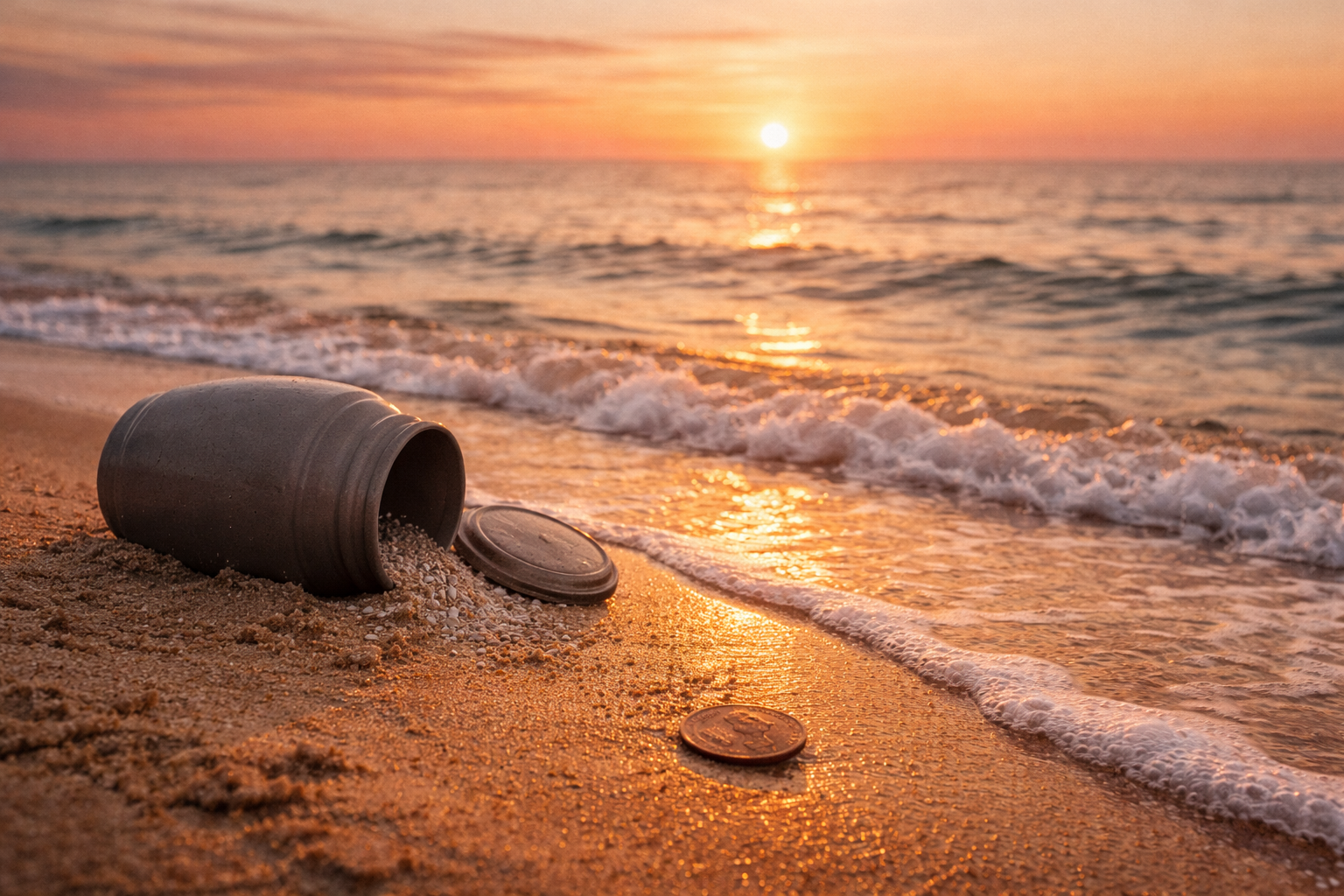
The first time I saw her, she was stealing a penny off the floor of the oncology waiting room.
Not some grand, glimmering theft. Just a small, quick scoop into her coat pocket. She glanced around like a child doing something wickedly unimportant. Our eyes met, and she gave me a shrug that said: yes, and what of it?
“Lucky penny?” I asked.
“No,” she said. “It looked lonely.”
I wanted to laugh, but my name was called, so I went in and let her vanish.
A week later, she was back. Same seat. Same coat. A different penny.
“You again,” I said.
She smiled like she’d been waiting for me. “You have cancer?”
“Bit forward.”
She tilted her head, playful. “Bit true.”
I hesitated. “Yeah. You?”
“Nope. My mum.”
We sat in silence. The clock made a tapping sound. Like it wanted us to fill it.
“She’s in Room Nine,” she said. “Lung. Doesn’t smoke. Life’s a shit comedian.”
“I’m in Five. Pancreas. Did smoke. Life’s a fair bastard.”
That made her laugh. Not prettily. It was a honk. I liked it more than I should have.
“I’m Layla,” she said, and held out her hand like it was an ordinary thing to do.
“Ben,” I said. “Collector of bad decisions.”
She didn't let go straight away.
—
We met every Thursday, without planning to. She always sat by the fake plant near the lift. I always pretended not to look for her.
We didn’t talk about the chemo. Or the weight loss. Or the inevitable. We talked about stupid things. Whether soup was a food or a beverage. What kind of dog most closely resembled our doctors. Which swear word was the most versatile.
“I say ‘bollocks’ far too much,” she confessed once. “Mum hated it. Now I say it to feel close to her. Is that weird?”
“No,” I said. “But mine’s ‘bastard’.”
“Yours is a bit meaner.”
“Well, life’s a—”
“—bastard,” we said together.
God, she was sharp. A little tired in the eyes, maybe, but she had this energy that made everything else seem background noise. I found myself talking to her like I wasn’t sick. That was a rare gift. Rarer than people realise.
—
Her mum died in January.
I brought her a sandwich the next week, and she cried into it. Not pretty, not poetic. Just raw, wet grief that leaked into the bread.
“I hated her sometimes,” she said.
“I know.”
“I was cruel when she got bad. I called her selfish.”
“She probably knew.”
“I can’t remember the last nice thing I said to her.”
“She probably can.”
Silence. She handed me the soggy sandwich. “Eat that, it tastes like salt and guilt.”
I ate it anyway.
Later, we lay side by side on the hospital lawn, our backs cold from the ground.
“Don’t die,” she said.
I didn’t promise.
—
February. I got the results: three to six months. Maybe. A shrug from a doctor with tired eyes.
I told her. She went quiet, then kissed me on the mouth so hard it made me forget how close I was to the edge.
“You don't get to die without sleeping with me first,” she whispered.
I laughed until I coughed. “Is that a threat?”
She smiled, lips still brushing mine. “A bribe.”
—
March. We rented a cabin near the sea. I left the pills in the drawer. She brought pennies in her coat pocket and left one on every windowsill, every fence post, every ledge.
“What's with the pennies?” I asked.
“They're anchors,” she said. “Little reminders the world is still here.”
“And you think the world notices?”
“No,” she said. “But maybe someone else will pick one up. And think of something nice. Or something sad. Or maybe they'll just wonder who dropped it. Either way, it matters.”
I kissed her then, because there wasn’t any better answer.
—
April. I started needing help up the stairs. She held my elbow like I was made of glass.
“You’re going to be fine,” I told her one morning, when my voice sounded like paper tearing.
“No,” she said. “But I’ll manage.”
She never cried in front of me again. But I found a pillowcase with mascara stains when I woke alone one night. I didn’t mention it.
—
May. We planted daffodils outside her mum’s house. I wrote her a letter for every month of the year and told her to burn the ones she didn’t want.
She made me soup and called it a beverage just to spite me.
I fell asleep in her lap while the telly muttered in the background. I remember her fingers tracing my cheek.
I died in my sleep. I know that, because the last thing I remember is her voice humming. A nursery rhyme or a hymn. I couldn’t tell.
—
June. She scattered my ashes in the sea.
She dropped a penny in after me.
She did not cry.
She went home, alone, and found the first letter marked July. She opened it early. I forgive her for that.
It read:
If you’re reading this, I probably died too soon. Or maybe right on time. Either way, don’t go waiting by lifts for ghosts. And don’t stop stealing lonely pennies off the floor. You made this bastard of a world feel kind, for a while.
That’s no small thing, Layla.
I love you. And yes, soup’s a bloody beverage.
4/4/2026
The Words That Got to Me
Wow - this was so powerful. I had just been reliving my parents' illness and deaths, so this hit very hard. I loved the way you concentrated on the little things that make a relationship, such as shared sayings or conversations about mundane things that nonetheless feel special with the person we love.
Suggestions / Possible Tweaks
None.
I thought you handled the theme with sensitivity and panache. Well done!