The drip woke her, as it always did — slow and fat, falling from the misting pipe onto the cracked water pan near her bed. She didn’t open her eyes at first. There was no rush, no schedule, no bell to demand her movement. Only the shape of the day pressing gently against her ribs. The cold had settled overnight; her breath caught in the still air, faintly visible.
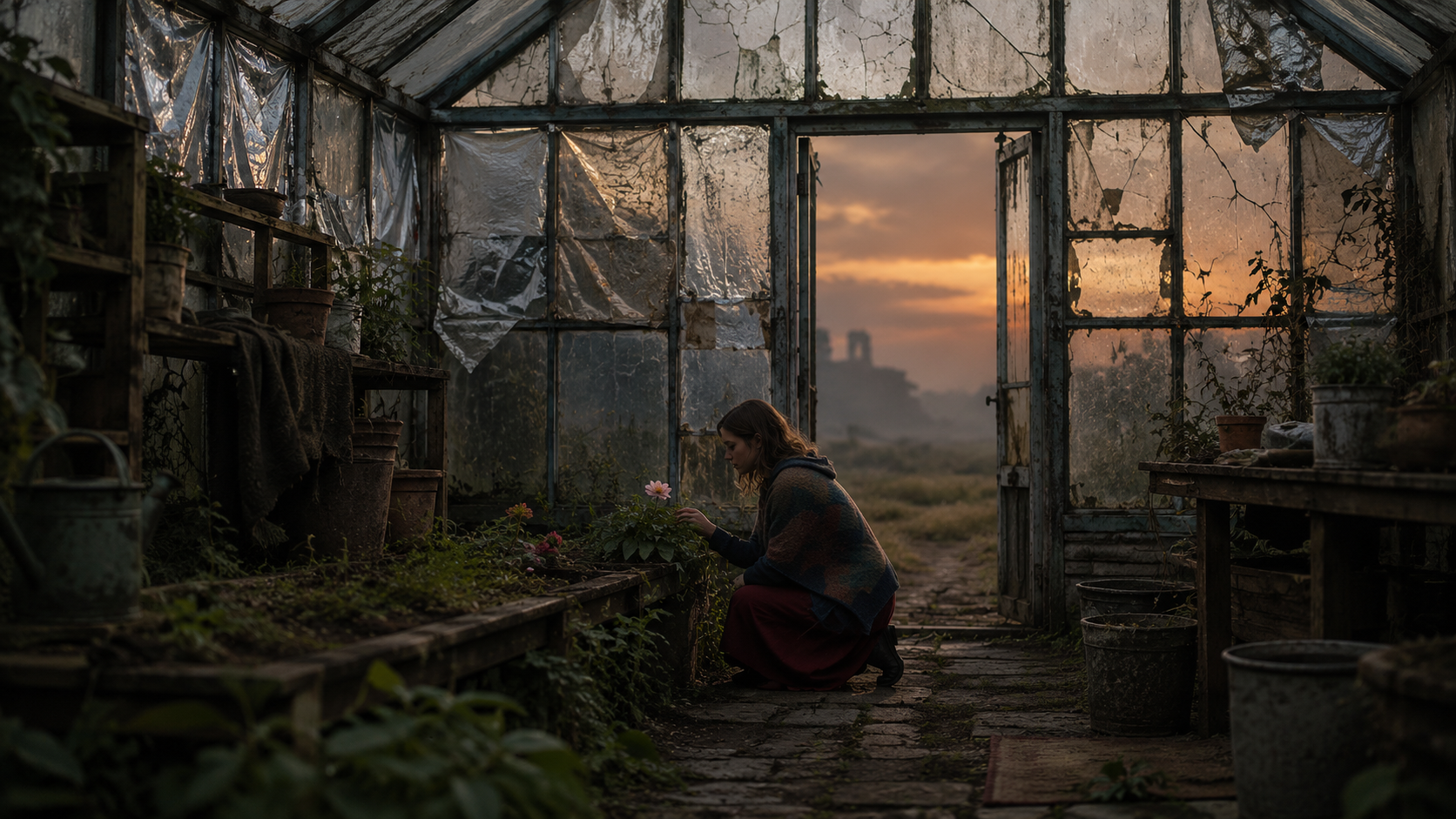
Calla sat up, pulling the woven blanket tighter around her shoulders. The greenhouse never warmed. Despite the layered tarps, resealed seams, and foil-patched curtains draped along the east side, the air stayed damp, like living inside the lungs of something long buried.
She eased onto her feet, careful of the hip she’d bruised two days earlier slipping on algae-slick stone. Her joints popped, like twigs under snow. The familiar dull ache in her lower back reminded her she wasn’t quite alone in her body anymore. A flutter, something like the shiver of a moth’s wing, brushed her from within.
She smiled, but didn’t speak. No need to startle the peace.
The flower shelf always came first. She unhooked the wool blanket she used to shield it from excess chill and light, folding it with reverence, as if unwrapping something sacred. Eight pots. Six growing. One refusing. One… uncertain. They were stunted, asymmetrical, a little bruised by the world, much like everything left alive. But still they reached. One soft coral-pink bloom had opened overnight, its petals still curled at the edges like a child’s fingers in sleep.
Calla crouched and inhaled. The scent wasn’t strong, but it was there; sharp, slightly acidic, with a hint of something like apple peel left too long in a drawer. She touched the petals with the back of her finger.
“Good morning,” she murmured. “Still here, then.”
She pulled her gathering bag from its hook and laid out her morning bundles. The flowers were paired with care: one for the chapel ledge, a tradition no one acknowledged aloud, and one for the cairn in the western field, where moss had half-eaten the name stone.
Her breakfast was a piece of spiced root, left over from a trade two days ago. It tasted faintly of dust and anise. She chewed slowly, pausing now and then to sip water boiled and cooled in a cracked glass jar. Nothing wasted. Nothing ever wasted.
Before leaving, she lifted her shirt and placed a hand over the barely risen curve of her stomach. It wasn’t yet a secret someone might guess, but it was a truth she carried like an ember under ash.
The flutter came again, small and tentative, like a breath testing its space. She let her hand rest there a few more seconds, steadying herself.
The wind outside had started to rise. She wrapped herself in the patchwork coat, mostly scavenged UV netting and old curtain fabric, the roses faded but defiant, and opened the side panel just wide enough to slip through. Light crept in like suspicion, orange-grey and heavy with particles. The air tasted faintly of metal.
She paused. The greenhouse door clicked behind her. Her boots crunched frost-dust as she crossed the overgrown yard, picking a careful path between curling bramble vines and the splintered remains of an old trellis. Once, it had held grapevines. Now it held rust and bird droppings.
The cairn lay at the end of the field, half-swallowed by wild sage and creeping stoneleaf. Calla knelt, laid the smaller bouquet down; three red-edged leaves, a stalk of ghostgrass, and one trembling white bloom that hadn’t yet learned to fear the sun.
“I haven’t forgotten,” she said.
The silence took her words and buried them in the soil. That, too, was routine.
The horizon leaked colour slowly, the sun rising behind a filter of sickly amber and smoke-grey clouds. It was not sunrise as Calla’s mother had described it in bedtime whispers, not bright and blooming and filled with birdsong, but a slow and sullen lifting of night’s hand from the throat of the land.
Langmere waited a half-hour walk away, a smudge of battered roofs and leaning fence posts visible only once she cleared the tree line. She walked steadily, each step practiced, knowing exactly which stone wobbled, which root clawed upward, where the road cracked widest. The wind pulled softly at her cloak, tugging stray threads, asking quiet questions she had no answers to.
The walls of Langmere, more patched than whole, were makeshift and stubbornly enduring. No gate barred entry; just a worn gap between old vehicles now mostly rust and regret. The guard tower, once a fire lookout, stood empty, its ladder long since pulled up. She was recognised instantly, not welcomed, exactly, but acknowledged with wary nods and averted eyes.
She approached the barter post. A ramshackle market of canvas tarps, wooden crates, and rusted shelving. Aromas of smoke, old grease, and damp wool filled the air. She laid out three small bundles of salted mushrooms, wrapped neatly in cloth scraps, and watched as the traders assessed her offering.
"Water's low again," said a man named Hale. He always said it, as though stating the obvious was his birthright. Calla nodded but said nothing.
“A stranger on the ridge,” another voice muttered. “Been watching since yesterday. Old coat, odd walk.”
She kept her face carefully blank, gaze fixed on her goods. “Just mushrooms today,” she said softly.
Hale’s eyes lingered on her a second too long. “Got no use for flowers anyway.”
“None offered,” Calla said evenly.
She took dried beans, a half-bottle of oil, and a scrap of old soap wrapped in waxed paper. A fair trade. The exchanges were silent, hands reaching without touching. When she left, the voices behind her resumed, hushed, edged with suspicion or boredom. Langmere had little else to speak about these days.
On the way out, Calla made her usual detour to the chapel. It stood at the village’s far edge, roof caved in decades before, its spire broken and sprawled like an exhausted body. Only one stained-glass window remained partly intact, its shattered patterns looking like trapped wings, fragments catching and scattering thin sunlight.
She placed the bouquet, three pale blooms threaded with rosemary, upon the stone ledge beneath the broken glass. Last week’s offering lay ruined below, petals shredded, stems splintered. A deliberate act.
Calla gathered the torn fragments gently, pressing them into the crevice between bricks, where the air whispered damply. No anger rose in her; she felt only weariness, like the slow press of stones on her chest.
Turning back to the path home, a councilwoman named Judith blocked her way. Age had softened Judith’s face, but the eyes remained sharp, wary. She gestured vaguely at the flowers.
“You think this helps?”
Calla did not flinch. “I don’t think it hurts.”
Judith's gaze flickered down to Calla’s stomach, hidden under fabric but momentarily touched by instinct. Calla felt the secret flutter there again, sudden and anxious.
“You waste water,” Judith said finally. “You waste time. Nobody’s left to appreciate those things.”
“Maybe,” Calla murmured, moving past, “that’s exactly why I do it.”
Judith did not follow or speak further. Her presence dissolved back into the murmur of Langmere’s routines.
The return journey was heavier. The beans rattled quietly in her bag, the oil pressed coldly against her hip. She walked steadily, shadows sliding behind her, the sun reluctantly rising higher, the sky streaked with threads of distant rain that never seemed to fall.
The stranger’s presence nagged softly in her mind, an unwanted seed planted there, waiting silently to sprout.
By the time Calla reached the greenhouse again, the sun had climbed to its harshest point, bleaching the world a thin, sour yellow. Each step back had felt slower, heavier, as though her body recognised the approach of something unseen. The air tasted like iron filings, and the familiar ache in her bones whispered warnings she didn’t know how to interpret.
As she approached the greenhouse, she paused. A trail of boot prints, carelessly pressed into the frost-softened earth, led from the sagging outer fence toward the concealed side door. She stood still, heart pulsing in her throat, fingers tightening involuntarily around her gathering bag. She had always been careful. She had always kept distance.
She pushed gently at the door, already ajar. It gave way, hinges groaning softly, protesting betrayal. Inside, the air felt suddenly cooler, thicker. Something had shifted. As if the greenhouse no longer belonged entirely to her.
At first glance, nothing seemed out of place, her tools lay untouched, water barrels stood silent. But the flower shelf, her fragile, living memorial, had been disturbed. One pot lay shattered on the floor, soil spilling darkly like clotted blood. Another had been pushed aside roughly, its tender green stems crushed, petals scattered like torn paper.
Calla moved forward numbly, placing the bag down, eyes scanning every detail. Her breath stuttered in the silence, turning ragged at the edges. She reached out, fingertips brushing the broken stems, as though she might mend them through sheer will alone.
A message had been crudely scraped into the damp grime of the wall above the shelf. Scrawled words pressed deep, angry and sharp-edged:
We dont want yur gosts
She stepped back, the hurt hitting sharper than expected, an icy shock between her ribs. Flowers had always been her language of remembrance and stubborn hope. This place was sacred to her, and now someone had torn through its thin veil of peace.
Instinctively, her hand fell to her stomach, protective and gentle. Another flutter, small and restless, as though sensing her unease.
Calla exhaled slowly, reclaiming her balance in careful breaths. Without anger, without panic, she knelt to gather the wreckage. She reburied roots tenderly, salvaged stems, whispered apologies to leaves that would never heal. She knew the stranger who had done this was not cruel, merely frightened. Fear had always been easier to spread than kindness.
When nothing more could be done for the shelf, Calla moved aside, slipping her fingers into a hidden crack in the stone floor, lifting the worn slab that concealed her mother’s secret. Inside, an old metal tin sat quietly, rust nibbling gently at its edges. She pulled it free, heart heavy, memories pressing down softly like summer rain.
Opening it revealed the small seed packet her mother had left for her long ago, words inked in fading letters:
For the day you can’t forgive them.
Calla stared at it, the weight of choices pressing hard against her chest. She wondered if today had finally arrived. Her thumb traced the brittle paper, gentle and slow, and she tucked it safely into her coat.
A quiet sound from outside, perhaps a shifting stone or snapped twig, made her head turn sharply. Her pulse quickened again, uncertainty prickling her skin. Slowly, she rose, stepping carefully toward the outer door, peering through a crack in the foil curtains.
At the edge of her vision, framed against the bitter sunlight and stillness of afternoon, a figure stood. He did not move, did not approach, simply waited, distant yet somehow inevitable.
Calla’s heartbeat matched the tiny flutters deep inside her, uncertain and tentative. She stood motionless, watching him, breathing slow, until he turned quietly away and disappeared again behind the twisted remains of fencing, leaving only silence and questions in his wake.
The day softened, shadows lengthening with the hesitant grace of retreating tides. Calla waited by the greenhouse, her thoughts suspended like silent smoke in windless air. Her fingers played absently at the hem of her coat, plucking threads loose without meaning to.
At last, the figure returned, picking his way through the fading dusk. He moved with care, making no attempt at concealment, projecting calm instead of threat. Calla did not retreat. Instead, she stood rooted, heartbeats measured in shallow breaths.
He stopped a short distance away, close enough now to make out the rough lines of age on his face, etched by hardship and sun. His coat, patchworked with faded fabric, spoke of endless roads and uncertain shelters. His eyes were watchful, wary but not hostile, pale and colourless in the dying light.
Calla was the first to break the silence, her voice surprisingly steady. “Why have you come here?”
He tilted his head slightly, as if weighing how much truth to offer. “I heard tales of the flowers.”
His voice was weathered, warm despite its caution, like stones left out in summer. Something about it tugged faintly at Calla, nudging at memories that didn’t fully belong to her, pieces of her mother’s stories worn smooth by repetition.
“The flowers?” she echoed.
He nodded slowly, gaze drifting toward the greenhouse. “They say you still grow them, that you leave them as gifts. It reminded me of someone… someone I lost long ago.”
Calla’s heart quickened, curiosity threading through the guarded fear. “Who was she?”
His eyes returned to her, lingering quietly on her face. “Someone who believed beauty wasn’t foolishness, even when everything else fell apart. You remind me of her.”
He paused, choosing carefully. “Your mother.”
The breath caught sharply in her throat, brittle as dried grass. The stranger saw the shift, softening his stance a little.
“You look so much like her,” he murmured. “The stubbornness, too.”
Calla swallowed hard, hand pressed unconsciously over the gentle curve of her stomach, the secret there suddenly heavier, warmer. “Why now?” she asked quietly. “Must be two score years since the Glare. She died when I was ten. Why find me now?”
He shrugged slightly, palms open, revealing calloused hands. “Because it took me that long to stop running from everything I left behind.”
The dusk was deepening now, casting his face into half-shadow, obscuring details, softening lines. Calla moved slightly closer, drawn by something older than caution, something almost hopeful.
“You were close,” she said, careful not to make it a question.
He nodded again, more slowly this time, voice gentling further. “Closer than I ever deserved.”
They stood quietly, the weight of things unspoken settling between them, soft and heavy as fallen snow. Calla spoke first again, a quiet determination shaping her words.
“Someone was here earlier, disturbed the flowers. Left a message.”
The stranger’s face hardened subtly, lines tightening with sudden protectiveness. “Not me. But I heard talk in Langmere. Your kindness frightens some. People think remembering softness makes you weak. They think you’re dangerous.”
“And you?”
He sighed quietly, gaze distant now, lost in a memory too long held silent. “I think remembering softness is the only reason we’re still worth saving.”
The words lingered, small and careful, pushing gently against the guarded spaces Calla had long maintained. For a moment, silence returned, full and deep, richer than words could fill.
Finally, the stranger stepped back slightly, breaking the fragile tension. “Tell me to go if you want, but in case someone else comes. I’ll stay close.”
He turned away, melting into the gathering darkness, leaving behind only a quiet trace of comfort like woodsmoke on cold air. Calla stood motionless, feeling again the soft flutter inside her. It was stronger now, not cautious but curious, testing the small space that held both fear and possibility.
She placed her hand there, fingers gentle against the warmth beneath, and whispered words from memory into the silence.
“Stay safe, little one.”
For a long while she didn’t move, letting the dusk settle around her, until finally the night deepened, the air grew colder, and the greenhouse drew her back into its familiar embrace.
Inside, darkness had already begun to seep into the corners, softening edges, reclaiming shadows. Calla moved with deliberate care, gathering herself again, hands shaping purpose from instinct. Her mother’s old seed packet lay open beside her, its brittle edges fluttering slightly as though touched by a quiet breath. Each seed inside was tiny and dry, like grains of sand or forgotten prayers.
She filled a pot with soil, rich and dark, pressing softly with fingers worn rough by a thousand small labours. Her fingertips pushed each seed down, patient and tender, each an offering of hope or defiance. She watered sparingly, the droplets sinking in before disappearing into darkness.
Outside, the stranger sat quietly on a broken bench, his silhouette marked only by faint starlight. She glanced toward him occasionally through the fogged glass, watching him carve a long splinter of wood into something smooth and careful. The scrape of his blade was steady, rhythmic as breathing.
The bouquet she prepared was different tonight. The flowers were bold, petals deep purple and sharp yellow, colours her mother had always described as those of the old world, bright without apology. Each bloom glowed softly beneath her fingertips, a brief pulse of memory made tangible.
She wrapped them in a scrap of fine fabric, the edges frayed but dignified, tied with a small, faded ribbon her mother once wore in her hair. It was the last piece she’d kept for something special. Something that mattered.
Calla slipped from the greenhouse quietly, stepping out beneath the scattered starlight. The stranger glanced up, nodded gently without speaking, returning to his carving. She passed him, feeling the reassuring steadiness of his silent presence.
Langmere lay muted in the moonlight, shapes softened, edges uncertain. The council hall rose starkly, an angular shadow against the night, proud yet brittle. She knelt at the door, placing the bouquet down carefully, her fingers lingering briefly on the ribbon.
“This is not pity,” she whispered softly to the empty darkness. “It’s memory. It’s hope.”
As she straightened, a tiny flutter within her answered, quick and warm, as though responding to the quiet strength in her voice. She stood still for a long moment, the sensation like delicate wings brushing softly inside her.
Returning home, her pace was unhurried, her steps confident in the shadows, guided by instinct rather than sight. The stranger was waiting near the greenhouse door, his carving finished, a simple wooden bird, polished by thumb and knife, elegant despite its simplicity.
“Take this,” he said, placing it gently in her palm. “For the child. A reminder to always look upward.”
She closed her fingers around the bird, nodding once, gratitude exchanged in silence. But as he turned away again, the quiet weight of what he'd given settled within her. She had told him nothing of the life growing inside her, yet somehow he had known. A flicker of wonder touched her, like a whisper brushing softly against her skin. How had he seen what she'd hidden from everyone else?
She watched him step slowly back into shadow, carrying secrets she hoped one day she might understand. His presence felt comforting, familiar in ways she couldn’t fully rationalise.
Inside, the air was still, heavy with scent and soil. She lay down beneath the flower shelf, one hand cradling the tiny wooden bird, the other resting protectively on her belly. Sleep felt close, gentle but lingering just out of reach.
She stared upward, eyes tracing the shadows of leaves, stems, petals, the small shapes blurred by darkness. A faint shift caught her attention: a single flower, opening slowly, shyly, petals unfurling like quiet breaths. It glowed faintly in the starlight, delicate, uncertain, yet determined.
Calla’s breath steadied, slowing to match the gentle rhythm of the night. Her eyelids grew heavy, her body relaxing, finally releasing the day’s tension.
Before sleep took her fully, she whispered one last promise into the silence, her voice firm yet tender, an anchor in the dark.
“We will grow.”
Above her, the flower finished opening, fragile and brilliant against the dark. It held steady, rooted, and waiting for dawn.