Hear now the tale of Wetherdown,
When autumn stripped the ancient trees,
When storm clouds gathered on the down,
And thunder rode the rising breeze.
The summer's warmth had fled the land,
The harvest safe from wind and rain;
And winter waited, close at hand,
While men rejoiced in gathered grain.
But from the west a tempest came,
With winds that bent the tallest oak;
The heavens flashed with fleeting flame,
And thunder through the darkness broke.
The rain fell hard on roof and stone,
The sheep drew close against the cold;
And one man kept his watch alone,
While others slept within the fold.
For Edric Wolfbane held the night,
Where lesser men might turn and flee;
He stood against the tempest's might,
As steadfast as the ancient tree.
The wind tore fiercely at his cloak,
The rain ran cold beneath his mail;
Yet neither thunder's mighty stroke,
Nor autumn's breath could make him quail.
And high above the sleeping vale,
The storm grew wild, the heavens roared;
While Edric stood against the gale,
And held his ground with lifted sword.
❦ ─── ✦ ─── ❦
The rain had begun before supper, and by the time Edric had finished his second bowl of stew, it was coming down hard enough to make the thatch hiss. He sat beside the fire, his boots stretched towards the hearth, watching Mara mend a tear in Bren's tunic. Every so often, he glanced towards the shuttered window and sighed.
Mara ignored him as another gust rattled the shutters.
“Terrible night,” Edric observed.
“Aye.”
“Going to get worse.”
“Likely.”
He waited. Mara drew another length of thread through the cloth.
“Wouldn't want to be out in that.”
“Then it's fortunate you've a cloak.”
Edric frowned at her. “Why should I have to watch the sheep on a night like this?”
“Because it's your turn.”
“But look at it out there.”
“I have. It's raining.”
“And blowing.”
“That too.”
“There'll be thunder before midnight. Mark my words.”
Mara bit through the thread and examined her work. “Then you'd best be getting along before it starts.”
Edric shifted closer to the fire. “Couldn't Jory take my place?”
“Jory did his watch last night.”
“Old Cale, then.”
“Has a cough.”
“Bren?”
“Your son is twelve.”
“Old enough to watch sheep.”
“Then perhaps he's old enough to eat your supper tomorrow.”
Edric looked towards the empty pot.
“That's hardly fair.”
“Neither is asking someone else to stand in the rain because you don't fancy it.”
A particularly violent gust sent a draught beneath the door. Edric drew his feet closer to the hearth, as though determined to absorb enough warmth to last the night.
“I'm Edric Wolfbane,” he said at last.
Mara looked up. “And?”
“Seems a poor thing, sending a man who's faced the Devil's own beast out to stand amongst sheep.”
“You faced a wolf, Edric.”
“A very large wolf.”
“Aye. And tonight you're facing some very wet sheep.”
She folded the tunic and laid it aside. “Get your bloody cloak.”
Edric sighed, rose reluctantly, and took his cloak from its peg. It was still damp from the previous day. He stood in the doorway for a moment, looking out at the rain, then gave his lantern a shake to check it had oil before lighting it with a splint.
“Suppose I catch my death?”
“Then I'll have Jory take your turn next month.”
He went out without another word.
Behind him, Mara shut the door, dropped the wooden bar into place, and returned to the fire. For the first time that evening, she had the warmest seat for herself.
❦ ─── ✦ ─── ❦
Then came a flash that split the sky,
A thunderclap that shook the ground;
And from the darkness rose a cry,
As fire swept the village round.
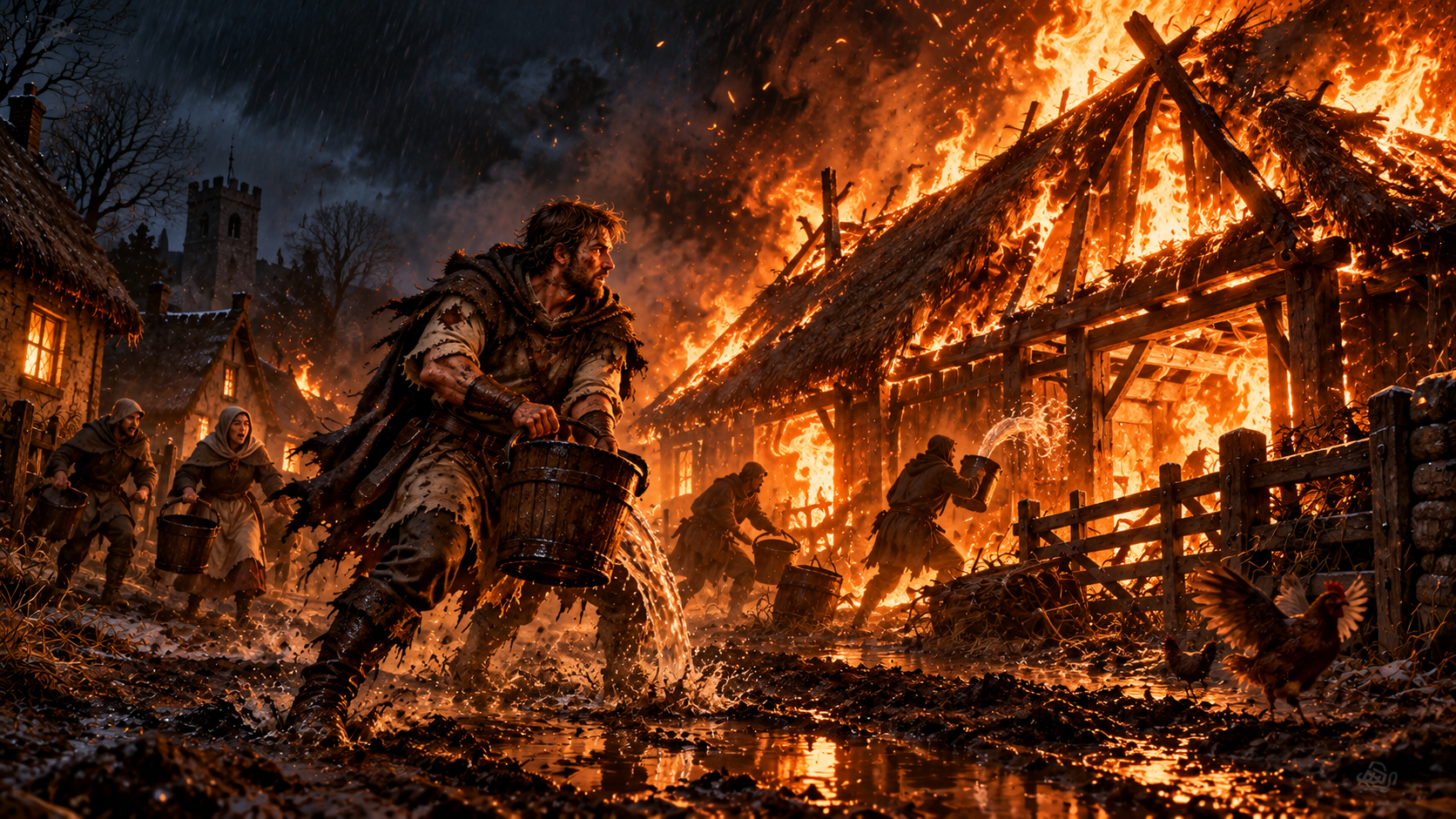
The ancient barn, with harvest stored,
Stood blazing in the driving rain;
And all the wealth the fields afford,
Was threatened by the hungry flame.
Yet Edric did not turn or flee,
Nor seek the shelter others sought;
He faced the flames full steadfastly,
And with their raging fury fought.
He seized the pails and raised the cry,
And summoned men from hearth and bed;
While burning timbers fell nearby,
He stood where lesser spirits fled.
The wind drove sparks across the thatch,
And flame from roof to rooftop flew;
No mortal hand could hope to catch
The burning brands the tempest blew.
Yet still he fought, though smoke rose black,
Though burning rafters split and fell;
He would not yield, nor turn his back,
Upon that roaring mouth of Hell.
Then came a roar beyond all sound,
The very earth beneath him shook;
The blazing roof came crashing down,
As fire the sleeping village took.
The grain, the straw, the winter's bread,
Went up beneath that dreadful sky;
And where the living flames had spread,
The hopes of Wetherdown would die.
But Edric stood amidst the blaze,
His cloak in tatters, black with smoke;
And through the fire's infernal haze,
He fought while beams and timbers broke.
For though the harvest might be lost,
And hunger stalk the winter's door,
He fought, whatever be the cost,
Saviour of Wetherdown once more.
❦ ─── ✦ ─── ❦
By the time Edric reached the sheepfold, the rain had found its way beneath his collar, down his neck and into places that had no business being wet. His cloak, never particularly waterproof even when new, had become a heavy, clinging nuisance, and the wind seemed determined to lift it over his head whenever he turned towards the village.
The sheep, meanwhile, appeared entirely indifferent to his suffering. They stood huddled together beneath the shelter of the low stone wall, occasionally shifting to accommodate another animal seeking protection from the weather. One or two watched him with the mild curiosity of creatures whose principal concerns were food and the whereabouts of other sheep.
Edric watched them in return.
“Bloody stupid animals,” he muttered.
One of the ewes bleated.
“And you can shut up.”
The village rota had been established long before Edric was born, and every able-bodied man was expected to spend one night each month watching the communal flock. It was a sensible arrangement, designed to discourage wolves, thieves and anything else inclined to help itself to the village's most valuable livestock. Edric had never objected to the principle, particularly on those twenty-nine or thirty nights when somebody else was doing the watching.
Tonight, however, he considered the entire arrangement profoundly unreasonable.
He made one circuit of the fold, checking the gate and peering into the darkness beyond the wall, although what he expected to see in the driving rain was anybody's guess. The sheep were accounted for, or at least there appeared to be approximately the right number of them, and nothing seemed particularly interested in eating them.
Another gust drove rain into his face, and he turned towards the buildings beyond the fold.
The grain barn stood perhaps fifty paces away, its broad timber doors secured against the weather. Within lay much of the village's autumn harvest, sacks of barley and oats stacked beneath the rafters, bundles of straw piled against the walls and the various implements that accumulated wherever farmers found a little space to put them. It was dry, or at least considerably drier than the field, and the thick walls offered some protection against the wind.
Edric regarded it thoughtfully.
There was no particular reason why a man watching sheep had to remain outside with them, provided he could hear if anything went wrong. Indeed, he reasoned, a sensible watchman ought to preserve his strength for the moment when it might actually be needed. A man chilled to the bone was hardly in a fit state to confront a wolf, particularly one of the enormous and possibly unnatural creatures now reputed to inhabit the woods around Wetherdown.
Having satisfied himself that this was not shirking his duty but merely performing it with greater efficiency, Edric crossed the yard and slipped into the barn.
The smell of stored grain and dry straw enveloped him, rich and earthy after the wet misery outside. Rain hammered against the roof, and somewhere high amongst the rafters a loose board rattled with each gust, but the air was still and the worst of the cold remained beyond the doors.
He found an overturned wooden measure, dragged it beside a stack of grain sacks and sat down to consider his situation.
After a while, he decided that sitting was uncomfortable and that there was no particular virtue in discomfort. A little straw made a tolerable cushion, and a folded sack provided somewhere to rest his head. He had every intention of remaining alert, and for several minutes he listened conscientiously to the rain while considering the unfairness of a world in which a man might defeat a monstrous wolf only to find himself spending an entire night guarding ordinary sheep.
The thought had barely reached its conclusion before he fell asleep.
He woke to a tremendous crack of thunder, convinced for one dreadful instant that the barn had collapsed around him. Darkness filled the building, broken only by a faint reddish glow somewhere near the far wall, and the air carried an unfamiliar smell beneath the comforting scent of grain.
Edric sat up, blinking.
He had left his lantern hanging from a wooden peg beside the sacks, safely out of the way of his makeshift bed. Now it lay on its side amongst the scattered straw, its little pool of oil burning merrily beneath the wall.
For a moment he simply stared, trying to understand how it had come to be there. Perhaps he had caught the peg with his cloak when he settled himself, or perhaps the loose board above had shaken something free. The explanation seemed considerably less important when a tongue of flame climbed the dry straw and reached towards the timber panelling.
Edric scrambled to his feet, snatched up a sack and began beating at the fire. The first few blows scattered sparks across the floor, and by the time he realised he was making matters worse, the flames had found another bundle of straw.
He threw the sack over them and stamped furiously, coughing as smoke billowed into his face. For a brief moment he thought he had succeeded, but then a fresh orange glow appeared beneath the edge of the covering and flames curled upwards again.
There was a water barrel near the door, kept for cleaning tools and dampening the grain floor when necessary. Edric seized a wooden pail, filled it and hurried back, sloshing half its contents over his boots before flinging the remainder at the burning wall.
The flames hissed and shrank.
He stared hopefully.
Then the fire reappeared, climbing higher than before.
Edric ran for another bucket, and then another, but the blaze had already reached the old timber lining and was working its way upwards towards the rafters. Smoke thickened beneath the roof, spreading across the building until he could scarcely see the far wall, and the heat drove him backwards each time he approached.
At last he understood that a single man with a wooden pail was unlikely to defeat a burning barn.
He staggered outside, dragging the doors wide, and shouted for help.
The storm swallowed his first cries, and it was only when he ran towards the nearest cottages, hammering on shutters and bellowing that the barn was burning, that the village began to stir.
Men emerged carrying buckets, women hurried towards the well, and someone began ringing the little bell beside the chapel. Within minutes the yard was crowded with frightened villagers forming a chain from the water trough, passing brimming pails towards the burning building while others rushed to move the livestock away from the spreading heat.
Edric joined them, grateful that nobody had yet thought to ask how the fire had begun.
The wind, which had been his principal complaint earlier that evening, now became the fire's greatest ally. Each gust drove fresh air through the open doors, feeding the flames until they roared upwards into the rafters, while sparks escaped through the thatch and swept across the yard towards the neighbouring buildings.
Someone shouted that the roof was going, and the men nearest the entrance stumbled backwards as burning straw and fragments of timber began falling from above.
Edric, who had gone back inside for another attempt with a bucket, found himself suddenly surrounded by smoke and falling embers. He dropped the pail, pulled his cloak across his face and ran towards the doors, colliding with Jory Finch in his haste to escape.
“Get back!” Jory shouted. “The whole bloody thing's coming down!”
Edric needed no further encouragement.
They had scarcely reached the yard when a tremendous concussion shook the barn. Grain dust, disturbed by the collapsing timbers and driven through the building by the rushing air, had ignited in a violent flash that burst through the weakened roof and sent burning debris spinning into the night.
The force threw Edric to the ground, where he landed heavily amongst the mud and discarded buckets. Above him, the sky blossomed orange as fragments of blazing thatch sailed over the yard and settled upon the roofs beyond.
For several moments he lay stunned, his ears ringing and his face pressed into the wet earth.
Then he heard the shouting.
The fire had reached the neighbouring buildings.
He scrambled upright to find men running in every direction, some towards their homes, others towards the well, while a handful struggled to free the animals from a stable whose thatch had begun to smoulder. Beyond them, the grain barn was no longer recognisable as a building, merely a great roaring furnace surrounded by falling timber.
Edric stood amongst the chaos, his cloak scorched, his face blackened and his hands shaking.
He had never in his life felt so completely helpless.
Then he saw Mara pushing through the crowd towards him, her face pale beneath the rain.
“Edric!”
He turned, and she caught hold of his arms, searching his face.
“Are you hurt?”
He shook his head, unable for the moment to speak.
She looked past him towards the burning barn and then back at his soot-blackened face.
“Were you in there?”
Edric swallowed.
“Aye.”
Mara's expression changed. She pulled him close for a moment, then released him and turned towards the others.
“More water!” she shouted. “Get those animals out before the stable catches!”
Edric followed her, seized another bucket and joined the desperate effort to save what remained.
For the rest of the night he worked beside his neighbours, hauling water, dragging smouldering timber clear of the cottages and helping pull frightened animals from the threatened buildings. His hands blistered, his lungs ached from the smoke, and twice he stumbled so badly that others had to help him to his feet.
Nobody could have accused him of lacking courage that night.
Nobody knew, either, that the man fighting so desperately to save Wetherdown was also the man who had set it alight.
And Edric, finding no suitable moment to volunteer the information, said nothing.
❦ ─── ✦ ─── ❦
When dawn broke pale on Wetherdown,
The smoke lay thick upon the vale;
Where once had stood the harvest's crown,
Now ash lay scattered by the gale.
The barns were black, the rafters gone,
The grain lay ruined in the mire;
And all the wealth of summer's sun
Had perished in the autumn fire.
The women wept beside the wall,
The men surveyed the blackened stone;
Where once the harvest filled the hall,
Now lost beneath the ash alone.
The winter stretched before them long,
With hunger waiting at the door;
No hearth could warm, no prayer nor song
Restore the plenty held before.
Yet midst the ruin, one stood tall,
His cloak was torn, his face was scarred;
For Edric first had raised the call,
And fought where death itself stood guard.
Within the burning barn he'd stayed,
While others gathered safe outside;
Where flame and falling timber played,
He faced the fire and would not hide.
And though the harvest could not last,
Though winter's hunger none could flee;
The village knew, when night had passed,
How brave a mortal man could be.
For he had stood where others feared,
And fought where lesser hearts would fail;
And as the morning mist had cleared,
They spoke his deeds throughout the vale.
Thus Wetherdown would sing his name,
As long as hearth and home endure;
The man who walked amongst the flame,
Whose courage kept their village sure.
And though the fire had taken all,
Though empty stood the winter store;
They swore that Edric Wolfbane's call
Had saved their lives for evermore.
10/12/2026
The Words That Got to Me
And thunder rode the rising breeze. *My favorite poem since I was a child is entitled "The Highwayman," and this one phrase evoked that for me immediately. Your choice of words and riveting rhythm never ceases to mesmerize me. xoxo The heavens flashed with fleeting flame, *Absolutely brilliant. A vivid visual enhanced with alliteration. Oy. My constant question every time I read ANYTHING of yours is: Why is he not famous yet?! draught *I've always loved this spelling. On this side of the pond, we write: DRAFT. Snoresville. "Aye, and tonight you're facing some very wet sheep." "Suppose I catch my death. Then I'll have Jory take your turn next month." *HAHAHAHA. I remember a 60 Minutes interview I saw one time when I was a teen. Harriet - from Ozzie and Harriet fame - was asked about her now teen-idol-heartthrob son, Ricky. The interviewer asked what he was like at home and their relationship. Harriet said, "Well, the other day, he put his wet coat on the banister, so I told him to take it upstairs and put it in his room. As he started up the stairs, he kind of muttered under his breath, "Doesn't she know who I AM?" His cloak, never particularly waterproof even when new, had become a heavy, clinging nuisance, and the wind seemed determined to lift it over his head whenever he turned towards the village. *This is beyond excellent. It makes me feel cold and wet and bedraggled as I sit here in my nice warm house. Your talent is extreme. The wind, which had been his principal complaint earlier that evening, now became the fire's greatest ally. *This is perfect. Your final stanza reminded me of the end of a piano lesson once when my little student returned an extra piece of candy she'd taken without my noticing. "Thank you for being so honest, Sweetie," I told her warmly. She looked down at the floor and said, "If I'd eaten it, it would have tasted like guilt." That's how all the post-conflagration adulation must feel to Edric, in light of the reality of it. Living with that would be unbearable in no time, I would imagine.
Suggestions / Possible Tweaks
I think a different font is in order when you change from poetry to prose. I feel like just the ❦ ─── ✦ ─── ❦ is not quite enough. (One reader's personal opinion...that carries with it the potential of being worth exactly what you paid me for it...)
Wow, Tim. This is an epic tale, and you tell it with sheer mastery of the arts of both prose and poetry. You seamlessly move from enthralling poem to eye-popping story mode in a way that fills in the gaps and enhances both aspects. I love this presentation and the way the story just captivates from the first word to the last. Absolutely EXCEPTIONAL job here in every possible way!!! Wowie zowie!! xoxo