“Thank goodness you’ve come at last.”
The dark-haired woman was leaning on a stick and looked so haggard that for a split second I thought she was the one awaiting me, but I soon realised my mistake. I followed her down the dark hall, into a dingy room where a younger woman waited besides a huddled shape in a rocking chair.
“There you go, Dad. I told you they wouldn’t be long now,” said the younger woman, looking at me as she spoke, instead of at her father. I’ve noticed that no-one wants to look at the old. I look at them all the time. I’ve become fascinated by the point in time when they cross from being part of the living process to starting the final journey away from us all. By the look of this one, he’d already begun that journey.
I knelt on the threadbare carpet, automatically taking his pulse as I spoke gently. It was slow, but still there. I smiled at him. I like it when they don’t give in too easily.
“Hello, Mr Miles. How are you doing? I’m your ambulance driver today.”
“Ambulance?” His watery eyes flicked nervously. “Am I going to hospital again?”
“Of course you are Dad,” his younger daughter snapped. “I told you that.”
He flinched a little, as if her sharp tone was a spear poking his befuddled brain. “I’m sorry,” he said. “I forgot.”
“This is always happening,” she said, as if lodging a complaint. Her whole manner told me she considered him a nuisance, as if she had a meeting somewhere and we were holding her up. I could imagine her relief when the whole business was over, though I was sure she’d suffer some pangs of guilt and conscience. Not my department. I glanced at her with what I hoped was a repressive stare. I don’t like to be rushed in my work.
The daughter with the stick edged forward.
“It’s alright Dad. They’ll look after you now.”
“Of course we will,” I inserted softly. “Now, Mr Miles, I’m going to fetch my colleague, and we’ll carry you out to the car. We won’t be a minute.”
He smiled wanly, his eyes ancient with knowledge. I think he realised I was giving him a chance to say his goodbyes. They call me Queen of the last times, and there’s rarely a way back from that final date.
“Car?” said the younger daughter. “Haven’t you got a proper ambulance?”
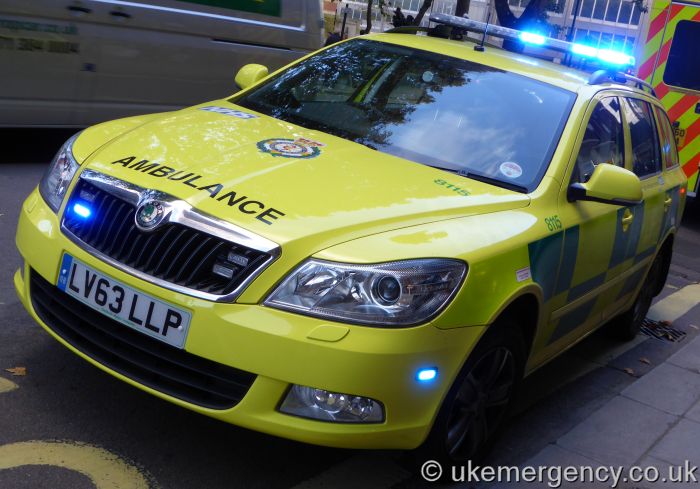
“No, just the ambulance car, but I can assure you that your father will be quite comfortable.”
People are always disappointed when you turn up in the car as human nature longs for a bit of noise, drama and flashing lights. I must admit; there are times when the rush through peak-time traffic with the blue lights and insistent siren get my blood pumping. Not much can beat that cliff-hanger moment, wondering if your patient will be snatched away from you.
I knew this one wasn’t going to be snatched away in a hurry by anyone.
“Can’t we come as well?” asked the daughter with the stick, her dark hair like a wreath around her lined face.
Itching to get on with my work, I tried to speak calmly.
“Do you have a car that you could follow us in?”
She turned to her sister with urgency. “Drive me up there. Please!”
“Oh but…”
“It really might be a good idea,” I inserted gently, aware of the old man’s knowing eyes. Perhaps they’d had these dramas so often that she didn’t realise this was the very last time. I knew it and so did the old man. The older woman knew it too, I could tell. By the look of her, she wouldn’t take too many months to follow her father out of the world. Cancer – spreading with wicked and rapid malignancy by the looks of it. She would make an interesting case to follow. I shook myself and hurried out to fetch my colleague and a stretcher. One patient at a time. The old man deserved my full attention.
I’ve often wondered how it feels to look around your home for the last time. Would your eyes hungrily devour the photographs of happy times, the loving pet in the corner or a favourite row of books? Or, perhaps, you would only notice the swooping cobwebs your arms were too weak to swipe, the damp mould crawling up the wall or the drip-drip of the tap the authorities never got round to fixing. It’s a comfort to believe that happy images surround your final hours, but I’ve seen the blood drain from exhausted features, leaving only disappointment and regret as they face the final journey of their life. It’s my job to ease that journey and I take pride in it.
Pete, my colleague, followed me in and sniffed apprehensively, still young enough to shudder. It’s a strangely accurate odour signifying neglect, decay and ensuing death, but I’ve learnt to tolerate it, even appreciate it as certain evidence that I’ve come to the right place.
We lifted the old man as respectfully as we could and settled him on a stretcher, me keeping up a soothing patter all the time, Pete concentrating on keeping the old man steady and comfortable. He likes to deal with the physical elements. I’m more inclined to calm the soul.
The daughter with the stick hung back, defenceless, and alone. I wondered what part the old man had played in her life, whether he had dominated her every move. There was something in his diminished figure that sill smacked of restrained power. The younger sister fidgeted, her tense frame filling the small room.
“Right-oh, Mr Miles, have we got you?” asked Pete.
The old man grimaced, trying to smile as we carried him out. I noticed he shut his eyes as we passed his daughters. I could understand that. There are times in life when you must concentrate on yourself, not be swamped by others’ needs.
The fresh air hit his grey cheeks as we headed for the rusty gate.
“Are you cold?” asked the daughter with the stick.
He shook his head irritably. I wish he hadn’t. She’ll remember that careless gesture for the rest of her short life. I asked her to open the gate to give her a purpose.
Suddenly, the old man’s eyes opened.
“I’ve cheated death before you know,” he warned me defiantly.
I smiled, feeling a sudden surge of affection for him. “I know you have. I can see that.”
I saw it in the jutting chin and the knotty muscles in his wasted forearms. I could see his military past, imagining him diving away from shells and proudly donning a poppy each November 11th. I could envisage him as a young father, dashing across a road to cheat Death of another child. Later in his life, I could imagine him staring down the pneumonia, which had so easily whipped his wife away.
“I can see it all,” I assured him. He smiled back, satisfied. It’s important to give them that moment of pride. We all need to know we’ve done something well in life.
We eased him into the car, very carefully, and then he started to panic.
“My daughters!” he gasped, wheezing perilously. He stared wildly. Moments like that break my heart. I wondered what he could see from his restricted vantage point – a rectangle of grey sky and a glimpse of bare tree. His last view of the outside world.
“Your daughters are following in the car,” I promised, squeezing his shaky hand.
“Both of them?”
“They’re both on their way.”
He closed his eyes, peace softening his aged face. I looked at him tenderly, wondering if it would be kinder to take him at that moment with hope and calm emanating from his shrunken frame. Why suffer the indignity of pounding machines and operating instruments at his time of life?
I brushed my gentle hand over his face, sweeping his finished life away. I refused to give anyone the chance to snatch him from my certain grasp.
I’m proud of my vocation. They may call me Queen of the last times, but I do it in as sensitive a manner as I can. Whatever people say, Death is often a kindly tool. Don’t be afraid when it comes to your turn to meet me. I’ll do my best to accompany you out of this life as gently as I can.
5/11/2026
The Words That Got to Me
The central narrative voice is excellent. Lines like: “I’m more inclined to calm the soul.” “People are always disappointed when you turn up in the car…” “Death is often a kindly tool.” All reinforce the narrator’s identity without over-explaining it. “I’ve become fascinated by the point in time when they cross from being part of the living process to starting the final journey away from us all.” A very strong part that is the key turning point of the story. It beautifully captures the narrator's perspective.
Suggestions / Possible Tweaks
A few places over explain. For instance: “I refused to give anyone the chance to snatch him from my certain grasp.” While this is thematically understandable, it is slightly more overt than much of the preceding subtlety. The story is strongest when Death’s nature emerges indirectly. A few line-level notes: “besides a huddled shape” Should probably be “beside”. “that sill smacked of restrained power” Presumably “still”. “repressive stare” Possibly meant “reproving stare”.
This is an emotionally mature literary piece with a strong narrative voice. You manage to maintain a fine balance between tender care and inevitability and, importantly, avoid becoming overly melodramatic. I felt your greatest strength was empathy. Even minor characters feel observed rather than judged. The old man, especially, is handled with dignity throughout. The concept draws on familiar themes, but the execution and tone give it individuality and emotional weight, bringing its own unique flavour.