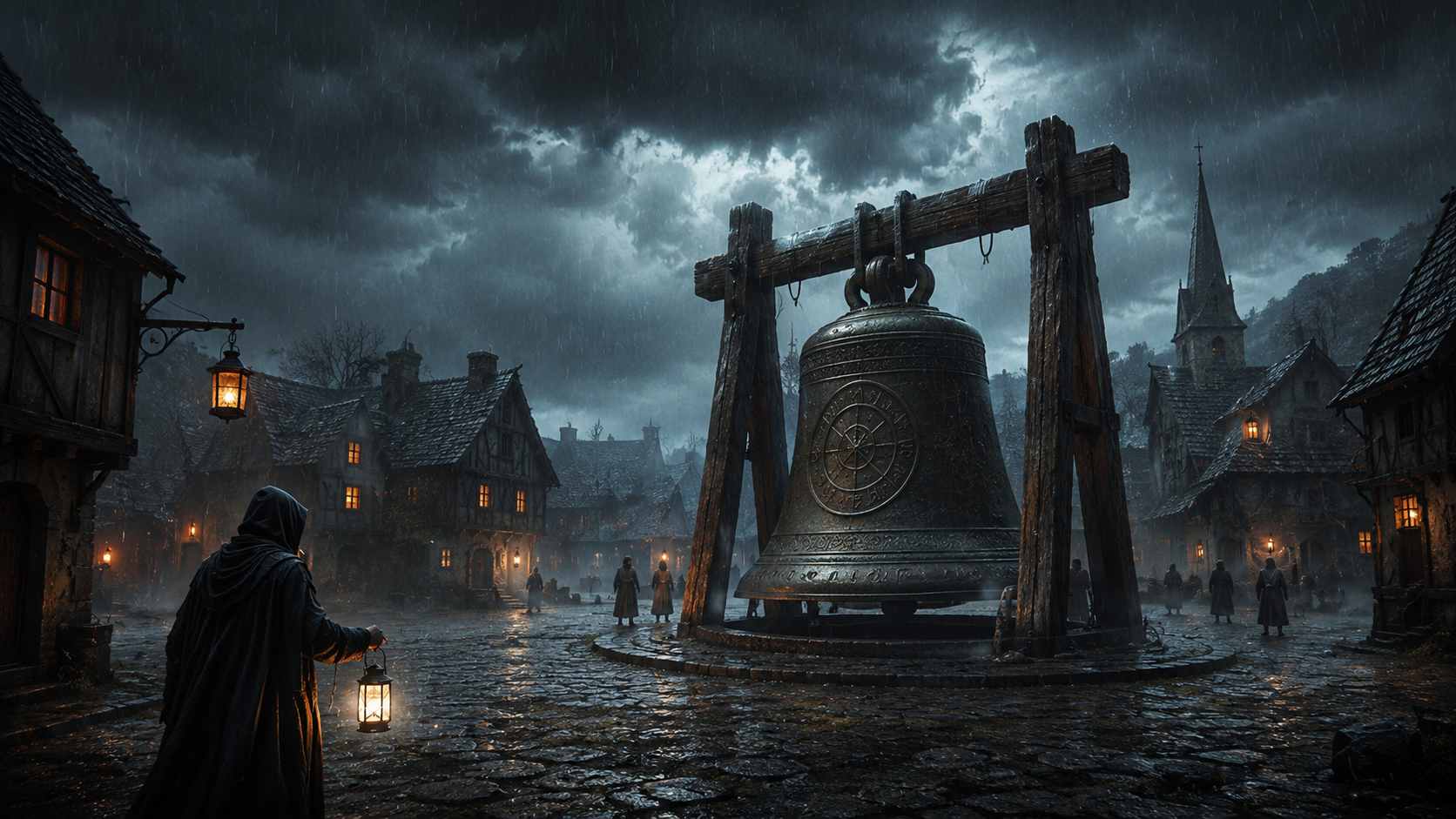
The first thing Renna noticed about the village was the bell. It seemed to emit a weight of silence—thick, pressing, unnatural.
It stood in the centre of the square, an immense bronze behemoth, hanging from a thick wooden frame that had blackened with age. Verdigris streaked its surface, the edges worn smooth by time, yet something about it still held power—a heaviness that pressed against her senses, thick and suffocating.
She pulled her cloak tighter against the wind, her fingers cold against the fabric. A handful of villagers moved about the square, their faces drawn, their steps brisk. None of them so much as glanced at the bell.
Not once.
It was odd.
She stepped forward, her boots pressing into the damp, packed earth, as the scent of storm-heavy air filled her lungs. The wind had carried whispers of rain all afternoon, and now the sky churned with sluggish clouds, thick with the promise of thunder.
At the far end of the square, a wooden sign swayed on rusted hinges.
‘The Hollow Oak Inn’
Renna exhaled. Shelter. Finally.
She adjusted the strap of her pack and pressed forward. The inn’s door creaked as she pushed it open, releasing a wave of warmth scented with burning wood, hot broth, and damp wool. The change in temperature settled around her like a heavy cloak, thick after the sharp chill outside.
A handful of patrons sat hunched over their drinks, voices low, eyes cautious. They looked up as she entered, but none held her gaze. Conversations resumed in murmurs, the atmosphere heavy, subdued.
Renna stepped toward the counter, where a woman—broad-shouldered, the streaks of grey in her dark hair catching the firelight—was polishing a tankard with slow, methodical strokes.
“Storm’s coming,” Renna said, tugging off her gloves and tucking them into her belt.
The woman nodded. “You’ll be wanting a room then.”
“If you have one.”
“Aye.” The woman set the tankard down with a dull thud. “Payment up front.”
Renna slid a few coins onto the counter, her gaze drifting back toward the door. “The bell in the square…” she started. “It’s quite large. Haven’t seen one like that before.”
The air in the room changed.
The innkeeper’s fingers stilled over the coins, her shoulders tightening ever so slightly. Across the room, a man seated by the fire shifted in his chair, slow and deliberate.
“That old thing,” the woman said finally, scooping up the coins. “No one pays it any mind.”
Renna lifted an eyebrow but didn’t press. She had spent enough time in strange places to know when a subject was unwelcome.
“Room’s at the top of the stairs,” the woman added. “Second on the left.”
Renna nodded her thanks, before heading up. The wooden steps groaned underfoot, the inn settling around her with the quiet creaks of its old frame. The air inside carried the scent of aged wood and stone, undercut with something faintly herbal.
Her room was small, the bed modest but inviting, a single window facing out toward the square.
Toward the bell.
She let out a slow breath and set down her pack, rubbing warmth into her arms.
Outside, the sky had deepened to a bruised grey, the first flecks of rain tapping against the glass.
The storm would break before morning.
The first toll of the bell came just past midnight.
Renna’s eyes snapped open.
The sound was deep, vibrating through the walls of the inn, rattling the windowpanes. It wasn’t just noise—it was pressure, sinking into her bones, seeming to vibrate into her very soul.
She threw off the blanket and moved to the window, expecting to see people spilling into the streets, roused by the sound.
But the village remained silent.
The bell had tolled—she was sure of it. She could still feel the reverberation in her chest.
And yet… no one stirred.
She grabbed her cloak and stepped out of the room, her heartbeat pounding a steady rhythm against her ribs. The hallway was still, the flickering light from a lone candle casting long, shifting shadows.
She descended the stairs quietly, each step deliberate. The air inside the inn was warm, the fire in the hearth still burning low, its embers pulsing like a heartbeat.
The innkeeper was asleep in a chair by the counter, her head tilted forward, breaths slow and steady.
Renna hesitated.
She stepped closer, reaching out to shake the woman awake—
Then she saw it.
A shadow standing in the square.
Directly beneath the bell.
Watching.
Waiting.
Renna’s breath caught.
The figure stood motionless, half-obscured by the thin mist curling from the damp earth. Tall, still, featureless in the dim light, it seemed less like a person and more like an absence—a shape carved from the night itself.
Her fingers twitched toward the dagger at her belt.
The innkeeper remained undisturbed, her breath slow, deep, as if the sound of the bell had never reached her. The fire still burned, the room untouched.
Everything was as it had been.
Everything but the figure in the square.
Renna forced herself forward, her steps light as she grabbed a lantern from its hook. The glass was cool in her hands, the oil inside sloshing as she unlatched the vent and used a splint from the hearth to light it. The wick flared to life, casting a flickering glow across the wooden floor.
She stepped outside.
The village square stretched before her, the bell looming overhead, its great frame groaning faintly in the wind. The air smelled of damp stone, old metal, and the lingering promise of rain.
She took another step.
The figure did not move.
“Hello?” she called, her voice low, wary.
No response.
She lifted the lantern, the flame flickering as the glow spread outward, light pooling at the bell’s base, spilling across the cracked stones beneath it—
But the figure was gone.
Renna stilled.
The wind curled through the empty square, carrying the soft creak of wood, the rustling of fabric, the restless shifting of a place that should have been asleep.
She turned in a slow circle, scanning the darkness. Nothing.
But something had been here.
And she had felt it watching her.
She lowered the lantern slightly, its light trembling in the damp air. Her gaze flicked to the bell again, its surface slick with age, streaked with deep lines of green patina. Closer now, she could see the faint markings beneath the corrosion, nearly swallowed by time.
Not just weathered grooves.
Words, letters etched in the metal surface
Old ones.
She raised a hand and brushed her fingertips against the cold metal.
A sharp breath of wind cut through the square.
Renna flinched as movement flickered at the edge of her vision—a shape shifting just beyond the lantern’s glow. The whisper of cloth, the creak of a wooden beam.
And then—a voice.
Soft.
Distant.
"Not yet."
Renna turned sharply, lantern held high, but the space behind her was empty. The shadowed streets stretched into silence, the buildings little more than black shapes against the storm-heavy sky.
The voice was gone.
She exhaled slowly, heart hammering, and stepped back toward the inn, keeping her eyes on the square. The bell loomed above her, heavy with something more than time.
She would get answers in the morning.
For now, she would try to sleep.
The next morning, the village smelled of rain.
Pale light filtered through the mist, beading against the rooftops, running in thin rivulets down wooden doorframes. The air was fresh, cleaner than the night before, but beneath it lay something else. A stillness. A quiet that didn’t feel quite right.
Renna stood at the inn’s threshold, a steaming mug of something vaguely herbal in her hands. She had slept poorly, her dreams restless, full of shifting shadows and the echo of the bell’s tolling.
No one else had heard it.
Not a single villager had stirred.
She turned to the innkeeper, who was wiping down the counter with slow, deliberate strokes, her focus fixed on the grain of the wood as if it held some great importance.
Renna watched her for a moment before speaking.
“I heard the bell last night.”
The cloth stilled.
The woman’s jaw tightened slightly, her fingers pressing into the wood. A few beats passed before she resumed her movements, her face carefully blank.
“You were dreaming,” she said.
Renna frowned. “I wasn’t.”
A longer silence.
Finally, the innkeeper exhaled through her nose, setting the cloth aside. “Then you should leave,” she said simply. “Before it rings again.”
Renna’s grip on the mug tightened.
So. She had heard it.
The innkeeper’s words hung between them, heavy as iron.
She knew exactly what it meant.
Renna studied her face—the tight set of her mouth, the way she kept her eyes low, the quiet, measured movements of her hands. Everything about her spoke of restraint, as if speaking too much might stir something that was better left sleeping.
Renna set her mug down deliberately. “Why would I need to leave?”
The innkeeper hesitated.
“You’re an outsider.” Her voice was flat, matter-of-fact. “This isn’t your burden.”
Renna’s patience, already worn thin from a restless night, frayed further. She leaned against the counter, lowering her voice. “I don’t like riddles. And I don’t like being lied to.”
The innkeeper’s gaze finally snapped to hers.
“I didn’t lie,” she said coolly. “I said you should leave. That’s the truth.”
Renna held her stare for a moment longer before exhaling sharply and stepping back. She could push—press for answers—but something told her that would do more harm than good.
Besides, there were other ways to get information.
“Fine,” she said at last. “I’ll be on my way soon.”
It was a lie, of course.
The innkeeper didn’t look convinced but made no move to argue. Instead, she turned away, gathering up her cloth and mug as if the conversation had already been dismissed.
Renna let herself out.
The village had begun to stir, but something about the way people moved felt wrong. Conversations were hushed. Doors closed a little too quickly. Footsteps hurried just enough to be noticed.
A few villagers glanced at her as she passed. They said nothing.
But they knew.
Knew she had heard the bell.
Renna ignored them and walked toward the square, her boots scuffing against the ground. The bell stood exactly as it had before—motionless, silent. As if it had never rung at all.
She stepped closer, her eyes tracing the weathered surface. Those markings she had glimpsed in the lantern’s glow—half-hidden beneath the patina—she could see them more clearly now.
They weren’t just random words or letters.
They were names.
Hundreds of them.
Some had been worn down by time, the letters nearly unreadable, but others remained sharp. A long history, carved into the bronze, layer upon layer.
Renna ran her fingers over the rough surface, following the curve of the bell. Near the bottom, beneath the most recent names, a phrase had been cut deeper than the rest.
‘It calls for what is owed.’
A sharp chill ran through her.
She took a slow step back, glancing around the square.
No one else was looking at the bell.
Not a single soul.
Renna spent the rest of the morning watching. Listening.
She made her way through the village, stopping at the bakery, the blacksmith, the tailor’s shop—casual visits, polite conversations. But no matter who she spoke to, no one mentioned the bell.
Not a single person spoke its name.
It was as if the thing didn’t exist.
But Renna had learned to read the spaces between words—the way people flinched at certain phrases, the way their gazes lingered on something they refused to acknowledge.
The bell was feared. That much was obvious.
She needed history. Records. And for that, she needed the oldest place in the village.
The chapel sat at the very edge of town, its weathered stone walls streaked with moss, its sagging roof bowed beneath the weight of age.
Renna hesitated at the threshold. The air here felt denser, heavier than in the rest of the village. As if the ground itself had been holding its breath.
She pushed inside.
The chapel was small, dim, the scent of old wax and ancient wood pressing in around her. Candles flickered at the altar, their flames weak against the gloom. At the far end of the hall, an old man in a frayed robe sat at a wooden desk, his head bent over a book.
Renna cleared her throat. “Excuse me.”
The man didn’t startle, but he turned his head with careful slowness. His pale eyes settled on her, deep-set and knowing.
"You heard it," he said.
Renna’s breath stilled.
It wasn’t a question.
He closed the book and gestured for her to sit.
His fingers traced absently over the brittle pages, the motion slow, thoughtful.
"The bell doesn’t ring unless a debt is due," he murmured. "And if you heard it…"
His pale eyes met hers, steady, certain.
"Then the one who is owed has come to collect."
A chill curled down Renna’s spine.
She had expected denial, half-truths—maybe even some cryptic superstition. But this was different. The way he said it, quiet and matter-of-fact, carried the weight of certainty.
She pulled out a chair and lowered herself into it, the old wood creaking beneath her.
“You’re the first person to acknowledge it,” she said, keeping her voice level. “Everyone else pretends the bell doesn’t exist.”
The old man exhaled through his nose—a sound somewhere between amusement and weariness.
"They do not pretend," he said. "They survive."
Renna frowned. “Survive what?”
The old man’s gaze drifted toward the rafters, as though searching for the right words—or perhaps listening for something just beyond her hearing.
Then, with slow deliberation, he opened the book before him, its yellowed pages curling at the edges. A withered finger traced the text, stopping near the bottom.
"The bell was not always silent," he said. "Once, it rang often. For births. For deaths. For warnings." His voice dropped lower. "And for payment."
Renna’s stomach tightened.
“What kind of payment?”
The old man turned the book toward her. Ink faded by time stretched across the pages in neat lines, but the structure was clear—a list. Names. Dates.
And a single word repeated beside some of them.
Taken.
She inhaled sharply.
“The bell doesn’t just warn of death,” she murmured.
"It decides it."
The old man closed the book gently, pressing his fingers against the worn cover as though feeling for the heartbeat of something long buried.
"It was a bargain," he said. "Struck generations ago, when this land was wild—when the first settlers had no choice but to seek… protection."
Renna’s thoughts spun. Protection. A bargain. A debt.
"And what was the cost?"
The old man’s expression darkened.
"Blood."
Renna leaned forward, her pulse a steady drum against her ribs.
"You mean sacrifices?"
The old man did not nod, but he did not deny it either. "Every few decades, the bell would toll. And the village… would give what was owed."
The implications settled like stone in her gut.
"And then?"
"The bell fell silent," he said. "A hundred years ago. The last name was carved, the last price paid. And the village let itself forget."
Renna’s mind raced back to the night before—to the way the bell’s toll had thrummed through her bones. The way no one else had heard it.
She met the old man’s gaze. "So why now? Why did it ring again?"
His pale eyes held hers, steady, unreadable.
"Because something has come to collect."
The words sat heavy between them.
Renna forced herself to breathe evenly, though her pulse hammered in her ears.
She had dealt with superstition before. With old stories, half-truths twisted by generations of fear. But this—this felt different.
This felt real.
Her gaze flicked to the book again, scanning the faded ink. The last name on the list was barely legible, worn by time, but she could still make it out.
‘Aldric Venn.’
She tapped the name. "Who was this?"
The old man’s lips thinned. "The last taken."
"And no one after?"
"No." A pause. "Until now."
Renna leaned back in the chair, exhaling slowly.
If the bell had rung, then someone was marked. Someone was owed.
Her skin prickled.
"And how did they choose?" she asked.
The old man’s fingers curled against the table.
"They didn’t."
Renna frowned. "Then who—"
"The bell."
A shudder ran through her.
Before she could speak, a gust of wind rattled the chapel’s beams, making the candle flames gutter and dance. Shadows flickered against the stone walls, and for a brief moment, she felt it—something shifting in the air.
She wasn’t alone.
Not just with the old man.
Something else was listening.
Something that had been waiting.
Renna pushed back from the table and stood. "I need to see the records."
The old man gave a slow, careful nod. "Then follow me."
Renna followed the old man through a narrow door at the back of the chapel, descending a steep, winding staircase illuminated only by the flickering light of his lantern. The air thickened with mildew, stone, and age; the scent of ink and paper growing stronger with every step.
At the bottom, they entered a small chamber lined with shelves, each crammed with leather-bound volumes and rolled parchments. Dust motes floated in the lantern’s glow, and the silence was profound, as though the room itself held its breath.
The old man set the lantern on a wooden table and began pulling books from the shelves, his movements practiced, deliberate. He laid them out carefully, each thud against the wood a quiet echo in the confined space.
Renna approached, running her fingers along the spines—some cracked and faded, others surprisingly well-preserved. The weight of history pressed in around her, each book a silent witness to lives long past.
"These are the parish records," the old man said, his voice barely above a whisper. "They chronicle every birth, every death, every… offering made in this village."
Renna’s fingers brushed the nearest volume, the leather cool and textured beneath her touch. "Offerings," she repeated, the word bitter on her tongue.
The old man nodded, his expression unreadable. "A pact was made, long ago. To ensure the village’s prosperity, a life was given in exchange." He opened one of the books, revealing pages filled with careful, meticulous script. "The bell would toll, and the chosen would be led to their fate."
Renna’s stomach tightened as she scanned the entries, each name a stark reminder of the village’s dark history.
"And now it's tolling again," she murmured. "But why? The pact was fulfilled, wasn’t it?"
The old man’s gaze met hers, shadowed, weary. "Perhaps the terms have changed," he said softly. "Or perhaps the debt was never truly settled."
A shiver ran down Renna’s spine.
"We need to warn the village," she said, urgency tightening her voice. "If the bell is tolling for another offering—"
The old man placed a gentle hand on her arm, his grip surprisingly firm.
"Be cautious," he warned. "Not everyone will be willing to listen. Denial is a powerful shield against fear."
Renna nodded, resolve hardening inside her. "Then I'll make them listen. We can't let history repeat itself."
She turned to leave, but the old man’s voice stopped her.
"Remember," he said, his tone grave. "The bell chooses its own. Interfering with its will can have dire consequences."
Renna hesitated, the weight of his words pressing against her. "I understand," she said, though uncertainty gnawed at her resolve.
With one last glance at the records—the silent evidence of the village’s past—she ascended the stairs, her mind racing with the enormity of what lay ahead.
Outside, the sun had dipped below the horizon, casting long shadows across the village. Lanterns flickered to life, their warm glow dotting the streets as the low murmur of evening routines filled the air.
But to Renna, everything felt different.
The weight of what she had learned pressed against her, an unshakable undercurrent of impending doom.
She made her way to the village square, where a few townsfolk lingered, chatting and laughing, their voices light and careless. The normalcy of it all sent a chill through her. They had no idea what was coming.
Taking a deep breath, she stepped forward, her voice ringing out clear and steady.
"Everyone, please," she called, drawing their attention. "I have something important to share."
Faces turned toward her, expressions shifting—curiosity from some, mild annoyance from others.
"Earlier today, I heard the bell toll," she began, choosing her words carefully. "I know many of you didn't hear it, but it was a warning—a sign that something is coming."
Murmurs rippled through the crowd, skepticism evident in the tight set of shoulders and the uneasy glances exchanged.
"This village has a history," Renna continued, raising her voice above the growing whispers. "A pact made long ago, requiring sacrifices to ensure prosperity. The bell's toll signifies that a debt is due."
A man stepped forward, his brow furrowed. "Those are just old stories," he scoffed. "Meant to scare children."
Renna met his gaze without wavering. "They're more than stories," she said firmly. "The records in the chapel confirm it. We can’t ignore this."
The crowd shifted uneasily, doubt and fear mingling in their expressions.
"What do you suggest we do?" an elderly woman asked, her voice trembling.
Renna took a slow breath. "We need to come together," she said. "Acknowledge your past and find a way to break this cycle. If we stand united, we can face whatever comes."
Silence hung heavy in the air.
Thick with uncertainty.
Faces flickered between skepticism, fear, and a deep, ingrained reluctance to acknowledge what she was saying.
Renna had seen this kind of reaction before. People clung to their version of reality like a shield. Admitting the truth meant admitting danger, and admitting danger meant facing it.
The elderly woman wrung her hands, glancing toward the inn. "We haven’t had reason to fear the bell in a long time," she said. "And you expect us to believe it’s suddenly started up again—just because an outsider says so?"
Renna set her jaw. The weight of their doubt pressed in on her. Words alone weren’t enough.
"I don't expect you to believe me," she said, her voice measured but firm. "But you do believe your own records." She turned toward the chapel. "Come with me. See for yourselves."
A few villagers exchanged uneasy glances. Some hesitated, shifting on their feet. Others remained unmoving, their silence a quiet defiance.
"It’s just old folklore," the man from earlier muttered. "No different from stories about spirits in the woods or curses on lost graves. We outgrew those fears. We should outgrow this, too."
A new voice cut through the tension—soft, but heavy with the weight of years.
"The bell doesn’t toll for nothing."
The crowd parted slightly as a frail-looking woman stepped forward. Deep lines marked her face, her once-dark hair streaked with silver. She walked with the careful deliberation of someone who had carried burdens alone for far too long.
Renna watched as the crowd shifted uncomfortably.
They knew her.
"You heard it, too?" Renna asked.
The woman nodded. "I did. And not just last night." Her voice was barely above a whisper, but in the hush of the square, it carried. "Three nights ago. And a week before that."
A murmur of unease rippled through the villagers.
Renna’s stomach tightened. If the bell had been ringing for days, that meant—
"It never rang twice before a name was called," the woman added, her voice strained. "This time it has."
True fear swept through the square.
Renna gripped her lantern, casting a glance toward the bell tower. "If it tolls to warn of a debt being due, we may already be too late," she said. "But if we act now, we can figure out who is marked."
The woman’s fingers tightened around the edges of her shawl. "And then?"
The question hung in the air like a blade.
Renna had no answer.
She turned to the old man from the chapel, who had followed her into the square without a word. "You said the bell chooses, but in the past, people were taken. Who decided who that would be?"
His expression was unreadable. "The bell made its call," he said. "And the village—" he hesitated, "—made its choice."
Renna felt ice settle in her veins.
A sacrifice.
A decision made by human hands, forced by an unbreakable curse.
She could see it clearly now: A name whispered in hushed council meetings. A family forced to part with a loved one, silent and shaking. A procession toward the place where the debt was paid.
Her stomach twisted.
"Not this time," she said, the words slipping free before she had even fully formed them. "We won’t let that happen this time."
A gust of wind stirred the silence, making the bell’s frame groan in protest. The night thickened, pressing in, something unseen listening.
And then—
A single, low, resonant toll.
The ground seemed to tremble beneath their feet, windows rattling in their frames, the sound sinking into their bones.
Renna whirled, eyes locked on the bell.
This time, she wasn’t the only one who heard it.
Gasps and cries broke through the square. Some villagers clutched their chests, others stumbled back as if struck by an unseen force.
A second toll followed—deeper, heavier—a sound that carried more than warning.
It carried a name.
The old man closed his eyes. "It has chosen."
Renna’s heart pounded. "Who?" she demanded. "Who is it calling for?"
A whisper moved through the air, threading between the houses, curling around the bell, winding its way through the square.
And then—
The frail woman beside Renna went still.
All colour drained from her face. Her lips parted slightly, as if to speak, but no words came.
She already knew.
And so did Renna.
The bell had rung for her.
The square fell into a heavy silence, the second toll still lingering in the air like an unspoken verdict.
Renna's gaze remained fixed on the woman beside her—the one who had heard the bell before anyone else. She stood rigid, caught between terror and grim acceptance.
A choice had been made.
By whom?
By what?
The villagers took a slow step back, as if distance alone might shield them from what had just been decided. Their faces twisted with guilt and relief, and Renna hated them for it.
She turned sharply to the old man. "This can’t be final."
His mouth was a tight line, shoulders drawn tense beneath the weight of history. "The bell has spoken," he said quietly. "And in the past, none have been spared."
The chosen woman exhaled shakily. Her trembling hands clutched at the edges of her shawl, but when she spoke, her voice was steady.
"I always knew it would be me."
Renna’s stomach twisted.
"Why?" she demanded. "What makes you so sure?"
The woman turned to her, and in her gaze was the quiet resignation of someone who had spent a lifetime waiting for the inevitable.
"Because my father was the last," she murmured. "And the debt never truly ended."
A cold shock swept through Renna’s chest.
Her mind snapped back to the book in the chapel. The last recorded name.
Aldric Venn.
"You’re his daughter," she whispered.
The woman nodded. "He was the last one taken. But something changed. The bell rang, and the village ignored it. They let themselves forget. But the bell does not forget." Her voice was steady, but there was something hollow in it. "It remembers unfinished business."
Renna’s jaw tightened.
The village had not escaped its fate.
It had only delayed it.
For a century, the debt had waited.
And now, it was being called in.
A ripple of unease spread through the crowd. Some villagers looked away, their relief curdling into guilt. Others cast uncertain glances toward the chapel, toward the past they had chosen to bury.
"That’s madness," the man from earlier snapped, his voice tight. "No one needs to die! We’ve lived in peace for decades. Who’s to say this isn’t just coincidence?"
The frail woman—the one chosen by the bell—smiled, but there was no warmth in it.
"You can say whatever you want," she murmured. "But the bell has already called my name."
The crowd remained frozen as the wind shifted, curling between them like unseen fingers, slipping through the streets, twisting around the edges of the bell’s frame.
Renna turned her gaze back to the towering relic, her pulse hammering.
No.
No, this couldn’t be how it ended.
She had spent her life studying patterns, tracing old records, unearthing forgotten histories. And if there was one thing she had learned, it was this: every curse had a source.
Every debt had a root.
If she could find it—if she could understand why the pact had been made in the first place—then maybe, just maybe, there was a way to break it.
"You said the bell chooses," she said, stepping forward, her voice cutting through the uneasy murmurs. "But you also said the village once made the decision themselves." She turned to the old man. "Tell me what that means. How was the choice made before?"
The old man hesitated.
Renna stepped closer. "Tell me."
He sighed, his fingers tightening over the sleeves of his robe. "The village council would… deliberate," he said carefully. "Once the bell tolled, they would convene, and by dawn, a name would be given."
Renna’s breath caught. "You mean—"
"The bell never spoke a name outright," he admitted, his voice a whisper. "Only that a price was due. It was the village that chose who paid it."
A terrible realization crept over Renna, slow and suffocating.
"You’re saying—" she swallowed. "The bell never chose at all. The people did."
The villagers stirred uneasily, their carefully constructed denial crumbling under the weight of truth.
For generations, they had convinced themselves the bell was an immutable force, an ancient magic beyond their control.
But it had always been them.
A human decision.
A sacrifice of convenience.
Renna turned to the old woman, who met her gaze with steady, knowing eyes. "So you see," the woman said softly. "It was always going to be me."
Renna’s pulse thundered in her ears.
"Not this time." Her voice was firm.
The wind surged, pushing through the square with a force that made the bell’s frame groan.
And then, for the first time, Renna felt it.
A presence.
Not in the shadows. Not in the bell.
In the village itself.
It watched from the walls, from the stones beneath their feet, from the air thick with waiting. She felt it pressing against her ribs, unseen and unrelenting.
Something old.
Something patient.
Her fingers curled into a tight fist.
"You’ve spent a century ignoring the bell," she said, turning back to the villagers. "Now’s your chance to defy it."
The old woman smiled, but there was sadness in it. "And if we can’t?"
Renna took a steady breath. "Then I’ll find out what happens when you refuse to pay."
The villagers stared at her, horrified.
"You can’t mean to—"
Renna turned toward the bell, ignoring them.
The wind whispered against her skin, carrying something with it—something just on the edge of language.
She stepped forward.
And the bell tolled for a third time.
The third toll ripped through the air like a living thing.
It wasn’t just sound. It was force.
Renna felt it press against her chest, reverberating in her bones, sinking deep into the marrow. The very ground trembled beneath her feet as if the earth itself recognized the weight of the moment.
Villagers cried out. Some clutched their ears, others stumbled back as if struck by an unseen wave. Windows rattled. The lanterns in the square flickered violently, their flames twisting, stretching—nearly snuffed out.
The bell’s echoes lingered, curling around them, pressing into the village like a great, unseen hand.
Renna staggered but refused to fall.
Then—a whisper in the wind.
Not quite a voice.
Not quite a breath.
"Three tolls. The price is set."
Renna’s blood turned to ice.
The old woman let out a trembling breath, shoulders squared in quiet acceptance. "It’s time," she murmured.
"No," Renna snapped. "It’s not."
She turned toward the bell, its great, weathered surface shrouded in shadow despite the flickering lanterns around it. The names carved into its bronze skin—the long, unbroken line of sacrifice—seemed to shimmer faintly in the dim light.
It was waiting.
Watching.
And it expected obedience.
Renna’s hands curled into fists.
She had spent her life studying old things, forgotten things. She had seen what blind adherence to tradition could do—how stories became shackles, how fear made people prisoners of their own past.
Not this time.
Not here.
She turned to the villagers, lifting her voice against the rising wind.
"This isn’t the will of the bell!" she shouted. "It’s not fate! It’s a choice!"
The villagers stared, wide-eyed. Fear had always kept them bound—fear of change, fear of questioning, fear of what might happen if they said no.
The wind howled around them, slithering between heartbeats.
"The price is set."
Renna gritted her teeth. "Then let’s see what happens when the price is denied."
She moved.
With a sharp breath, she stepped forward, pushing through the unseen resistance pressing against her, trying to hold her back.
She reached for the bell.
The moment her fingers brushed the metal, the world lurched.
The village square vanished.
Renna stumbled into darkness—not just the absence of light, but something deeper, vast and endless.
The wind was gone. The villagers were gone.
She stood in a space too large, too empty, the air thick with something unseen.
Then—a flicker.
Not light. Not fire.
Memory.
The village as it was, decades ago, before the silence of the bell.
Renna watched as figures took shape—council members of the past, gathered in a tight circle, their faces etched with worry. She could hear their whispers, their arguments.
"The bell has rung."
"The debt must be paid."
"But who?"
"Someone must go."
She knew what this was.
The moment when the village, again and again, had chosen.
Another flicker.
A girl, barely sixteen, dragged toward the square, her face wet with tears.
Flicker.
A man, head bowed, hands bound behind his back.
Flicker.
A mother, whispering apologies to her child.
Again and again.
Not fate.
Not magic.
Fear.
The bell had never named them.
The villagers had.
Renna felt the weight of it, pressing against her ribs.
The bell was never alive.
It was never a god.
It was a tool.
And the people had given it power.
The darkness shuddered.
And suddenly, Renna was back.
The wind screamed, furious. The villagers stood frozen, watching her with wide, stricken eyes.
She knew what had to be done.
She turned to the old woman.
"The bell didn’t choose you," she said, steady and sure. "The village did."
The woman stared, breath hitching.
And for the first time, Renna saw it—the faintest flicker of hope.
Hope that maybe, just maybe, there was another way.
Renna faced the villagers.
"You don’t have to do this."
The wind howled.
The bell shuddered on its frame.
Renna lifted her hand again—but this time, she didn’t wait.
She did the one thing no one had dared.
She pushed.
The bell tipped.
The massive weight of it shifted, groaning, screeching as it began to fall.
A cry rose from the crowd as the great bronze shape toppled forward, crashing into the earth with a thunderous, final THUD.
The moment it hit the ground—
The wind stopped.
The whispering ceased.
The air went still.
Renna stood panting, arms trembling, the reverberation of the fallen bell humming in her bones.
Then—the villagers exhaled.
One by one, tension drained from them, shoulders loosening, hands unclenching. The air smelled cleaner. The village felt lighter.
And the old woman, the one who had been prepared to die, stepped forward.
Hesitant. Disbelieving.
She reached out and placed her hand on the bell’s fallen body.
She was still here.
She was alive.
And for the first time, the bell was silent.
Truly, completely silent.
Dawn rose over the village, soft golden light spilling across the square.
The bell lay where it had fallen, its carved names facing the sky.
Renna stood beside it, exhaustion pulling at her limbs. She had barely slept. She doubted she would for some time.
The villagers remained quiet, shaken. Some still stared at the bell, as if expecting it to rise again, to demand its due.
But it wouldn’t.
Not anymore.
The cycle had been broken.
The fear had been severed.
And the bell—once a symbol of power—was now just metal in the dirt.
The old woman approached, her expression unreadable.
"You saved me," she said simply.
Renna shook her head. "No. You saved yourself."
A long pause.
Then—a slow, tired smile.
For the first time, no one looked at the bell with reverence or fear.
They looked at it for what it was.
An artifact of history.
A reminder of what must never be repeated.
And as Renna turned away, ready to leave the village behind, she knew—
The bell had rung for the last time.

7/6/2026
Well, wow to the million-zillionth power for THIS masterpiece of a story!! Holy Moly. This had EVERYTHING!! Sensory descriptions (your forte), mystery (oh, also your forte), anticipation (ditto), fear (HUGE big-time ditto), the supernatural (ditto, ad infinitum) and brilliant craftsmanship (ENORMOUS DITTO). Oh - plus an allegory that requires much rumination long, LONG after the story has been read in its entirety. One of the only times when my beloved husband annoys me is when he gives as his reason for something, "Well, but we've always done it this way." I'm not against tradition, but as you masterfully showed here, when it enters into the "but this no longer makes any sense" zone, it HAS to be confronted and changed. This was EPIC in the way it was handled. Very Nathaniel Hawthorne, replete with the wind and the menacing, shadowy figure and the "crowd mentality" of the villagers who just wanted relief from their fear, no matter the price it took to achieve it or how temporary. I absolutely love this tale. Writing perfection...and you know I'm fussy, so that means you know I really do mean it! Congratulations. Find somewhere to publish this. It's writing gold. xoxo