November 2024
Boxes of cherished family photograph albums greet me as I walk into my son’s vacated bedroom.
I am drawn to these collectively captured moments more than ever now that both of my parents have passed away.
Tangible, visual connections to their past and mine as well.
I carefully search through each one hoping to find “her.”
I am not disappointed.
She is there.
My aunt. My aunt with the beautiful smile and contagious laugh.
My favorite photo of her is from the summer of 1940. She is fourteen years old, tall, slender, and smiling with a mischievous grin. Standing with her seven siblings in front of their mother's beloved rose garden on the family farm. Arms linked around one another. They are not just smiling; they are laughing heartily. At what? Only they know. But this I do know: their joy radiates from a place in time that has yet to experience personal tragedy and loss, yet all too soon will...
shadows appear
in memory’s mirror ~
shards of broken glass
Autumn 1947
Undulating pain has become the norm. Sometimes, it takes her by surprise. At other times, she can sense its burgeoning awakening. No memory afterward. Just complete exhaustion. Finally, after a steady stream of unknown fears, fervent prayers, futile questions, and few answers, she is sent, at twenty-one, to a psychiatric hospital for treatment. Diagnosis: rheumatoid arthritis and petit and grand mal epilepsy. In truth, she is treated as if she, too, is mentally ill, enduring electrical shock therapy and drug-induced treatments that render her nearly comatose. Under the prescribed care of the “best medical doctors of the day,” my aunt, the youngest daughter in my father’s devout and sprawling Catholic family, begins to mimic the mannerisms and manifestations of those around her until the day that my grandmother, defying the counsel of the family priest and dictates of self-proclaimed omnipotent doctors, single-handedly removes my aunt from that hell. My grandmother brings her daughter home to the family farm. There, surrounded by the love and care of my grandparents, my aunt will live for more than two decades, until she takes her final breath.
song sparrow lies stunned
under blooming rose bush ~
silent symphony
Christmas 1965
I hold the front door open for my father as he carries my aunt from my grandparents’ sedan into our home. Grandfather readies her wheelchair. Grandmother removes her outer clothing. Knitted wool cap. Red woolen mittens. My aunt is gently situated in her wheelchair in the living room by the warmth of the fireplace. There, she is out of harm’s way from excited and jostling grandchildren, but in clear sight of the beautifully decorated Christmas tree. No shoes. Slippers and bulky woolen socks. Pillows support her back and her feet. A blue crocheted shawl lies limply over her thin shoulders. Her breathing is labored. I want to talk to her, but at twelve, I am hesitant. I cannot find the words, and I have been told to be quiet around her and to not bother her. Instead, I smile weakly from the safety of the couch. She reminds me of a porcelain doll that is placed on a shelf, treasured but never touched. I lift my gaze away from her twisted feet. I want to tell her that sometimes I think of her. Not always. But sometimes. There are so many questions I want to ask her. I wonder when she knew that her life would be relegated to a wheelchair and an adjustable bed, complete with protective side rails, surrounded by dolls from her childhood. Did the surrender of who she once arrive suddenly, or did it slowly ease its way into her mind and crippled limbs? I long to hear her laugh. But she does not laugh. She does not even speak. Not even when my father kisses her gently on her forehead.
My mother serves my aunt Christmas dinner on a tray secured to my aunt’s wheelchair. Everything on my aunt’s plate is cut up into little pieces or mashed. The food runs together. Cranberries bleed into the mashed potatoes. She has difficulty feeding herself. Plastic spoon, not my mother’s polished sterling silverware. No crystal goblet on her tray; she sips water through a straw in a plastic glass. My grandmother intermittently assists her, but she is relishing this holiday gathering with her offspring and these stolen moments of levity from an otherwise caregiving existence. A bit of mashed potatoes falls onto my aunt’s bib. I look away. I want to help her. But I do not. I cannot. I am silent. I fear that if I gaze too long or intently, she will know that I pity her. I choke on my shame and ask to be excused from the dining table.
morning mist clings
to memory’s traveler ~
mud-encrusted boots
May 22, 1968
Today is my aunt’s funeral. Following Mass, she is to be buried in the Catholic cemetery near the family farm next to the plot my grandparents have already secured.
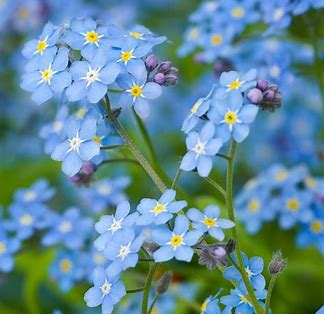
My mother has instructed me to wear my new, pale blue dress because it’s the color of forget-me-nots, my aunt’s favorite flower. Favorite flower? If I had ever visited at length with my aunt, I may have known that. But I have never truly conversed with her. She was always a fragile, sheltered, and silent presence that existed on the periphery of my childhood.
But I should have known.
Now it is too late.
At her funeral service, the priest says, “Barbara suffered greatly, died peacefully, and is now with the Lord. Let us bow our heads and pray for the soul of our dearly departed sister in Christ."
He doesn’t mention that she loved to laugh.
He doesn’t share that she adored forget-me-nots.
He doesn’t speak of any of her childhood accomplishments.
He doesn’t proclaim that her life mattered.
I am fifteen. The same age my aunt was when her epileptic seizures began. The specter of epilepsy frightens me, even more so than the prospect of rheumatoid arthritis. I want to ask my parents that if I died tomorrow, would my life have mattered? But I will wait until a later time. Later, when we are alone, and they are no longer grieving for all to see.
Gray, overcast skies have gradually given way to a touch of blue sky and sunshine as we slowly drive in the funeral procession along the winding country road to the cemetery. We pass a farmer readying his fields for a second planting now that the danger of frost has passed. My father comments that beans and sugar beets "should do good" this year.
A soft breeze is blowing as we gather by my aunt's gravesite. My father has his arm tightly wrapped around my grandmother’s waist. She looks so very small as she leans heavily into my father. Her rosary dangles from her white-gloved right hand. My aunt is the third child my grandparents have lost. My grandfather is standing stoically silent beside my grandmother. Head bowed, hat held in both of his rough, hardworking hands. A few mourners and family members have brought floral bouquets to place at my aunt’s gravesite. I place a small bouquet of slightly wilting, but fragrant purple lilacs from my mother’s garden on top of my aunt’s casket. How I wish they were blue forget-me-nots.
northern star still shines
along broken country road ~
homeward bound...
May 2025
Finally, after struggling and coaxing my gardens to thrive for the last thirty years on this, our stubborn “forever acre of possibilities,” they are brimming with a riot of purple violets, pink and white bleeding hearts, trillium, columbine, and velvet carpets of Sweet Woodruff, the fullness and density of which I have always dreamed but never seen until this year. The Japanese flowering dogwoods and Miss Kim lilacs are teeming with buds; even the doublefile viburnum did not fall victim to the killing frosts of April. I gently brush away bits of rich topsoil and find little nubs of hostas breaking through the earth.
More importantly, everywhere I look, in places I least expect to find them, forget-me-nots have taken hold. An explosion of the most delicate blue appears on our hillsides, peering out from soon-to-be blooming roses, clinging to uneven flagstone pathways. Their presence is not confined to our yard; indeed, in sun-kissed patches of woodlands across the road, these lovely harbingers of remembrance have taken root and bloomed as well...
They will not be disturbed or mowed down.
They will not be plucked to make our land appear manicured and socially acceptable to the dictates of our neighborhood’s restrictive covenants.
They will be allowed to bloom, flourish, and continue to laugh in the warm sunshine for as long and hard as their growing season lasts.
They matter.
She mattered.
Never to be forgotten…

4/13/2026
The Words That Got to Me
My mother has instructed me to wear my new, pale blue dress because it’s the color of forget-me-nots, my aunt’s favorite flower. Favorite flower? If I had ever visited at length with my aunt, I may have known that. But I have never truly conversed with her. She was always a fragile, sheltered, and silent presence that existed on the periphery of my childhood. But I should have known. Now it is too late. **Oy. This is where my heart started hurting for you both. In your defense, you WERE told to be quiet around her. At her funeral service, the priest says, “Barbara suffered greatly, died peacefully, and is now with the Lord. Let us bow our heads and pray for the soul of our dearly departed sister in Christ." He doesn’t mention that she loved to laugh. He doesn’t share that she adored forget-me-nots. He doesn’t speak of any of her childhood accomplishments. He doesn’t proclaim that her life mattered. *And here I realized why you were meant to be an educator...and an exemplary one at that. You "got" very deep and important life concepts. More importantly, everywhere I look, in places I least expect to find them, forget-me-nots have taken hold. An explosion of the most delicate blue appears on our hillsides, peering out from soon-to-be blooming roses, clinging to uneven flagstone pathways. Their presence is not confined to our yard; indeed, in sun-kissed patches of woodlands across the road, these lovely harbingers of remembrance have taken root and bloomed as well... They will not be disturbed or mowed down. *And here's where I lost it completely. Oy. Thank you for ripping my heart out for THE most perfect reason.
Oy, you immensely talented artist, you! You've brought me to my knees with this one and have completely outdone yourself today. The heartfelt quiet and excruciating pulse of regret throughout the various vignettes are all but tangible. The educator in me wanted to say to twelve-year-old you that wanting to talk to your aunt but not being quite able to ford that chasm was TOTALLY, TOTALLY understandable. Your sentience was so sweet, and your ruefulness in the face of not engaging her broke my heart for you. You so very earnestly WANTED to, and you made that point abundantly clear in such a poignant way. When you got to the stanza about the forget-me-nots in your own forever acre of possibilities, I totally broke down. Here's how I see it, though: it's her telling you, "It's alright, you wonderful niece; I totally understand and love the intent that I could sense in you. You were so young, and I was such an unusual and unfamiliar sight." She bestowed her lover metaphysically in a way that she knew you would cherish. I also LOVED the way you interspersed poetry into this beautiful, exquisite story line. I honestly feel you need to publish this story because it would bring emotional depth and untold joy to all who were lucky enough to read it. You are SO immensely talented. Oy. This one really got to me. Thank you for this gift today. xoxo