August arrived that year with little sense of occasion. The newspapers had spent much of June predicting heatwaves and water shortages, only for the summer to settle into a more typically English compromise of warm afternoons, occasional cloud, and the sort of gentle breezes that encouraged people to postpone whatever jobs they had intended to do until tomorrow.
Edith did not mind. At seventy-eight, she had developed a healthy appreciation for moderate weather and moderate expectations. Both, she had discovered, were far more reliable than enthusiasm. Most mornings began in much the same way they always had. She would rise shortly after seven, put the kettle on, and carry her tea into the conservatory where the first sunlight usually found its way through the climbing rose Peter had insisted on planting against the back wall nearly thirty years earlier. The rose had long since outlived his certainty that it would never survive the winter, and she often found herself smiling at that.
Six years had passed since Peter's death. Long enough for grief to have softened into something quieter and less demanding. There were still moments when she caught herself turning to make a comment only to discover nobody was there to hear it, but such moments no longer carried the sharp edge they once had. Instead they had become part of the landscape of her days, as familiar and unavoidable as the creak in the third stair or the blackbird that treated the birdbath as his personal property every afternoon.
Her children worried about her in the affectionate, slightly patronising way adult children often worried about ageing parents. Charlotte telephoned every Sunday without fail and asked questions which invariably began with, "You're not still..." while Michael preferred practical concern, appearing on the doorstep every few weeks to inspect gutters, replace light bulbs, and identify household disasters that had not yet occurred.
Edith accepted these attentions with good humour. The truth was that she was doing rather well. The mortgage had been paid off years before. Peter's life insurance had proved sufficient to remove any lingering financial anxieties, while her own savings and pension allowed her a degree of comfort she had never quite enjoyed during the busy decades of raising children and balancing household budgets. It struck her occasionally as one of life's peculiar jokes that she now possessed both the time and the means to indulge herself, having spent most of her life with either one or the other, but never both.
The days passed pleasantly enough. There were books waiting to be read, flowers requiring deadheading, neighbours to exchange polite gossip with, and grandchildren who appeared periodically like weather systems, bringing noise, laughter, and an astonishing quantity of electronic chargers before disappearing again.
Somewhere in the middle of the month, although she would later struggle to identify exactly when, Edith became aware of a small but persistent sensation that something was missing.
The feeling did not arrive dramatically. It lingered instead at the edges of her attention, surfacing briefly while she watered the hanging baskets or folded washing in the spare bedroom, only to disappear again before she could properly examine it. Several times she found herself pausing in the hallway for no obvious reason. Once she caught herself glancing at the calendar beside the kitchen door and could not immediately explain why.
The answer came to her one warm afternoon while she was standing at the sink, drying a collection of mismatched mugs accumulated over decades of birthdays, holidays, and well-meaning gifts.
Beyond the window, the lavender was alive with bees. Their steady hum drifted through the open door along with the scent of cut grass from somewhere further down the lane. Edith had almost finished drying the last mug when the thought arrived with such quiet certainty that she actually stopped what she was doing.
She looked towards the calendar.
The twenty-ninth of August.
For a few moments, she simply stood there, tea towel in hand.
Then she smiled.
"You're late," she said softly.
The words sounded faintly ridiculous in an empty kitchen, yet they felt no less true for that.
It was not unusual. The postcard had never adhered to any particular schedule. Over the years, it had almost always arrived in early August, apart from one memorable occasion several days into September, prompting a degree of concern she had later felt rather foolish about.
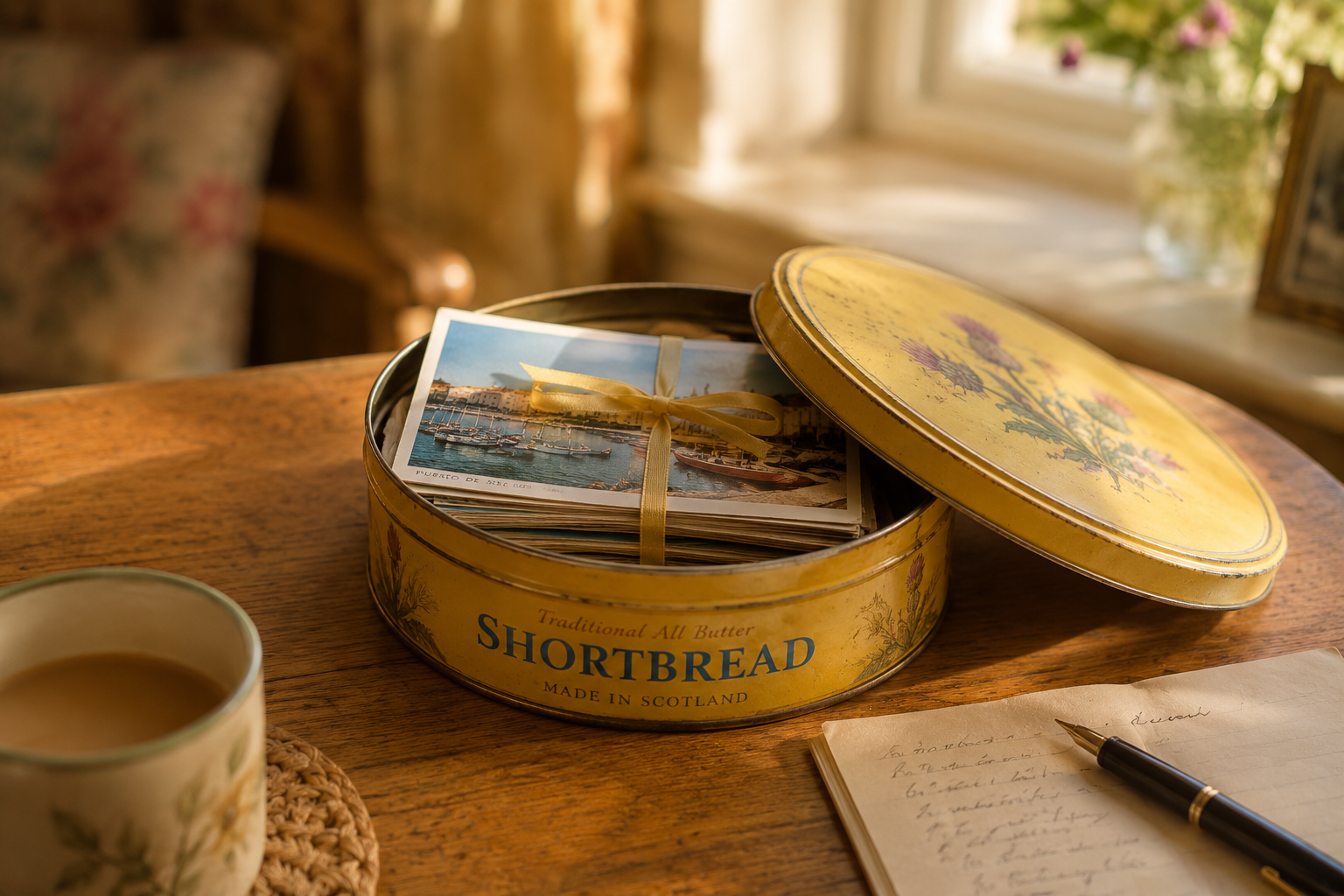
The biscuit tin lived in the hall cupboard beneath the stairs, tucked away behind a stack of board games that had not seen daylight in years and a jigsaw puzzle missing enough pieces to make its eventual completion an act of optimism rather than expectation.
Edith lifted it with both hands and carried it through to the kitchen table, where the afternoon sunlight had begun its slow migration across the worn oak surface. The tin itself had once contained shortbread, a Christmas gift from a neighbour long since moved away, but its original purpose had been forgotten decades ago. These days it housed something altogether stranger. For a moment, she simply rested her fingers on the lid.
There was no anticipation in the gesture, nor any sense of ceremony. If anything, the feeling was closer to greeting an old acquaintance unexpectedly encountered in the street. Familiarity had long ago worn away whatever mystery had once attached itself to the postcards, replacing it with something quieter and considerably more difficult to define.
She had been eighteen when the first one arrived.
Not on her birthday, as she had once briefly imagined, nor attached to any particular anniversary. It had simply appeared one August morning among the usual collection of bills and circulars, bearing a photograph of a harbour she did not recognise, a Spanish stamp and a message so brief she initially assumed part of it must be missing.
The fish was excellent.
Thomas
That was all.
No surname. No return address beyond the printed details of the card itself. No clue as to why a complete stranger had apparently felt compelled to share his lunch with a girl from Dorset he had never met.
She had shown it to nobody. Not because it seemed important, but because it seemed faintly ridiculous. The second postcard arrived the following August. By the third, curiosity had given way to expectation.
By the tenth, the postcards had become part of the shape of the year.
Looking back, Edith sometimes thought the true mystery was not that Thomas had continued sending them for six decades, but that she had continued accepting their arrival with so little examination. There had been opportunities, certainly. More than enough. Any reasonably determined person could probably have traced a pattern, followed a trail, perhaps even discovered who he was.
Yet she never had.
Partly because life possessed a remarkable talent for placing more urgent matters directly in front of less urgent ones.
There had been examinations to pass and jobs to begin. Marriage had arrived in its own good time, followed shortly afterwards by a mortgage, a leaking roof, two children, and all the countless small obligations that quietly assemble themselves into a life. Somewhere amidst school uniforms, Christmases, broken washing machines, family holidays, hospital appointments and Sunday roasts, August would arrive and another postcard would appear on the mat.
For reasons she had never entirely understood, she had never mentioned them to Peter.
The omission had not been deliberate, at least not initially. After the first few years it had simply begun to feel oddly difficult to introduce into conversation.
How exactly did one begin such a discussion?
By the way, darling, a stranger has been sending me postcards every August since I was eighteen.
The longer she remained silent, the stranger the explanation seemed to become.
And so the postcards remained hers.
Not a secret in the dramatic sense. There was no guilt attached to them, no betrayal, no hidden romance. They occupied a small private corner of her life, no larger than the biscuit tin in which they were stored, and over the years she came to think of them less as correspondence and more as markers.
Athens had arrived the year Charlotte married.
York during the winter Michael broke his arm falling from a tree.
Paris shortly before Peter's redundancy.
Prague the summer they finally replaced the kitchen.
The memories had become inseparable.
Sometimes she could not immediately recall a year, but she could remember the postcard that belonged to it. Edith smiled at the thought and finally lifted the lid. Inside, arranged in neat chronological order and tied with a frayed yellow ribbon, lay fifty-nine postcards and a silence where the sixtieth should have been.
For a few moments she simply looked at them.
The ribbon had once been bright, almost cheerful in colour, but six decades of sunlight and handling had reduced it to something softer and more subdued. Edith loosened the bow carefully and began laying the postcards out across the table, arranging them in no particular order beyond the chronology they had always occupied within the tin.
The earliest cards had acquired the sort of wear that comes only from repeated handling. Their corners had softened. The colours had faded slightly. One or two bore faint creases from having been carried about in handbags before eventually finding their way home again. Later cards remained crisper, their journeys shorter and their mysteries already familiar.
As she turned them over, she found herself noticing details she had long ago stopped paying attention to. A faded stamp from Ceylon. One from Yugoslavia. Another bearing the name West Germany. Small pieces of a world that had quietly rearranged itself while she had been occupied with the business of living.
The messages remained as brief as they had always been.
Pickpockets are not the problem; beware the pigeons
Thomas
Worth the climb.
Thomas
The Mona Lisa is a lot smaller than I expected.
Thomas
Edith laughed softly at that one. She remembered reading it while Charlotte, then barely six years old, had been attempting to cut her own fringe with a pair of nail scissors. The resulting rescue operation had occupied most of the afternoon and left both mother and daughter in tears, albeit for very different reasons.
Another card carried a photograph of York Minster beneath a lowering grey sky.
Excellent cathedral.
Questionable weather.
Thomas
Michael had broken his arm that year. Not seriously, although it had seemed serious enough at the time. She could still remember the smell of the hospital waiting room and Peter's insistence that everything would be fine despite looking considerably more worried than she was.
One by one the years unfolded around her.
A postcard from Athens—worth the climb— arrived carrying memories of Charlotte's wedding.
Prague belonged forever to the year Peter's redundancy had unexpectedly become the beginning of something better.
Venice recalled a family holiday that nearly ended in disaster after Michael managed to lose both his passport and his shoes within the same afternoon.
It occurred to Edith, as the afternoon slowly lengthened around her, that the cards told her so little about Thomas, and yet, so much about herself. For sixty years, she had assumed the postcards were preserving fragments of another person's life. Looking at them now, spread across the table like stepping stones through time, she realised they had been quietly recording her own.
The thought stayed with her throughout the remainder of the day.
When evening came she gathered the cards together, retied the ribbon and returned the tin to its accustomed place beneath the stairs. Yet the feeling lingered. For the first time in many years, she found herself wondering not where Thomas might be, but where he had gone.
September arrived without a postcard.
October followed.
By the time the first autumn storms began rattling the windows, Edith had accepted what she had been reluctant to admit even to herself.
The postcards had stopped.
She stood for a long while at the kitchen window one wet November afternoon, watching rain drift across the garden and collect in shining beads upon the greenhouse roof. On the table behind her lay an open travel brochure that had arrived with the morning post and would ordinarily have gone straight into the recycling bin.
Instead, she found herself turning back towards it. A photograph of Athens occupied the centre spread. The Acropolis stood beneath a sky of impossible blue. Edith looked at it for a long time before smiling.
Apparently, one day had finally arrived.
The brochure remained on the table for three days.
Not because Edith was undecided. The decision, she suspected, had already been made somewhere beneath conscious thought. What occupied her instead were the practical considerations that invariably accompanied any undertaking of significance. Travel insurance required investigation. Suitcases needed locating. Passports to renew. Somewhere in the loft lurked an assortment of adapters accumulated during family holidays and subsequently forgotten.
By the end of the week, she had booked a flight.
The act itself felt surprisingly unremarkable. No fanfare accompanied the confirmation email. No sudden rush of excitement. One moment, she had been comparing departure times and hotel reviews; the next, she was the owner of a ticket to Spain departing in January.
When Charlotte telephoned on Sunday evening, Edith mentioned it in the same tone she might have used to discuss replacing a kettle.
There was a brief silence.
"Spain?"
"That's generally where people go when they book flights to Spain."
"Mum."
Edith smiled into her tea.
"What?"
"You've never just decided to go to Spain."
"No," Edith agreed. "Apparently, I have now."
The conversation resurfaced three days later when Charlotte relayed the news to her brother.
"Mum's booked a holiday."
Michael looked up from the newspaper.
"Good."
"That's all you've got to say?"
"What would you like me to say?"
Charlotte sighed.
"She's nearly seventy-nine."
"She's seventy-eight."
"Not helping."
Michael folded the newspaper.
"Charlotte, Mum spent forty years putting everyone else first, then another six looking after Dad. If she wants to spend January sitting in the Spanish sunshine eating olives and judging foreign architecture, I think she's earned the right."
The following month found Edith seated beside an aeroplane window, watching England disappear beneath a blanket of cloud.
She had travelled abroad before, of course. Family holidays. Occasional city breaks. Once, many years earlier, a coach tour of Italy that Peter had spent almost entirely comparing unfavourably to Dorset.
This felt different. For the first time in her life she was travelling for no reason beyond curiosity.
The harbour proved remarkably easy to find. Its name had been printed on the reverse of the postcard all along in small, easily overlooked lettering. Edith wondered whether eighteen-year-old Edith had ever imagined she might one day stand there herself.
The answer was almost certainly no.
The sea possessed the impossible blue peculiar to postcards and holiday brochures, as though determined to justify decades of exaggeration. Fishing boats bobbed gently against the quay. Elderly men occupied shaded benches and conducted conversations that appeared to require neither urgency nor conclusion.
Edith sat at a small café overlooking the water and ordered tea and a pastry.
For a long while, she simply watched.
Nothing happened.
No mysterious revelation presented itself. No clue emerged regarding Thomas's identity. Nobody recognised his photograph because she had no photograph to show. The harbour carried no memory of a stranger who had passed through sixty years earlier.
And yet she found herself unexpectedly content. The place existed. That was enough. Somewhere near this harbour, a young man had once purchased a postcard, affixed a stamp, written a single sentence and posted it to a girl in Dorset.
Sixty years later, she had finally arrived. As the winter sun settled lower across the bay, Edith raised her cup slightly towards the water.
"Well," she said softly.
"That took longer than expected."
Athens followed in the spring.
The climb proved every bit as demanding as Thomas had implied and considerably more demanding than Edith had hoped. By the time she reached the summit, she had consumed two bottles of water, accepted encouragement from three separate strangers, and seriously considered abandoning the enterprise on no fewer than four occasions.
Yet when she finally emerged onto the sunlit plateau, the Parthenon standing magnificent before her, and looked out across the city towards the distant sea, she found herself smiling.
The view was magnificent. The heat was unforgiving. The stone beneath her feet had witnessed more history than she could comfortably comprehend. And Thomas, she reluctantly admitted, had been right.
Worth the climb.
The postcard she later sent Charlotte showed little more than blue sky, ancient columns and an alarming quantity of sunshine. The message on the back just three words.
‘Worth the climb.’
Charlotte fixed it to the refrigerator.
The journeys accumulated gradually after that.
A week in Prague became ten days in Florence. Florence led to Vienna. Vienna led to Dubrovnik. A river cruise appeared one spring, followed by Amsterdam, Bruges and a Greek island whose name Edith could never quite pronounce correctly despite spending twelve delightful days there.
The postcards that arrived at Charlotte's house became an ongoing source of amusement.
Vienna.
The cake was worth the walk.
Mum.
Amsterdam.
The bicycles are organised chaos.
Mum.
Dubrovnik.
The sea appears to be showing off.
Mum.
Somewhere along the way travel ceased to be something Edith was trying and became something Edith simply did. Guidebooks replaced gardening catalogues on the shelves beside her chair. New photographs appeared throughout the house. Her passport, dormant for decades, acquired a satisfying thickness. The grandchildren began treating her departures with the same casual acceptance once reserved for school holidays.
"Where's Nana this week?"
"Croatia."
"Oh."
The answer seemed entirely reasonable. Even Charlotte's concern gradually softened into affectionate resignation.
"She's booked another one."
Michael would nod.
"Good for her."
The years passed.
Edith turned eighty. Then eighty-one. Then eighty-two, the journeys continued.
Some she remembered vividly. Others merged together in pleasant fragments of sunshine, railway stations, unfamiliar languages and unexpectedly excellent coffee. What remained constant was the feeling that had first taken hold beside a Spanish harbour.
She was not searching for Thomas.
She never had been.
She was simply following the road he had pointed towards.
By the time she reached eighty-four, neither of her children found it remarkable that she might disappear for a fortnight with little more than a suitcase, a guidebook and a carefully planned itinerary. The woman who had once spent decades placing her own desires at the bottom of every list had quietly become someone else.
Or perhaps, Charlotte later reflected, she had finally become herself.
In the summer of her eighty-fourth year, Edith returned from a fortnight in Portugal carrying a slight tan, several hundred photographs and a determination to learn enough Portuguese to order coffee without accidentally requesting furniture.
She died peacefully in her sleep three weeks later.
The date happened to fall in August.
The house remained untouched for several months.
Not entirely untouched, of course. Immediate necessities were dealt with. Clothes were sorted. Paperwork organised. The garden received enough attention to prevent it declaring independence. Yet the larger task of dismantling a life proved surprisingly easy to postpone.
Eventually, sometime after Christmas, Charlotte found herself standing in the hall cupboard beneath the stairs. She had been looking for a missing set of keys. The biscuit tin appeared entirely by accident.
It sat exactly where Edith had left it, tucked behind old board games and a jigsaw puzzle whose missing pieces had become something of a family joke. Charlotte carried it through to the kitchen table.
The yellow ribbon caught her attention first.
Then the postcards.
By the time Michael arrived that afternoon, she had read nearly half of them.
"What have you got there?"
Charlotte looked up.
"I'm not entirely sure."
He pulled out a chair.
Together they read.
Spain.
Prague.
Athens.
York.
Venice.
Paris.
Sixty years of brief observations, faded stamps and a signature neither of them recognised. The postcards revealed almost nothing. A meal enjoyed somewhere beside a harbour. A queue endured in a museum. A train missed. A view admired.
The fragments stubbornly refused to become a person. Yet as the afternoon faded into evening, both found themselves trying.
"Who do you think he was?" Charlotte asked eventually.
Michael considered the question.
"I don't know."
He turned over another postcard.
The handwriting had remained remarkably consistent across six decades.
"So why did she keep them?"
Charlotte looked around the kitchen. At the photographs. The worn chair beside the window. The garden visible through the glass. All the familiar pieces of a life they had believed they understood.
Then she thought of the holidays. The guidebooks. The sudden journeys. The postcards Edith herself had begun sending during her final years. Slowly, the obvious question arose.
"Who do you think he was?"
Michael shrugged.
"Does it matter?"
Charlotte started to answer, then stopped. Looking back across the previous six years, she found herself surprisingly unsure. Because Thomas had sent the postcards.
But the journeys belonged to Edith.
Outside, evening settled gently across the garden. Somewhere beyond the window, a blackbird landed beside the birdbath and regarded the world with mild suspicion.
Charlotte gathered the postcards into a neat stack and retied the faded ribbon.
There were still questions, of course. Who had Thomas been to Edith? Why had he started sending the cards? Why had he stopped?
Those answers were gone now, and perhaps they always had been. Yet as she slid the ribbon into its knot, she found she no longer minded.
The mystery had never belonged to Thomas.
It had belonged to Edith. And for the first time in her life, Charlotte realised how much of her mother had remained undiscovered.
She carried the tin to the sitting room and placed it beside the photographs they had decided to keep. Then she stood for a moment looking at them all together.
The postcards.
The journeys.
The smiling woman in the pictures, taken during her final years. A life well lived. And, right at the end of it, a few unexpected adventures.
For reasons she could not entirely explain, the thought made her very happy.
The following August, Charlotte booked a holiday to Athens.
Nobody ever discovered who Thomas was.
7/28/2026
The Words That Got to Me
At seventy-eight, she had developed a healthy appreciation for moderate weather and moderate expectations. Both, she had discovered, were far more reliable than enthusiasm. This painted a picture of a woman settling for less than she deserved and grabbed my attention straight away.
This actually gave me a sense of hope - perhaps my travelling days are in front of me still! I loved the quiet, unsolved mystery of the postcard writer and Edith's late blooming int a world explorer. A gentle, realistic and warming story.