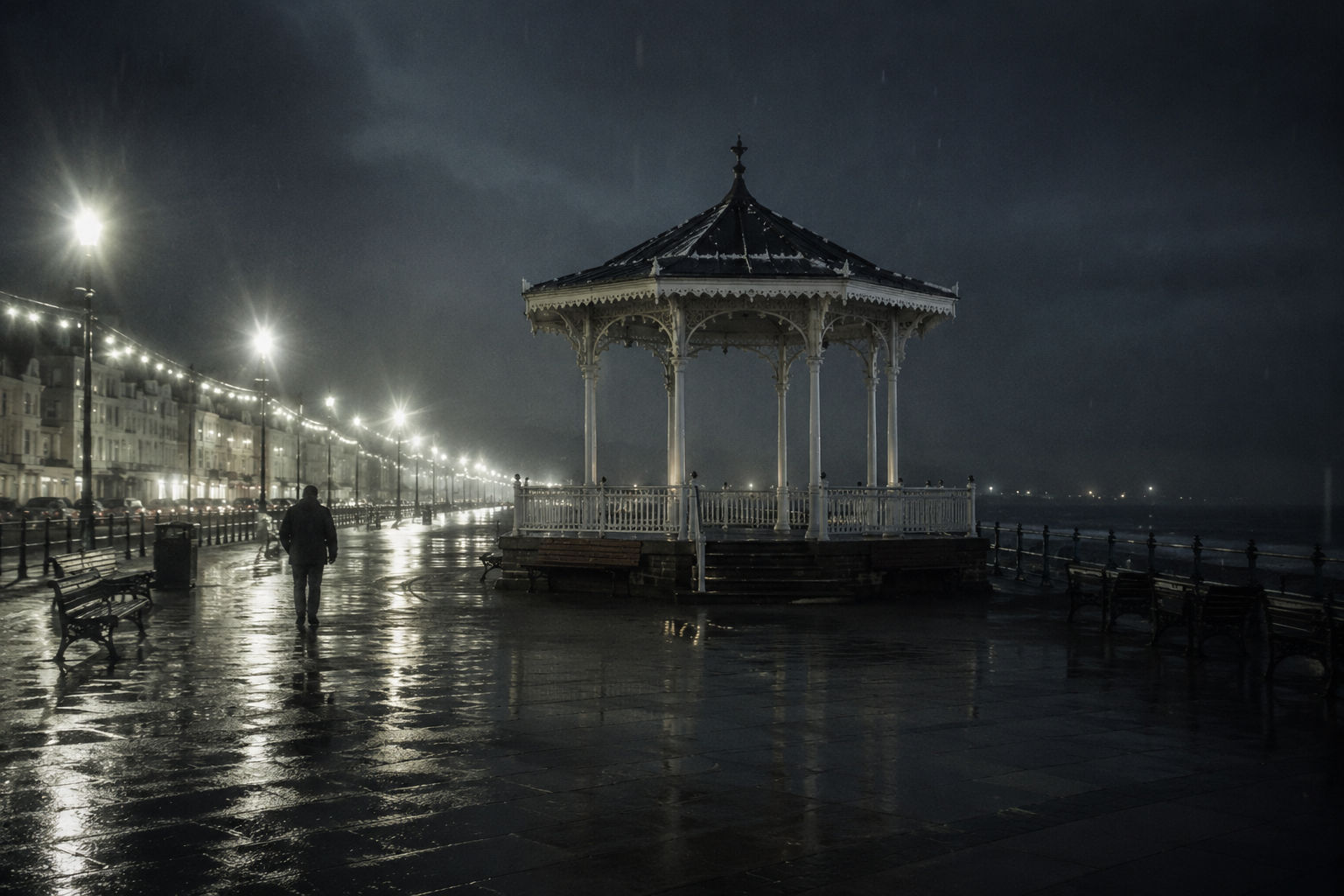
There are things that stay with a person long after they ought to have faded. Not dramatic things necessarily. Sometimes only a sentence overheard at the wrong time, or a promise made before you properly understand what is being asked of you.
At twenty-three, I still thought promises belonged mainly to the moment. You made them because somebody needed reassuring, or because silence would have looked cruel. Afterwards, life carried on around them. People finished their drinks. Somebody put the kettle back on. By the next morning, the whole business already seemed smaller.
I came to Eastbourne in October of 1978 and spent the first few weeks convinced I would hate it permanently.
The town smelt faintly of damp carpet and seaweed. Even on brighter days, there was something tired about it, as though the place had once made a great effort to be fashionable and had never quite recovered from the disappointment. Along the front, the hotels stood in pale terraces facing the Channel with a sort of stubborn dignity. Some had flaking paint around the windows. Others displayed plastic signs promising HOT BREAKFAST and COLOUR TELEVISION as if these were luxuries no sensible person could refuse.
I had a room in a boarding house just off Cavendish Place. The wallpaper was patterned with thin gold lines that never quite met properly at the corners, and the wardrobe smelled of lavender water and old dust. The landlady, Mrs Hargreaves, lived downstairs among heavy furniture and framed photographs of relatives I never saw in person. Twice a week, she cooked liver with onions, and the smell climbed patiently through the building.
I told everyone I was staying for a year at most.
Sometimes I said six months.
The truth was, I had no idea what I was doing. A friend of my mother’s had heard of a vacancy with a solicitor near the station, and three weeks after leaving Croydon, I found myself typing wills for strangers and carrying files between rooms that always seemed overheated no matter the weather outside.
It was not unpleasant work. There is comfort, I think, in being useful in small, predictable ways. I learned which clients liked to be fussed over and which preferred efficiency. I learned how to remove a paper jam from the photocopier by striking the side panel with the flat of my hand. By Christmas, I could recognise most of the regular callers from the sound of their footsteps in the corridor before they even reached reception.
At that age, I mistook competence for direction.
After work, I usually walked. Partly to save money, partly because the boarding house felt airless in the evenings with the television muttering downstairs. I would go down Terminus Road towards the seafront, hands buried in my coat pockets once the weather turned colder. Eastbourne in winter had a strange half-occupied feeling to it. The summer crowds disappeared, and the town seemed to fold in on itself. Café windows steamed up early. The amusement arcades closed before dark. Elderly couples sat in wool coats facing the sea with the concentration of people listening for distant instructions.
I remember the bandstand mostly because I failed to notice it properly at first.
It stood there on the promenade as though it belonged to another century entirely, all decorative ironwork and faded importance. In summer there were concerts sometimes. Brass bands mainly, or singers entertaining coach parties. But through that first winter, it became less a place for music than somewhere people gathered out of habit. Women with shopping trolleys. Men in caps drinking tea from flasks. Small groups who seemed to have been meeting in the same place for years.
One old woman was there almost every afternoon.
At least I think she was. Memory compresses things oddly after enough time has passed. Still, I can picture her clearly enough even now: a narrow face, neat grey hair pinned back from the wind, gloves regardless of weather. She carried a tartan flask and sat with the patience of somebody who no longer expected days to provide surprises.
Back then, I found it depressing.
That embarrasses me slightly now, though perhaps it shouldn’t. The young are often frightened by routines they cannot yet imagine themselves inhabiting. I would pass the bandstand and think of all those people sitting quietly beside the sea waiting for something unspecified to end.
Years later, I understood there are worse ways to spend an afternoon.
Martin visited near the end of November.
He arrived without warning on a Saturday evening while I was eating beans on toast from a tray balanced across my knees. Mrs Hargreaves shouted up the stairs that there was “a gentleman asking after me”, in a tone suggesting she found this unlikely.
Martin filled the doorway with cold air and cigarette smoke.
“You look dreadful,” he said cheerfully.
“You could have written.”
“And miss the expression on your face?”
He had not changed much since school. Perhaps that was what struck me first. The same quick grin, the same untidy dark hair falling forward whenever he laughed. People forgave Martin for things almost immediately after meeting him. Sometimes before.
We went to a pub near the pier where the carpet stuck slightly underfoot and a jukebox played songs already beginning to sound dated. Martin talked for most of the evening. About people from school. About a girl in Tooting, he claimed to be in love with. About some disastrous temporary job involving frozen chickens.
I remember thinking how relieved I was to hear a familiar voice in the middle of all that Eastbourne quiet.
Before midnight, he said he might come back the following week.
“Work?” I asked.
“Something like that.”
“What does that mean?”
“You’ll see.”
He smiled when he said it, but not properly. There was something distracted underneath the performance, though I only recognised it afterwards.
That is the difficulty with memory. Important moments rarely announce themselves at the time. They arrive looking very much like ordinary evenings. A few drinks, bad music, rain beginning outside.
Then years pass, and you realise your life divided itself there without bothering to inform you.
Martin came back the following Thursday.
All afternoon the weather had hung undecided between rain and fog. By five o’clock the sea had vanished almost entirely behind a grey whiteness that drifted inland in slow uneven breaths. The office windows misted over from the inside. Somewhere in the building a radio played quietly through static.
I remember very little work being done.
Mr Fielding spent most of the afternoon revising the same letter and eventually went home irritated with everybody. By half past five I was alone in reception straightening files I had already straightened once before when I saw Martin standing across the road beneath the weak glow of a pharmacy sign.
He did not wave.
Something in me tightened then, though I could not have explained why.
Outside, the air smelt of wet pavement and salt. Martin looked exhausted. Not dramatically so. Nothing theatrical. Just diminished somehow, as if he had been sleeping badly for weeks.
“You alright?” I asked.
“Fine.”
“You don’t look it.”
“That’s encouraging.”
Normally he would have smiled after a remark like that, or nudged my shoulder, or turned things into a joke before seriousness had the chance to settle properly between us. Instead, he glanced up the road towards the station.
“Walk with me a bit.”
We headed down towards the seafront without much conversation. Traffic hissed through the damp streets behind us. A woman struggled with an umbrella outside Woolworths while her husband stood uselessly beside her holding shopping bags. Martin lit a cigarette, then let it burn unsmoked between his fingers until the rain put it out.
“You’re quiet,” I said eventually.
“Tired.”
“From what?”
“Life, apparently.”
The answer should have sounded flippant but didn’t.
At the promenade the wind sharpened suddenly. The sea was still mostly hidden, though now and then darker movement showed through the mist beyond the railings. The lamps along the front seemed suspended in empty space.
The bandstand sat almost deserted apart from two old men drinking tea from a flask under the shelter of the roof. One of them coughed steadily into a handkerchief while the other stared out towards the water with complete concentration.
Martin leaned against the railing.
For a while neither of us spoke.
I remember noticing absurd things. A crisp packet snagged beneath one of the benches. The squeal of bus brakes further up the road. Water dripping rhythmically from the edge of the bandstand roof. At twenty-three you still imagine important conversations will feel important while they are happening. You expect some alteration in the atmosphere, some acknowledgement from the world outside yourself.
Mostly there is just weather.
“You remember Danny Mercer?” Martin said eventually.
The name meant nothing at first.
“From school,” he added. “Tall bloke. Used to nick calculators.”
“Oh. Him.”
Martin nodded once, still looking towards the sea.
“I ran into him a few months back.”
There was a pause then. Not a meaningful one exactly. More as though he had expected the sentence to continue itself and was surprised when it didn’t.
“What happened?” I asked.
“Nothing happened.”
But his voice had changed slightly.
I knew Martin well enough by then to recognise when he was approaching something sideways. He always circled difficult subjects first, as if testing whether they could safely be touched.
“He got himself mixed up in some things,” Martin said.
“What sort of things?”
Another shrug.
“Doesn’t matter.”
A gust of rain blew beneath the bandstand roof. One of the old men muttered something irritated and both gathered their things to leave. Their footsteps faded slowly along the promenade until only the sea remained.
Martin rubbed his hands together hard, more from nerves than cold.
“I need you to do me a favour.”
“Depends, what it is.”
“I’m serious.”
“I know.”
“No, I mean properly serious.”
That was the first moment I felt genuinely afraid, though even then I could not have said of what. Until then the evening had retained the shape of ordinary unhappiness. A debt perhaps. Trouble with a woman. Some fight in a pub gone wrong. The usual small disasters of young men who mistake recklessness for momentum.
But there was something else in his face now. Not panic exactly. Panic is quicker. This looked heavier than that.
“You can tell me,” I said.
Martin laughed once under his breath.
“That’s exactly the problem.”
He pushed himself away from the railing and began walking again, slowly this time. I fell into step beside him.
What I remember most clearly is his voice. Not the words themselves, not anymore. Only the effort it seemed to cost him to keep speaking steadily. Twice he stopped altogether. Once to light another cigarette, though the wind took the flame three times before it held.
We walked almost to the pier before he finally told me.
Or began to.
Even now I could not honestly say where the thing itself started. There were names first, fragments of explanation, people I had never met and places I barely knew. Then silence. Then Martin speaking again more quickly than before, as though once begun he no longer trusted himself to stop.
At some point he caught hold of my sleeve.
“If anybody asks you,” he said, “you don’t know anything about it. You understand?”
The sea crashed hollowly beneath the pier supports.
“I mean it.”
“I understand.”
“No matter who.”
“You’re frightening me now.”
“That makes two of us.”
Afterwards we stood for a while without speaking. Rain moved in silver lines through the glow of the lamps. Somewhere behind us music drifted faintly from an arcade preparing to close for the night.
I remember wanting very badly to go home.
Not because of what Martin had told me. Not entirely. It was more the feeling that something had altered quietly and could no longer be put back where it had been before. Until that evening my life had still seemed provisional. A year in Eastbourne. Maybe two. Temporary work, temporary room, temporary friendships.
Standing there beside Martin with the wet wind coming in off the Channel, I had the first brief sense of becoming fixed to something I did not yet understand.
Before we parted, he made me promise again.
Not dramatically. No handshake. No solemn ceremony.
Just a tired look across the pavement outside my boarding house.
“You won’t say anything?”
“No.”
“You swear?”
“Yes.”
He nodded once.
Then he went away down the street carrying more of my future with him than either of us realised.
For the first few days afterwards, I convinced myself the whole thing would resolve on its own.
That was the phrase I used then. Resolve itself. As though events possessed some natural tendency towards tidiness if left alone long enough.
Martin phoned once the following week from a call box somewhere I could not identify. The line crackled badly. I remember traffic noise and a siren in the distance.
“You haven’t said anything?”
“No.”
“Good.”
Then, after a pause:
“If anyone asks, you haven’t seen me for months.”
“I thought you said nobody would.”
“I’m just saying.”
The call ended abruptly after that. No goodbye.
For several days I found myself expecting another call. I began noticing telephone boxes in a way I never had before. How isolated they looked at night with their fogged glass and weak interior light. Sometimes walking back from work I would glance automatically towards them, half expecting to see Martin inside with one hand pressed against the receiver.
Nothing happened.
That was the strange part.
Nobody arrived asking questions. No police officers appeared at the solicitors. No mysterious strangers followed me through Eastbourne in the rain. Life retained its same small routines with almost insulting determination.
Mrs Hargreaves continued overcooking vegetables downstairs. Mr Fielding complained about paperclips disappearing from his desk. The old woman at the bandstand sat through most afternoons with her flask balanced carefully beside her gloved hands while gulls wheeled above the promenade making sounds like rusty hinges.
And yet something had altered.
Only in me, perhaps.
I became aware, gradually, of hesitation entering ordinary conversations.
Not visibly. Nobody would have noticed. But whenever Martin’s name arose — and for a while it did, casually, among old friends phoning from Croydon or people mentioning they had seen someone who knew someone — I felt a brief tightening somewhere inside myself before answering.
It is exhausting, I discovered, measuring every response before you give it.
Not because lying is difficult. In most situations it isn’t. The difficulty lies in maintaining a version of yourself that never slips accidentally into honesty.
At Christmas my mother asked whether Martin was still “gallivanting about somewhere” and I heard myself say, with surprising ease, that I had not seen him in months.
Afterwards I sat awake half the night disturbed less by the lie itself than by how naturally it had arrived.
That frightened me.
There is a particular kind of loneliness attached to holding information you cannot discuss. Not dramatic loneliness. Nothing so poetic. More an increasing sense of standing slightly apart from other people even while participating normally in life around them.
I still went to work each morning. Still drank too much on Fridays with colleagues I disliked only mildly. Once, during a wet February that seemed never to brighten properly into day, I spent three weeks seeing a nurse from Hastings who laughed with her entire body and owned a ginger cat called Wellington. We ate in cheap restaurants overlooking the sea and went to the cinema twice.
I nearly told her once.
Not the thing itself. Just that there was something.
We were lying awake after midnight listening to rain ticking softly against the windows of her flat. She had fallen half asleep against my shoulder when she said, very quietly:
“You always seem to be somewhere else.”
I remember the exact shape of the streetlamp light across the ceiling.
For a moment I considered speaking. The urge came less from trust than fatigue. I had begun to understand by then that secrecy is not silence but maintenance. Constant, low-level maintenance. Like tending a boiler in the basement of your life.
Instead, I kissed the top of her head and said I was only tired.
She moved back to Brighton that spring. We exchanged two letters afterwards and then stopped.
Years later I realised I had already begun arranging my life around containment.
Not consciously. That would have been easier to resist. It happened through a series of small refusals and postponements that seemed sensible at the time.
I turned down a better position in London because leaving Eastbourne suddenly felt dangerous, though I could not have articulated why. I avoided close friendships with people inclined towards personal questions. When Mrs Hargreaves died in 1982 and her boarding house was sold to developers, I took a small flat near Meads rather than move somewhere larger and less anonymous.
By then the routines of the town had entered me completely.
Morning buses crawling through sea fog. Pensioners queuing outside bakeries before opening time. Winter Sundays when the promenade stood almost empty apart from dog walkers and elderly couples moving slowly against the wind.
The bandstand remained oddly central to my life despite my rarely stopping there. I passed it continually. On the way to work, on walks after dark, returning from the station carrying shopping or newspapers tucked under my arm.
The old woman with the flask disappeared at some point during the mid-eighties.
Not dramatically. One winter I simply realised I had not seen her for several weeks. Afterwards the bench she used remained strangely noticeable to me for months, as though absence itself could leave a physical outline behind.
Around the same time, I began locking things away.
Nothing important in practical terms. Receipts mostly. Old letters. Martin’s postcard. Occasionally I would write down fragments of memory connected to that night — names, impressions, details I worried might fade — then seal the paper inside envelopes and place them in the bottom drawer of a cabinet I hardly opened otherwise.
I told myself this was precaution.
Against what, I could not have said.
The truth was more uncomfortable.
The secret had begun, quietly, to outlive its original shape. I no longer knew whether I was preserving it because it mattered, or because I had spent too long becoming somebody who preserved things.
“By 2003, the town looked brighter than I remembered from my first years there, though perhaps that was only because so many of the people from that time had disappeared. Even the promenade looked cleaner somehow, less weathered, though perhaps that was only because so many of the people I associated with the older town had died by then.
I was forty-eight years old and still living alone.
Not unhappily, at least not in any dramatic sense. Unhappiness suggests momentum. My life had settled instead into something flatter and more difficult to describe. I worked now in the records department at the council offices, having left the solicitors years earlier after Mr Fielding retired and the firm merged with a larger practice from Brighton. The work suited me. Old documents. Quiet rooms. Requests arriving in careful handwriting from people tracing boundaries or relatives or ownership disputes long since drained of emotion for everybody except themselves.
Some evenings, I still walked along the front after work.
The bandstand had been restored a few years earlier. Fresh paint. Summer concerts again. Brass bands playing to rows of pensioners eating ice creams in folding chairs while children ran circles around them shrieking into the wind. Occasionally, I stopped for tea from the kiosk nearby and sat watching the sea darken by degrees.
It was during one of those evenings in September that I saw Martin again.
At first, I only recognised the movement of him.
He was crossing the promenade ahead of me with the same quick forward lean I remembered from school, though broader now through the shoulders and greying heavily at the temples. Beside him walked a woman in a pale coat carrying sandals in one hand, and between them a girl of perhaps twelve or thirteen was complaining loudly about something to do with chips.
Martin laughed.
Not politely. Fully. Head tilted back into the sea air.
I stopped walking.
For a strange, suspended moment, I felt not shock exactly but dislocation, as though two different versions of time had collided awkwardly in front of me.
Then he turned and saw me.
There was the brief uncertainty people get when recognising somebody unexpectedly after many years. A narrowing of the eyes. Calculation. Then sudden certainty.
“Jesus Christ,” he said.
He came towards me, grinning.
“Look at you.”
We shook hands and then, awkwardly, embraced for half a second in the manner of men uncertain whether enough time had passed to justify it.
“You still here?” he said.
The question should not have stung as much as it did.
“I could ask you the same.”
“Oh no, we’re only down for the weekend.”
He turned immediately towards the others.
“This is my wife, Helen. And Sophie.”
The girl gave me the flat, suspicious look adolescents reserve for adults they have no intention of remembering.
“An old friend,” Martin told them.
His wife smiled politely. There was ease about her. The sort produced by long happiness or long security. Probably both.
We stood talking for several minutes while evening gathered slowly across the promenade. Martin worked in insurance now, somewhere near Reading. Good money, apparently. Detached house. Two children, though the older boy was at university and “too cool” for seaside weekends with his parents.
As he spoke, I became aware of how little there was to say in return about myself.
No wife.
No children.
No particular successes.
Only years.
I mentioned the council archives and watched Martin try courteously to make this sound interesting.
“And you stayed all this time,” he said eventually, looking around towards the sea.
“Looks that way.”
“Bloody hell.”
He said it affectionately, but I felt suddenly defensive, though against what I wasn’t sure.
His daughter had wandered ahead towards the railings. Helen followed after a moment, leaving the two of us standing near the bandstand with the sound of gulls overhead and music drifting faintly from somewhere further along the promenade.
For the first time since seeing him, silence settled properly between us.
Martin glanced towards the sea.
“You look well,” he said.
It was the kind of lie middle-aged people tell one another automatically.
“So do you.”
“I’ve put weight on.”
“We all have.”
He laughed again.
Then, before I had fully decided to speak, I heard myself say:
“I never told anyone.”
The sentence seemed to enter the air between us and remain there.
Martin frowned slightly.
“What?”
I almost lost my nerve then.
About what?
I could still have said.
About anything.
Instead, I held his gaze.
“That night,” I said quietly. “I never said anything to anyone.”
For a moment, he simply stared at me.
Then recognition arrived. Not dramatically. Just a small adjustment in his expression, like somebody finally remembering where they knew a face from.
“Oh Christ,” he said.
And then, unexpectedly, he laughed.
Not cruelly. More from surprise than amusement.
“I forgot all about that.”
Something inside me seemed to loosen and hollow at the same time.
Martin looked out towards the sea for a second.
“God,” he said quietly. “That was years ago.”
Behind us, his daughter shouted something about vinegar.
Martin turned halfway towards the sound, distracted already.
“Anyway,” he said, “do you remember Claire Withers? The one Mr Jennings was obsessed with.”
As we walked towards his wife and daughter waiting further along the promenade.