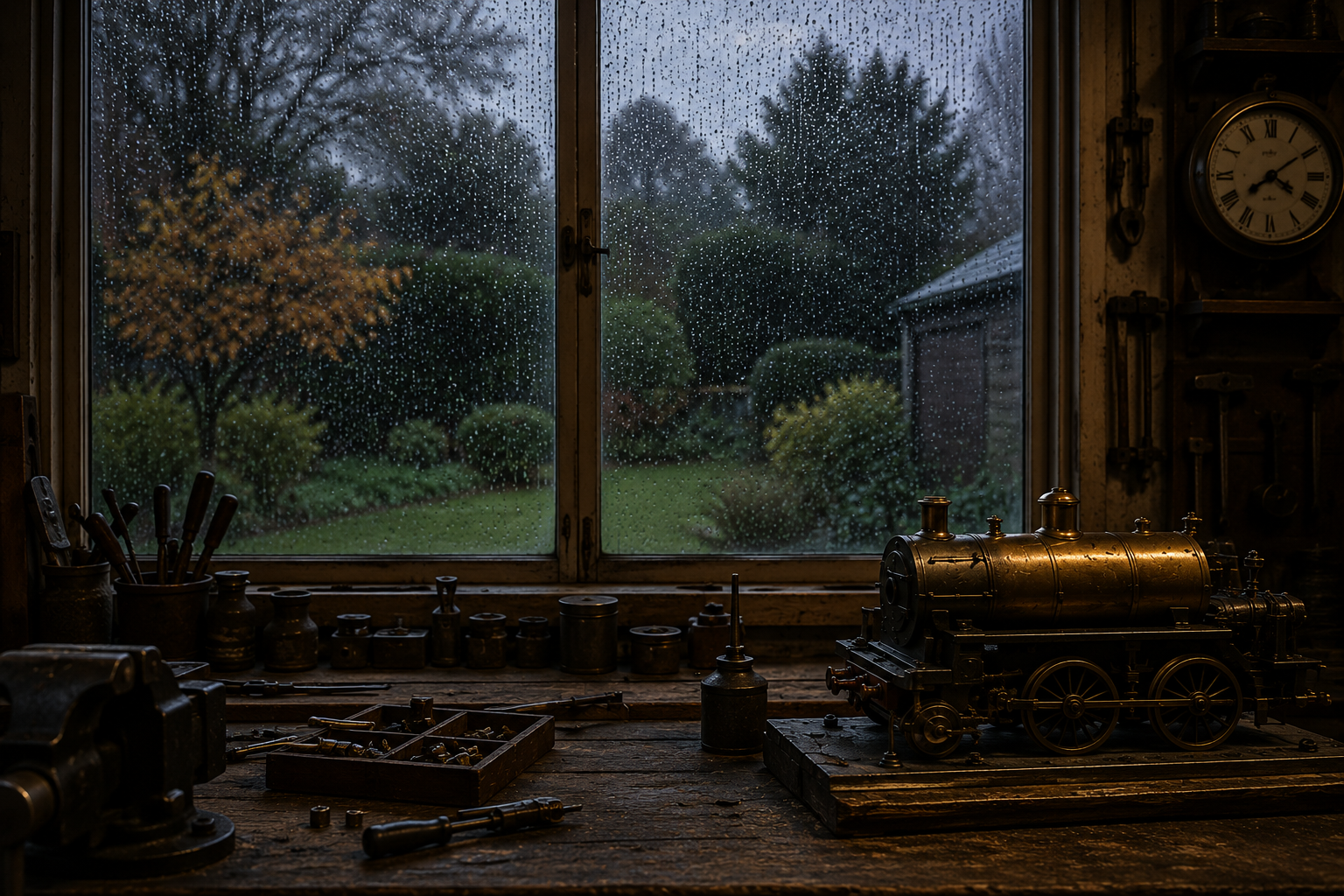
The model steam engine had been sitting on the workbench for four years.
Thomas Avery knew this because he had written the date on the underside of the wooden base when he first began building it. He had always done that with his projects. The habit had started when he was twenty-three and convinced he would eventually run out of ideas worth pursuing.
The irony was not lost on him as he reached out and brushed a finger across the miniature brass boiler. A faint line appeared in the dust.
Not too much dust, he thought, a week perhaps, maybe two. But enough to suggest neglect, but not abandonment. The engine told the story of how most things were these days. It wasn't as though he couldn't finish it. The skills hadn't deserted him, nor had time become some rare and precious commodity. Retirement had provided more free afternoons than he'd ever possessed while working. Yet somehow the engine remained exactly where it was.
The parts sat exactly where he had left them. The connecting rods nested neatly in their tray. The tiny painted wheels waited patiently beside the chassis. Given a free afternoon, he could probably complete the whole thing before dinner.
Yet the days slipped past all the same. Tomorrow became the weekend. The weekend led to next week. Before long, another month had gone..
If the weather improved or when he felt more in the mood. Excuses accumulated while the engine remained unchanged, and outside, rain whispered against the workshop window.
Thomas stood listening to it.
He looked around. A partially restored clock occupied one shelf. An oak cabinet stood against the far wall awaiting its final coat of varnish. Nearby, a stack of books promised instruction in half a dozen skills he had fully intended to learn.
None of them were failures. He had never made the decision consciously to abandon them. They had simply drifted into stillness. Like boats whose owners kept meaning to untie the ropes.
Thomas turned away from the workbench and crossed to the window.
Rain blurred the garden beyond into soft smudges of green and grey. The oak tree at the bottom of the lawn had already begun surrendering its leaves. A few clung stubbornly to the branches, but most lay plastered across the grass where they would remain until he found the motivation to rake them together.
The thought made him smile, though there was little humour in it. Was it really that time of year again? He thought. He had intended to rake them up last year as well. So many plans, so little actually accomplished. He could no longer remember when the small delays had started accumulating. A day postponed here. A week there. Nothing significant in isolation. The sort of thing everyone did.
The trouble was that they no longer seemed isolated. Each delay appeared to leave behind another. Tiny drifts of unfinished intentions accumulating year after year until they formed something substantial enough to notice.
Perhaps this was his life now, or at least the shadow of what it had once been. Behind him, the workshop clock on the wall ticked quietly. He glanced at it. Unlike most of the projects in the room, the clock actually worked. He had restored it almost fifteen years earlier. The brass pendulum swung steadily from side to side, measuring out the afternoon with patient indifference.
Time, it seemed, remained committed to doing its job regardless of whether anyone else did. The thought would have at one time, amused him. Now it just left him feeling a little sad and tired.
He switched off the workshop light and locked the door before trudging up the path to his house. The rain was easing as he covered the last few feet to the back door.
Inside, the familiar stillness greeted him. There was nothing unusual about the place. The furniture remained where it had always been. Family photographs occupied the mantelpiece. Books lined the shelves. A cardigan hung over the arm of the sofa exactly where he had left it the previous evening.
It was a good house, he had once imagined himself growing old in. Maybe that was exactly what he was doing.
The kettle boiled while Thomas stood at the kitchen window.
Outside, rainwater dripped steadily from the guttering. Somewhere in the garden a blackbird landed beneath the oak tree and began pecking through the fallen leaves. He watched it for several seconds before it flew off over the roof of the shed, long since converted into his workshop.
With a bit of a start, he realised he had no idea how long he had been standing there. The kettle had already switched itself off and started to cool. He poured water over the teabag anyway and carried the mug through to the sitting room.
A book lay face down on the arm of the chair. He picked it up automatically; the bookmark sat little more than twenty pages from the beginning.
Thomas frowned. That couldn't be right.
He opened the cover, the receipt from the bookshop remained tucked between the pages. Three years old.
He remembered buying it. Remembered reading the first chapter. Remembered thinking it looked interesting.
After that, nothing.
He glanced towards the shelves lining the far wall. Hundreds of books stared back. Some had accompanied him through half his life. Others had arrived more recently, purchased with genuine enthusiasm and every intention of being read.
An uncomfortable thought occurred to him. How many of them had suffered the same fate? He stood and crossed the room. The answer arrived more quickly than he would have liked.
Far too many.
Something tightened inside him as he realised something, a recognition of a pattern. The books, the engine, every other unfinished project. Damnit, even the bloody tree. Everything seemed connected.
Thomas lowered himself carefully back into his chair, tea forgotten and stewing on the table by his side. The room darkened as evening closed in, and eventually a thought arose. Simple, unwelcome, even a touch frightening, but impossible to dismiss.
Something had gone missing. Thomas knew without a doubt that somewhere, sometime, he had lost something important. More than an object, it wasn’t a memory or a person. It was something else and far harder to name. But without it, he was not the same Thomas he had always known.
And he had no idea how to find it.
Sleep did little to improve matters.
Thomas woke the following morning, hoping that the previous evening's melancholy would have faded into perspective. Instead, the feeling remained exactly where he had left it, waiting patiently for him the moment he opened his eyes.
The thought accompanied him through breakfast. It followed him into the shower. By the time he found himself standing in the supermarket debating between two brands of teabags, he was beginning to resent it.
Something had gone missing.
The phrase had become irritating in its persistence. He knew how absurd it sounded, yet every attempt to dismiss it only seemed to strengthen it. It sat at the back of his mind like a question he had almost remembered the answer to.
On Thursday, he mentioned it to Frank.
The two men had known each other for nearly twenty years, having first met through a local model engineering club that now consisted largely of retired men drinking tea and discussing projects they no longer had the eyesight to complete.
Frank listened without interruption as Thomas attempted to explain himself. It was not an easy thing to explain.
"You're depressed," Frank concluded.
Thomas shook his head.
"I don't think so."
"You sound depressed."
"That's because there isn't a word for what I actually mean."
Frank considered this.
"Midlife crisis?"
"I'm sixty-two."
"Late-life crisis, then."
Despite himself, Thomas laughed.
The conversation moved on, but the exchange lingered in his thoughts long afterwards. Three days later, he mentioned it again.
This time it was Margaret from number seventeen while they stood waiting for the post office to open. Margaret listened with surprising seriousness. When he had finished, she nodded slowly.
"I know exactly what you mean."
The answer startled him.
"You do?"
"Oh yes. Happened to my brother."
Thomas felt a sudden surge of interest.
"What was wrong with him?"
She shrugged.
"No idea. He found it eventually."
"Found what?"
"Whatever he'd lost."
The reply irritated him.
"Very helpful."
Margaret smiled.
"That's more or less what he said."
The queue began moving, and the conversation ended there. Really, it should have been forgotten. Instead, two days later, while sorting through a drawer full of old instruction manuals and expired warranties, Thomas found himself remembering the exchange.
Not the whole conversation. Just one sentence.
He found it eventually.
The words returned several times over the following week. By themselves, they meant very little. Yet somehow they refused to leave him alone.
The following Tuesday, he attended a community coffee morning at the church hall. Halfway through a discussion concerning rising electricity prices, failing knees and the declining standards of modern biscuits, the subject surfaced again.
This time he barely intended to mention it. The words simply escaped.
"I think I've lost something."
Several people nodded politely. An elderly woman sitting opposite him looked up from her tea. For a moment she appeared about to say something. Instead, she asked whether anybody wanted the last custard cream.
The conversation drifted elsewhere. Only as people began gathering their coats to leave did she approach him. She was small, silver-haired and walked with the aid of a carved wooden stick.
"You're not talking about keys or wallets, are you?" she asked quietly.
Thomas frowned.
"No."
The woman nodded as though this confirmed something.
"Thought not."
"What do you mean?"
She glanced around the hall before answering.
"When my husband lost his sense of humour, it took him nearly six months to realise it was gone."
Thomas blinked.
"I'm sorry?"
"He used to laugh all the time. Then one day he simply... stopped. Not overnight. Gradually. We didn't notice until we looked back." The woman adjusted her grip on the walking stick. "He found it again eventually."
There was that phrase once more. Thomas felt a curious sensation somewhere between annoyance and intrigue.
"How?"
The woman studied him for several seconds. Long enough for him to wonder if she had changed her mind. Then she smiled.
"It sounds ridiculous when you first hear it."
Thomas waited.
The woman leaned slightly closer.
"Have you ever heard of the Lost Property Office?"
Thomas found himself smiling despite the absurdity of the question.
"A lost property office?"
The old woman nodded.
"Not the sort that deals with umbrellas and train tickets."
"Of course not."
"I did warn you it would sound ridiculous."
She seemed entirely unoffended by his scepticism. In fact, she looked faintly amused by it. The church hall had almost emptied around them. Somewhere at the far end of the room, somebody was stacking chairs. The smell of tea and stale biscuits lingered in the air.
Thomas shifted his coat over his arm. "And this office finds... what, exactly?"
The woman considered the question. "Different things for different people."
"That doesn't answer it."
"No." She smiled. "I suppose it doesn't."
For a moment, neither of them spoke. The woman appeared to be deciding something. Eventually, she said, "My husband lost his sense of humour."
Thomas raised an eyebrow. "You mentioned."
"He was a funny man. Always had been. The sort who could find something to laugh about in almost any situation. Then, little by little, it disappeared."
She paused.
"At first, we blamed retirement. Then age. Then stress. Looking back, I suppose we were simply trying to find an explanation we could understand."
"And he went to this office?"
"He did."
"And came back funny again?"
The woman laughed softly. "No. It wasn't quite that simple."
Her eyes drifted somewhere beyond the hall.
"He came back lighter, though. As though something he'd been carrying for years had finally been put down."
Thomas waited. When she didn't continue, he said, "Did he tell you where this place was?"
"No."
"No?"
"He said that wasn't how it worked."
The answer irritated him more than he expected. Every conversation seemed to produce another mystery, and no actual information. Before he could respond, the woman reached into her handbag and withdrew a folded piece of paper.
"I did ask him to write something down before he passed away."
Thomas accepted it cautiously. The paper had been folded so many times that the creases were beginning to tear.
"What's this?"
"The only directions he ever gave me." She tapped the note with one finger. "I never needed them myself."
Thomas looked down. The handwriting was neat but cramped with age.
If you've lost something important enough, you'll find the Office.
If you haven't, you won't.
He read it twice. Then a third time. When he finally looked up, the woman was watching him.
"That's it?"
"That's all he wrote."
Thomas handed the note back.
"I'm not sure whether that's helpful or infuriating."
"My husband said exactly the same thing."
The smile returned briefly. Then faded. For the first time, she seemed genuinely serious.
"Be careful what you ask them to return."
Thomas frowned.
"The Office?"
She nodded. "Sometimes people lose things for a reason."
Before he could ask what she meant, someone called her name from across the room. The moment broke. The woman excused herself and made her way towards the door, moving slowly with the aid of her stick. Halfway there she paused and turned back.
"I almost forgot."
"Forgot what?"
"What you've lost probably isn't what you think it is."
Then she was gone. Thomas stood alone in the centre of the hall. The conversation should have been easy to dismiss. A strange story told by an elderly woman. Nothing more.
Yet during the drive home he found himself replaying every word. By the time he reached his house he had almost convinced himself to forget the entire thing. That resolve lasted until he entered the sitting room.
The unfinished book still rested on the arm of the chair. The tea stain he'd been meaning to clean from the carpet remained exactly where it had been for six months. A stack of paperwork sat unopened on the sideboard. Small things, ordinary things. Yet together they seemed to form a silent accusation.
The old woman's words returned.
If you've lost something important enough, you'll find the Office.
Thomas sighed.
"Rubbish."
The empty room offered no argument, and that night sleep came reluctantly and was accompanied by oddly vivid dreams. Nothing nightmarish or dramatic, just memories. All running into and through each other.
His first bike, the smell of oil when his father first taught him how to service his car. His daughter's first steps and his workshop after he first converted the old shed, filled with shiny tools and possibilities
He woke shortly before dawn with the lingering sensation that he had forgotten something. A feeling that remained throughout breakfast. By mid-morning, it had become impossible to ignore.
Without entirely understanding why, Thomas found himself pulling on his coat and leaving the house. He had no destination in mind. He simply walked.
The autumn air carried the sharp scent of rain-soaked leaves. Cars hissed along wet roads. Shopkeepers were busy serving customers or sometimes just standing looking out at the world as it passed by
Thomas wandered without direction. Past streets he knew. Then streets he only barely recognised. Eventually he realised he had drifted into a part of town he hadn't visited in years.
The buildings here were older, narrower. Many of the shopfronts looked unchanged since the previous century. He slowed. Something felt oddly familiar. Not the place itself, it was more the sensation. As though he were following a route he had travelled before, even though he knew he hadn't.
A bakery stood ahead on the corner, warm air carrying the smell of fresh bread drifted through the open doorway. Beyond it sat a locksmith's shop. Hundreds of keys hung in the window, catching the pale morning light.
Thomas stopped walking. A peculiar chill ran through him. The feeling wasn't fear, nor excitement.
Between the bakery and the locksmith stood a narrow building he was certain had not been there a moment earlier.
Or perhaps it had. He honestly couldn't tell. The structure looked utterly ordinary. So ordinary that it almost disappeared when he tried to focus on it. Frosted windows with faded lettering and a polished brass handle.
And above the door, a sign. The gold paint had cracked with age, yet the words remained perfectly clear. Thomas stared at it for a very long time.
LOST PROPERTY OFFICE
Thomas stood before the building for what might have been thirty seconds or five minutes. Time seemed oddly uncertain all of a sudden. Then, despite every sensible objection his mind could produce, he stepped towards the door.
The sign remained exactly where it was, fixed above the door in faded gold lettering. Nothing about the building appeared remarkable. Had he passed it on any other day, he doubted he would have given it a second glance. It possessed the same quiet anonymity as dozens of other offices scattered throughout the town. Solicitors occupied places like this. Insurance brokers. Accountants.
Yet the longer he looked at it, the more difficult it became to shake the feeling that he had arrived somewhere important. The brass handle caught the weak autumn sunlight. It looked recently polished, though the rest of the frontage suggested years of neglect. The windows were obscured by frosted glass, revealing nothing of whatever lay beyond.
A lost property office. The phrase still sounded faintly ridiculous, and he found himself glancing up and down the street, half expecting somebody to appear and explain the joke. The bakery continued serving customers. The locksmith remained bent over his workbench beyond the shop window. Life carried on around him with complete indifference. Nobody else seemed remotely interested in the building. Eventually, feeling rather foolish, he reached for the handle.
The door opened silently.
Warm air drifted out to meet him, carrying with it the faint scent of paper, furniture polish and something older that he couldn't quite identify. Not unpleasant. Merely old.
The reception area beyond was larger than he had expected. Rows of chairs occupied most of the floor space, arranged in neat lines facing a long wooden desk. Several people sat waiting. A middle-aged woman in a green coat stared fixedly at her clasped hands. A young man in work overalls leafed through a magazine without ever appearing to turn the page. Near the window, an elderly gentleman sat with his eyes closed as though listening for something only he could hear.
The room itself was almost silent. Not completely silent. There were small sounds. The rustle of clothing. The distant turning of a page. Somewhere, the faint ticking of a clock.
Yet nobody spoke.
The absence of conversation struck Thomas as strange. Waiting rooms usually encouraged a certain amount of shared misery. People complained about delays. They commented on the weather. They exchanged knowing looks whenever receptionists disappeared for suspicious lengths of time.
Here, nothing. The silence seemed less imposed than accepted. As though everyone present had arrived carrying questions too important to risk distracting themselves from.
Thomas suddenly became aware that he had stopped just inside the doorway. The elderly man behind the reception desk was watching him. There was nothing particularly unusual about him. He looked to be somewhere in his seventies. His grey hair had retreated almost completely from the top of his head, and a pair of reading glasses rested low on his nose.
What unsettled Thomas was the expression. Neither surprise nor curiosity. Instead, recognition. The man looked at him the way a receptionist might look at somebody arriving for a long-scheduled appointment.
"Good morning, Mr Avery."
Thomas felt his stomach tighten.
"I don't believe we've met."
The receptionist's smile was polite but brief.
"No."
The answer hung there. Thomas waited for further explanation. None came. After a moment he cleared his throat.
"How do you know who I am?"
The receptionist glanced down at the ledger open before him.
"Thomas Avery. Sixty-two years old. Retired mechanical engineer. One daughter. Three grandchildren."
The man looked back up. "Is that correct?"
Thomas stared. It was correct., every word. For several seconds, he considered turning around and leaving. The thought arrived with surprising force.
Leave now... Walk out... Go home... Forget the entire thing!
Yet even as the urge surfaced, another part of him recognised that he would not do it. He had spent too long wondering what was wrong. Too long searching for an explanation. Whatever this place was, it knew something. And he needed to know what that something might be.
The receptionist seemed to sense the conflict. "You're not the first person to feel apprehensive."
"I imagine not."
"No. Most people hesitate at the door."
Thomas glanced around the waiting room. "Most people?"
The old man followed his gaze. "Everyone here has lost something."
The statement should have sounded absurd, but instead it sounded perfectly reasonable. Perhaps because nobody in the room looked ill. Nobody appeared injured or distressed. Yet each carried the same expression Thomas had seen in his own reflection these past few months. The look of somebody searching for an answer.
The receptionist closed the ledger.
"Now then," he said pleasantly. "Do you have your ticket?"
The question caught Thomas off guard.
"My ticket?"
The receptionist nodded as though he had asked whether Thomas had remembered to bring his coat. "Yes."
"I don't have a ticket."
For the first time, the old man looked mildly puzzled. "You don't?"
"No."
The receptionist studied him for a moment, then leaned back slightly in his chair. "Would you mind checking?"
Thomas almost laughed. Checking where? His pockets contained the usual collection of everyday items. House keys. Wallet. Mobile phone. A packet of mints he had forgotten he was carrying. Feeling faintly ridiculous, he slipped a hand into the inside pocket of his jacket.
His fingers encountered a piece of card.
He froze.
Slowly, he withdrew it.
The ticket was made from thick cream stock, slightly yellowed around the edges as though it had spent years tucked inside a drawer. A number had been printed neatly across the front in black ink.
427
Thomas turned it over. The reverse side was blank. For several seconds, he simply stared at it.
"I've never seen this before."
The receptionist smiled. "Most people say that."
"Where did it come from?"
"Your pocket."
"You know perfectly well what I mean."
The old man spread his hands apologetically. "I'm afraid I don't."
Thomas looked again at the ticket. It felt real enough. The edges were worn smooth from handling, though he was certain he had never held it before in his life. A strange thought occurred to him.
"What happens if somebody loses their ticket?"
The receptionist considered this. "They generally find it."
"And if they don't?"
The smile widened slightly. "Then they've usually lost something much more important."
Thomas wasn't sure whether that was intended as a joke, but before he could decide, the receptionist held out his hand.
"May I?"
Reluctantly, Thomas surrendered the card. The old man examined it, then made a small notation in the ledger before him.
"Everything appears to be in order."
"What exactly is in order?"
The receptionist ignored the question. "Please take a seat. It shouldn't be too long."
Thomas glanced around the waiting room. Several empty chairs remained, though none appeared particularly inviting. Eventually he chose one near the middle and sat down. The cushion sank beneath his weight with a sigh.
The room returned to its silent stillness. Nobody acknowledged his arrival. The young man with the magazine continued staring at the same page. The woman in the green coat remained focused on her hands. Near the window, the elderly gentleman still sat with his eyes closed.
Thomas found himself wondering what they had lost. The question lingered far longer than it should have. The young man couldn't have been more than thirty. Strong shoulders. Workman's hands. Wedding ring.
Perhaps he had misplaced ambition. Or confidence. Maybe it was something simpler. Patience. Hope. Trust. The possibilities seemed absurd, and yet no more absurd than his own presence in the room.
A brass clock hung on the wall opposite. Its hands moved steadily, though Thomas noticed there were no numbers on the face. Only a blank circle interrupted by two black hands that continued their journey without apparent concern for how anybody measured their progress.
He checked his watch. The times didn't match. Doubting himself he checked again a few moments later. They still didn't match. For some reason that unsettled him more than finding a mysterious ticket in his pocket. He was still studying the clock when a door at the far end of the room opened.
A woman emerged. She appeared to be somewhere in her forties, dressed in an ordinary navy coat. Nothing about her stood out except her expression.
Relief radiated from her. Not happiness or excitement. Relief.
The profound, exhausted relief of somebody who had spent years carrying a burden and had suddenly discovered it no longer existed. She crossed the room without speaking. As she passed, Thomas noticed tears on her cheeks.
Nobody else appeared surprised.
The receptionist merely nodded and the woman nodded back and left. The door closed quietly behind her.
Thomas stared after her. "What did she lose?" he asked quietly.
The question escaped before he could stop it. The receptionist looked up from his ledger.
"I'm sorry?"
"The woman who just left."
The old man followed his gaze. "Oh."
For the first time, something resembling sympathy appeared in his eyes. "She misplaced forgiveness."
Thomas blinked. "Forgiveness?"
"Yes."
The receptionist returned to his writing. "It happens more often than you'd think."
Thomas waited for further explanation. None came, only silence remained once more in the room. Eventually he looked away.
Misplaced forgiveness. The phrase sounded ridiculous, yet the woman's face remained fixed in his mind. There had been nothing ridiculous about that expression. Whatever she had found in this place, it had mattered.
A movement beside him drew his attention. The elderly gentleman near the window had opened his eyes. They were pale blue and surprisingly alert. He regarded Thomas for a moment before speaking.
His voice was little more than a whisper. "First time?"
Thomas nodded.
The old man smiled faintly. "I thought so."
"You've been here before?"
"Several times."
The answer surprised him. "Several?"
"Oh yes."
The old man settled back in his chair. "Some people are careless with important things."
For the first time since entering the building, Thomas felt the faintest stirring of curiosity overcoming his unease. "What did you lose?"
The old man looked towards the frosted windows. When he answered, his voice carried neither embarrassment nor humour. "My wife."
Thomas hesitated. "I'm sorry."
The old man shook his head. "No, not like that." A small smile touched his lips. "She died twenty-three years ago."
The smile faded. "What I lost was the sound of her laughing."
The waiting room suddenly seemed much quieter than before.
"Is that something you can lose?"
The old man looked genuinely surprised by the question. "My dear fellow," he said softly, "you can lose almost anything."
The old man's words lingered long after the conversation ended.
You can lose almost anything.
Thomas found himself turning the idea over in his mind while the waiting room settled back into silence. Somewhere beyond the frosted glass a door opened and closed. The receptionist continued writing in his ledger. The clock without numbers carried on measuring whatever passed for time within the Office.
The elderly gentleman had returned to his private thoughts and closed his eyes once more. Thomas was left alone with his own. He was still trying to imagine what it might mean to lose the sound of somebody's laughter when the chair beside him creaked softly.
Someone had sat down. He glanced up. The woman looked to be somewhere in her late seventies, though age had become difficult to judge. Her silver hair was neatly pinned back, and she wore a dark blue coat despite the warmth of the room. A handbag rested on her lap, both hands folded carefully upon it.
Nothing about her appeared remarkable, yet she seemed oddly distracted. Not exactly nervous and certainly not frightened. Simply preoccupied.
The expression reminded Thomas of somebody trying desperately to remember a name that remained just out of reach. For several minutes they sat without speaking.
Then the woman sighed; it was not a dramatic sound. Just a small release of frustration. The sort people make when they have exhausted every other option.
Without looking at him she said, "I've checked three times already."
Thomas hesitated. "I'm sorry?"
"My handbag." She patted it lightly. "I keep checking inside as though it might suddenly appear."
He smiled politely. "Whatever you're looking for?"
At that, she finally turned towards him.
"My yesterday."
Thomas waited. The woman returned her attention to the handbag. For a moment he wondered whether he had misheard.
"Your yesterday?"
"Yes."
The answer came with complete seriousness. "I seem to have misplaced it."
Under any other circumstances, Thomas would have assumed confusion, dementia, perhaps simple old age. Yet the Office had already dismantled many of the assumptions he would normally have relied upon.
Even so, he found himself choosing his words carefully. "What exactly do you mean?"
The woman considered the question. "Tuesday happened. I remember Tuesday perfectly well."
She held up one finger.
"Today happened. At least, I assume it has. You're sitting there, so I presume I didn't imagine the journey."
A second finger joined the first.
"But yesterday..." She frowned. "Yesterday appears to have vanished."
Thomas studied her face. There was no humour there. No indication that she was joking.
"What do you remember about it?"
"Nothing."
"Nothing at all?"
She shook her head. "I woke up this morning and discovered an entire day was missing."
The woman lowered her voice. "I checked my diary. There are notes in my own handwriting. I apparently visited my sister. I bought groceries. I spoke to my son."
She paused. "I even have a receipt from a garden centre."
The handbag opened. A folded receipt emerged. She stared at it. "I don't remember any of it."
A chill passed through Thomas. Not because the situation was impossible. The Office had already made impossible things seem surprisingly plausible.
No.
What unsettled him was the woman's expression. She wasn't frightened. She was grieving as though something more than memory had been taken.
"Have they found it?" he asked.
The woman looked at him. For the first time, genuine fear surfaced in her eyes. "They have."
Thomas felt relief before he realised it. "Well, that's good."
"No." The word emerged almost as a whisper.
She looked away. Her hands tightened around the receipt.
"No," she repeated. "That is the problem."
Thomas stared at her. For several moments, neither spoke.
Then, very quietly, she said: "They found it."
And somehow the second time sounded completely different from the first. Thomas felt a chill creep up his spine.
"What was wrong with it?"
The woman stared at the handbag resting in her lap. For several moments, he thought she wasn't going to answer. When she finally spoke, her voice had become little more than a whisper.
"I don't know." She swallowed. "They wouldn't tell me."
For several moments neither of them spoke. Eleanor sat staring at the receipt she still held between her fingers. Thomas found himself watching her, trying to decide whether he believed her.
That wasn't quite right. The Office had already stripped away most of his disbelief. The real question was whether he wanted to believe her.
The missing day was unsettling enough. The fact that she seemed afraid of finding it was worse. Before he could think of another question, a soft chime sounded somewhere beyond the waiting room.
It wasn't loud. In fact, it was so gentle Thomas almost mistook it for part of the buildings ambience.
The receptionist looked up from his ledger. "Three eight six."
Nobody moved. A few seconds later the young man with the magazine stood up. Thomas watched him place the magazine carefully on his chair before walking towards the door at the far end of the room.
The receptionist nodded. The young man nodded back, Then disappeared through the doorway as it closed behind him.
With the rooms return to silence, Thomas became aware that Eleanor was still holding the receipt.
"You don't have to look at it." The words escaped before he could stop them.
She glanced down at the piece of paper. "No."
Her fingers folded it carefully and returned it to her handbag. "I suppose I don't."
Another few minutes passed. The clock continued its steady progress around its blank face. Thomas checked his watch again. The fact that they still disagreed annoyed him for some inexplicable reason. He even began to suspect the building did it deliberately.
Eventually Eleanor rose from her chair. The movement seemed to surprise even her. She smoothed her coat unnecessarily and adjusted the strap of her handbag.
Thomas looked up. "Leaving?"
"I don't think so."
The answer puzzled him until he noticed her eyes had settled on the receptionist. The old man had stopped writing. For the first time since Thomas had entered the building, the receptionist appeared to be waiting.
Eleanor drew a slow breath. The soft chime sounded again. The receptionist glanced at the ledger.
"Eleanor Marsh."
No number. Just a name. Thomas felt a curious sensation he couldn't quite identify. Eleanor seemed to feel it too as for a moment she remained exactly where she was. Then she looked back towards him.
"I hope you've only lost something simple."
The words were spoken with complete sincerity. Before Thomas could think of a response, she turned and walked towards the door. The receptionist stood and opened it for her.
For the briefest instant Thomas caught a glimpse of a corridor beyond. Cream walls. Wooden doors. Nothing remarkable. Then Eleanor passed through.
The door closed. And she was gone.
Thomas sat staring at the empty chair she had left behind. The waiting room felt different now. Not emptier but more uncertain. He found himself wondering what kind of answer could frighten a woman more than an entire missing day.
The thought lingered as time passed. Ten minutes, or perhaps twenty. The clock on the wall offered no help, and his watch had long since surrendered any claim to accuracy.
Another name was called. Another visitor disappeared through the door and at his desk the receptionist continued writing. The old man by the window appeared to be asleep once more.
Gradually Thomas felt his attention drifting back towards his own reason for being there. The unfinished projects, the books left half read, the workshop quietly gathering dust and all the while, the quiet certainty that some essential part of himself had slipped away unnoticed.
Perhaps the old woman at the church had been right. Perhaps what he had lost wasn't what he thought it was. The idea was still turning slowly through his mind when the receptionist finally looked up.
His eyes settled directly on Thomas. "Four two seven."
For a second Thomas didn't move. The number oddly familiar. Then he remembered the ticket still resting in his pocket. His mouth had suddenly become dry.
Around him, nobody reacted, nobody even looked up. The receptionist simply waited. Patiently.
As though he had known all along that Thomas would eventually arrive at this exact moment, Thomas stood. The chair creaked softly behind him, and for reasons he could not have explained, he felt as though he were about to step across a boundary from which it might be impossible to return unchanged.
Thomas hesitated for only a moment before opening the door and stepping through.
The corridor beyond was unexpectedly ordinary. Its cream walls and dark green carpet could belong to any low-key office building. Wooden doors bore small brass plaques and had he found himself it in a doctor's surgery or council office, he would have thought nothing of it.
The door closed quietly behind him, though the sound seemed oddly final. Cautiously he walked in silence. Several doors stood open as he passed, and he caught glimpses of offices beyond them. Filing cabinets. Desks. Shelves crowded with neatly labelled boxes.
One room appeared entirely filled with clocks. Another contained row upon row of photographs. He slowed, almost walked in, yet something told him it was not meant for him.
A few moments later he stopped outside a door marked:
DEPARTMENT 7
The brass plaque beneath it simply read:
LONG-TERM LOSSES
He could not have said how he knew, but he was sure this was where he was meant to be. As he raised his hand to knock, the door swung quietly open. A woman sat behind a desk positioned beside a tall window.
She appeared to be in her fifties, dressed in a charcoal suit. Her silver-framed spectacles rested low on her nose as she studied a file. Without looking up she said:
"Mr Avery."
It was not a question.
Thomas entered, closed the door and sat in the chair across from her.
The woman continued reading. A silence settled over the room. It was not uncomfortable. Simply deliberate. Eventually she removed her glasses and looked at him.
"You've been missing something for quite a long time."
Thomas gave a humourless laugh. "I was hoping you might tell me what."
The woman regarded him carefully. "Most people arrive convinced they already know."
"And they're wrong?"
"Usually."
She opened the file. "Tell me why you're here."
Thomas wasn't entirely sure where to begin. He found himself speaking about the engine, then the books. The workshop, everything started to flow from him in a tidal flow of frustrations and unfinished effort. The words came easier than he expected. Perhaps because this was the first place where they didn't sound absurd.
The woman listened without interruption. Occasionally making notes. When he finally finished, she closed the file.
For several moments she said nothing.
Then she frowned. "Interesting."
Thomas shifted uneasily. "Interesting good or interesting bad?"
"We try not to classify things that way."
That wasn't reassuring.
The woman opened a second folder, then a third. A fourth followed as her frown deepened.
Thomas felt a knot forming in his stomach. "What?"
She looked up. "You've made a common mistake."
His heart sank. "I'm depressed."
"No." The answer came immediately. "You're not."
Thomas blinked. "Oh."
"You've lost things before. Small things. Most people do."
She turned a page. "Patience in your thirties. A little confidence after your redundancy scare. Some certainty following your wife's death."
Thomas stared. The woman spoke with the casual tone of somebody discussing old medical records.
"You recovered most of those naturally."
"My wife's death was twenty years ago."
"Yes." She nodded. "You're not here because of that."
The file closed. The woman folded her hands.
"No, Mr Avery. The thing you're looking for appears to have gone missing much more recently."
Thomas swallowed. "What is it?"
For the first time since entering the room, the woman smiled. Not triumphantly. Not mysteriously, it was more like somebody who had finally solved a difficult puzzle.
"Anticipation."
The word hung in the air.
Thomas frowned. "Anticipation?"
"Yes." The woman reached for a slim folder from the edge of the desk.
"You no longer expect tomorrow to contain anything worth looking forward to."
Thomas opened his mouth to object. Then stopped.
Because he couldn't.
The woman continued. "People often confuse it with purpose."
She slid the folder across the desk. "Or happiness. Or motivation. Sometimes even depression."
Thomas looked down. His name appeared neatly typed across the front.
Beneath it, a single line.
ANTICIPATION
LONG-TERM MISPLACEMENT
The room suddenly felt very quiet. "I don't understand."
The woman nodded. "Most people don't." She leaned back slightly.
"Tell me, Mr Avery. When was the last time you were genuinely excited about next week?"
Thomas searched for an answer but none came.
"Next month, then."
Still nothing.
The woman waited patiently.
"Next year?"
The silence stretched.
Eventually, Thomas looked away. The answer was embarrassing because he genuinely couldn't remember.
The woman softened slightly. "It happens more often than you'd think."
Thomas stared at the folder. "Can you help me find it?"
The question escaped before he could stop it.
The woman looked at him for a long moment.
Then she said: "Perhaps."
"There it is again."
"I'm sorry?"
"Perhaps." Thomas gestured towards the folder. "Everyone in this building seems very fond of that word."
The woman laughed softly. "Occupational hazard."
"I'm serious."
"So am I." She folded her hands. "Mr Avery, we locate things. We identify them. We help people understand what has gone missing."
"And then?"
"And then they decide what to do about it."
Thomas frowned. "That sounds suspiciously like you're avoiding the question."
"No." She slid the folder slightly closer to him. "I'm answering it."
He looked down. A single sheet of paper rested inside. Unlike everything else he had seen in the Office, it appeared remarkably ordinary. No forms. No official stamps. No complicated instructions. Just a short, handwritten list.
Thomas recognised several entries immediately; The steam engine, the cabinet awaiting varnish, the half-read book from the sitting room. Further down were things he had almost forgotten. That walking holiday he had planned shortly after retiring, but something else always came up. The railway museum he had always meant to visit, even an evening class in furniture restoration.
At the bottom of the page, written in smaller script, were three simple words.
Someday, perhaps later.
Thomas stared at them. For a long while neither of them spoke.
Eventually he said, "This isn't anticipation."
The woman nodded. "No."
"It's a list."
"Yes."
"A list of things I never got around to."
"Also yes."
Thomas looked up. "I don't understand."
The woman removed her glasses. "Anticipation rarely vanishes all at once."
She leaned back slightly. "Most people don't wake up one morning and discover it's gone. They postpone it. Then postpone it again. Eventually they stop expecting anything to happen because they've taught themselves that nothing will."
The words settled heavily in the room. Thomas found himself looking again at the final line.
Someday, perhaps later. How many times had he said that? How many plans had been quietly transferred into a future that never seemed to arrive?
The woman rose from her chair and crossed to the window. Outside, autumn sunlight filtered through the trees beyond the car park.
"You haven't lost the ability to feel anticipation, Mr Avery." She looked back at him. "You've simply fallen out of the habit of inviting it into your life."
The room fell silent once more. After a while Thomas closed the folder.
"That's it?"
The woman smiled. "Most people are disappointed by the answer."
"I was expecting something more."
"Magical?"
He considered it. Perhaps he had been.
The woman opened the office door. "The truth usually sounds ordinary."
Thomas stood. For the first time since entering the building, he felt oddly uncertain, not because he doubted her. Because he didn't.
The folder remained tucked beneath his arm. "Do I keep this?"
"Of course."
"And if I lose anticipation again?"
The smile returned. "Then you know where to find us."
The corridor seemed brighter on the journey back. Or perhaps that was simply his imagination. He passed the room full of clocks. The other with all the photographs.
As Thomas entered back into waiting area the receptionist nodded as he crossed towards the exit. No words were exchanged. None seemed necessary.
Outside, the afternoon had settled into that brief golden light that arrives just before evening.
The bakery was still open. The smell of fresh bread drifted across the pavement.
Somewhere nearby a busker was playing a tune Thomas vaguely recognised from years ago. He glanced at his watch and wasn’t completely surprised to discover only an hour and bit had passed.
He stood for a moment, breathing in the cool air. Then opened the folder once more. His eyes settled on a single entry. The railway museum.
For reasons he couldn't explain, the thought made him smile. Not because it was important. And it certainly wouldn’t change his life. Because he suddenly found himself wondering whether it might still be there.
The thought lingered. Perhaps next week.
No, he laughed quietly to himself. Not next week. Saturday.
Thomas closed the folder and tucked it beneath his arm. Then, with no greater revelation than that, he turned and walked towards home.
For the first time in years, tomorrow seemed to be carrying something with it.
6/8/2026
The Words That Got to Me
Enough [dust] to suggest neglect but not abandonment * I really like this a lot. It sets the stage perfectly. Very relatable. They had simply drifted into stillness. *Relatable, too...to the point we, just like the protagonist, are "settling in." Clever. Each delay appeared to leave another behind. Tiny drifts of unfinished intentions accumulating year after year until they formed something substantial enough to notice. * And now WHAM! Right between the eyes, there it is. Who doesn't recognize this in his or her own life? Wicked how you sprang that on us. Some [books] had accompanied him through half his life. *This was poignantly offered up, and I cannot get it out of my thoughts. The paper had been folded so many times that the creases were beginning to tear. *Tim Margetts classic here. Vividly understated. Small things, ordinary things. Yet together they seemed to form a silent accusation. *The turning of the knife: it's THOSE things that matter. They AREN'T ordinary. Wake up. People often confuse it [anticipation] with purpose. *o.m.g. YESSSSSSSSS!!!! You haven't lost the ability to feel anticipation, Mr. Avery...You've simply fallen out of the habit of inviting it into your life. *So freaking stop falling asleep at the wheel of your life. I GET IT!! (and thank you!) The truth usually sounds ordinary. *Brilliant. Simple, but brilliant...and true!
Suggestions / Possible Tweaks
tea forgotten and stewing *I would trade that last word for "steeping." I know it's more pedestrian, but 'stewing' made me pause and lose my focus on the story.
First, please do not ever apologize again when you write something long. Why should you feel guilty for having served up this generous portion of brilliance to us? There were no "fillers" that could have been deleted, so your having chosen not to skimp is the sign of a gracious host. Now: This story is so engaging the way it presents Mr. Avery, an everyman, going through the motions of his life. He knows something isn't quite right...but what could it be? And then, by chance (or is it?) he has a passing conversation with a stranger...and BOOM! Nothing is the same. Curiosity returns, fascinating people, feelings are resuscitated...and an ANSWER. All this within an Alice in Wonderland kind of framework that somehow, as magically as the situation itself, also works for the storyline. I never heard my Little Voice, "Oh, Jesus; this is such bullshit." Instead, it said, "Keep reading! What happens next?" Nice vehicle in the middle, btw, with the woman who'd lost her yesterday. That it remained a mystery was so tense and foreboding that I was grateful that it was never revealed. And it made it much easier for Mr. Avery to accept - and be grateful for - his mere loss of anticipation! Beautifully developed story with lots and lots of beautiful facets that turned it into a diamond of a piece. Great work, Tim, but no surprise there. It's all you seem to know how to produce and create. xoxo