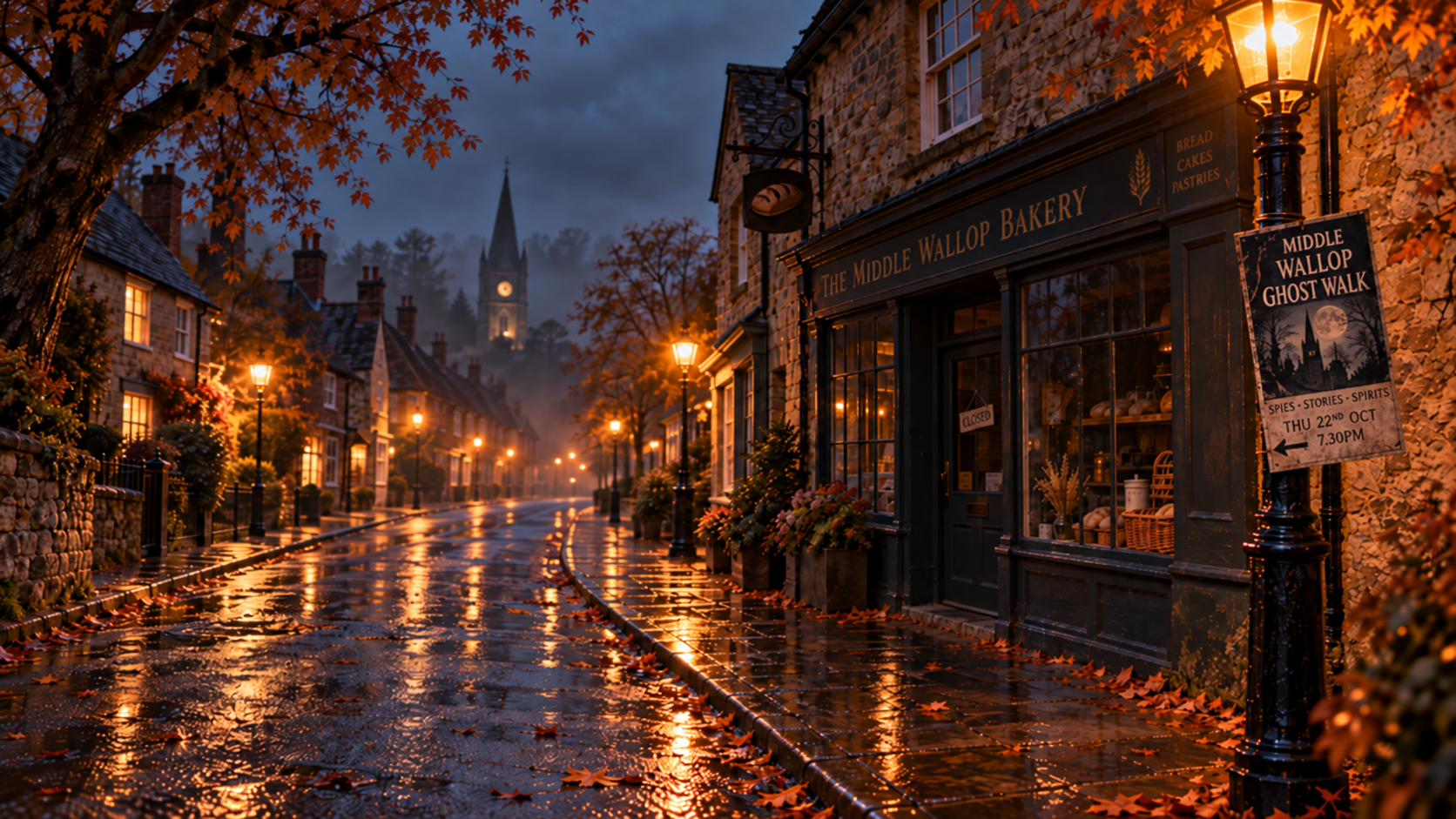
Middle Wallop was widely regarded as the most haunted village in England, mostly by people who lived in Middle Wallop and one website run by a man called Derek.
The village had embraced the distinction with enthusiasm. There were ghost-shaped biscuits in the bakery, a haunted-history shelf in the post office and a sign outside the King’s Head announcing that Room Four was definitely haunted, although Room Four had in fact been converted into a linen cupboard in 1996. Nobody seemed especially troubled by this. Tourists still photographed the door.
At half past seven on a damp October evening, Jerry, Bob, Tiffany and Phil stood beneath the crooked sign for the Middle Wallop Ghost Walk and wondered whether twelve pounds fifty had been too much to pay for an hour and a half of being lied to in the dark.
“It included a complimentary hot drink,” Tiffany pointed out.
“It was instant coffee,” said Jerry.
“It was complimentary instant coffee.”
“That doesn’t make it better.”
Phil was studying the leaflet. “Apparently we’re going to encounter restless spirits, grisly murders, inexplicable phenomena and Trevor.”
“Who’s Trevor?”
“No idea. He’s listed under Health and Safety.”
Their guide arrived two minutes late wearing a black cloak, walking boots and a hat that looked as though it had once belonged to somebody with considerably more authority. He carried an old brass lantern containing a battery-powered candle and introduced himself as Mr Pritchard.
“Welcome,” he said, raising the lantern, “to Middle Wallop, where the dead do not rest.”
A window opened above the bakery.
“They do after eleven,” shouted a woman. “Some of us have work in the morning.”
Mr Pritchard waited until the window had closed.
“As I was saying.”
Bob looked at Jerry.
Jerry grinned.
This, they decided, might actually be worth twelve pounds fifty.
Mr Pritchard swept his cloak around himself and set off down the High Street.
The cloak immediately caught on a litter bin. He freed it without comment and a slight sound of fabric tearing.
“Middle Wallop,” he began, once dignity had been restored, “has known bloodshed, betrayal, murder and mysterious death for more than nine hundred years.”
“Busy place,” said Bob.
Mr Pritchard ignored him.
Their first destination stood less than fifty yards away.
It was a bench.
Not an ancient bench. Not even an especially interesting bench. It was one of those brown recycled-plastic things councils bought in bulk, with a small brass plaque screwed to the back.
Mr Pritchard gathered them around it.
“Here,” he said, lowering his voice, “stands Widow’s Rest.”
Jerry looked at the bench.
“It says ‘Donated by Middle Wallop Women’s Institute, 2008’.”
“The bench is recent.”
“Right.”
“The haunting is not.”
This distinction seemed important to Mr Pritchard, so nobody argued.
He raised the lantern beneath his chin.
“In the winter of 1743, Elspeth Murgatroyd sat upon this very spot awaiting the return of her husband, Josiah, who had gone to Winchester to purchase a pig.”
Tiffany frowned.
“You said the bench was recent.”
“The spot.”
“Oh.”
“Josiah never returned.”
“Pig trouble?” asked Phil.
Mr Pritchard gave him a look.
“Neither man nor beast was ever seen again.”
“That sounds like pig trouble.”
Mr Pritchard continued, apparently encouraged by the fact that nobody had yet wandered off.
“Night after night, Elspeth came here and waited, until one bitter February evening she was found dead, frozen upon the ground. To this day, those who sit upon Widow’s Rest after sunset have reported feeling an icy hand upon their shoulder.”
This was plainly intended to produce a respectful silence.
Jerry ruined it by sitting down. He waited as absolutely nothing happened. He shifted a little to the left, as though supernatural activity might be concentrated towards one end.
“Try the other side,” Bob said.
Mr Pritchard lowered the lantern.
“This is not a fairground attraction.”
Jerry moved anyway.
A hand settled gently on his shoulder.
For perhaps half a second, he assumed it was Bob. Then he remembered Bob was standing in front of him.
The smile left his face.
Tiffany noticed first. Phil noticed Tiffany noticing. Bob, who had been preparing some remark about refunds, forgot it completely. Behind the bench stood an elderly woman in a bonnet and shawl.
There was nothing particularly spectral about her, apart from the inconvenience of being able to see the bench through portions of her skirt. Mostly she looked irritated.
“You’ve got that wrong again,” she said.
Mr Pritchard turned. His expression suggested that this was not covered in the tour notes.
The woman pointed at him.
“He bought the pig.”
Nobody seemed to know what answer was expected.
“He came back Tuesday,” she added helpfully.
Mr Pritchard stared at her. “You are—”
“Elspeth Murgatroyd, yes. And before you start, I did not pine away from grief.”
She leaned over the back of the bench and peered down at Jerry.
“You’re sitting on my shopping.”
Jerry rose with surprising speed and looked behind him.
There was nothing there.
Elspeth nodded. “Thank you.” She sat down with a small huff.
Mr Pritchard appeared to have arrived at the difficult conclusion that the dead were not merely real but willing to fact-check him.
“But you died waiting for Josiah.”
“No, I didn’t.”
“You were found frozen here.”
“I was found asleep.”
“In February.”
“I’d been drinking.”
Phil made an abrupt coughing noise and turned it into something respectable.
Mr Pritchard pressed on.
“But you died that winter.”
“No, it was nearer Spring.”
He seized on this. “There! The end of winter.”
Elspeth regarded him with pity.
“I choked on a walnut in March.”
The four friends looked at one another, then at Mr Pritchard, then finally at the leaflet, which suddenly seemed a less authoritative document than it had ten minutes earlier.
Phil tapped the page with one finger.
“Doesn’t mention the walnut.”
“It never bloody does,” said Elspeth.
Mr Pritchard looked from Elspeth to the leaflet and back again, as though one of them had clearly become unreliable and he was reluctant to admit which.
“This account,” he said at last, “has formed part of the documented history of Middle Wallop for more than a century.”
Elspeth sniffed. “No, it hasn’t.”
“It appears in Reverend Cartwright’s Historical Curiosities of Hampshire.”
“Cartwright was an idiot.”
“He was a respected antiquarian.”
“He thought my name was Elsie.”
That seemed to bring the scholarly dispute to an end.
Mr Pritchard opened his mouth, found nothing in it that would improve matters and closed it again. Elspeth, apparently satisfied that her reputation had been repaired as far as was possible in the circumstances, stood, bent down beside the bench and lifted something none of the others could see. Whatever it was, it seemed to require both hands and some effort.
“Well, if you’re all going to stand there gawping, at least move out of the way.”
They moved. There was something about being ordered aside by a dead woman carrying invisible shopping that discouraged argument.
Elspeth shuffled past them towards the High Street, muttering about walnuts being perfectly safe if people bothered to chew properly. At the corner she faded gradually into the darkness, although whether this represented supernatural dissolution or merely Middle Wallop’s inadequate street lighting was difficult to say.
For several seconds nobody spoke.
Jerry broke first.
“That was a ghost.”
Tiffany looked at him. “Yes.”
“An actual ghost.”
“Yes.”
Jerry stared towards the corner where Elspeth had disappeared.
“She was carrying shopping.”
Phil folded the tour leaflet and tucked it into his coat pocket. Its authority had suffered badly over the last few minutes.
“Dead people still need things.”
Jerry turned to him. “What things?”
Phil shrugged. “No idea. Seemed rude to ask.”
Mr Pritchard, meanwhile, had been making a determined effort to recover whatever professional dignity remained available to him. He straightened his hat, adjusted his cloak and raised the lantern again.
“There are,” he announced, with the grave confidence of a man who had decided to ignore the previous five minutes entirely, “many unexplained phenomena associated with Middle Wallop.”
Bob nodded towards the corner.
“She explained most of that one.”
“A manifestation of this nature is extremely rare.”
“She said you get it wrong every time.”
Mr Pritchard developed a sudden fascination with the workings of his lantern.
Tiffany watched him for a moment. “You’ve seen her before, haven’t you?”
There are silences which preserve dignity. Mr Pritchard’s did not.
“How many times?” Tiffany asked.
He sighed. “Four.”
“Five,” called a voice from somewhere beyond the hedge.
Mr Pritchard closed his eyes. Nobody investigated the hedge. The evening had reached a point where accepting unexplained voices seemed considerably easier than finding out what they belonged to.
“The tour,” Mr Pritchard said, turning sharply away, “will now proceed to St Mildred’s Lane.”
He set off before anyone could ask anything else.
The others followed. They had paid twelve pounds fifty, after all, and whatever faults the Middle Wallop Ghost Walk possessed, fraudulent advertising was no longer one of them.
St Mildred’s Lane was the sort of street that looked as though it had been built before anyone had decided how wide streets ought to be. The old cottages leaned towards one another across the road, their upper floors projecting farther than the lower ones, as if generations of timber and plaster had spent several hundred years trying to overhear the neighbours. Mr Pritchard led them between puddles, dustbins and a bicycle chained to a drainpipe which had acquired enough moss to suggest neither bicycle nor owner was in any hurry.
Jerry kept close behind him. “So where are we going?”
“The site of one of Middle Wallop’s most notorious murders.”
Jerry hesitated.
“Was it actually a murder?”
Mr Pritchard stopped walking. He turned slowly and looked at him. For the first time that evening, all trace of theatrical menace vanished.
“Yes.”
Jerry seemed almost disappointed.
At the end of the lane stood a narrow timber-framed building wedged between a cottage and a charity shop. A painted wooden sign swung above the door.
THE CROOKED FERRET
Beneath it, in smaller letters:
ALES — FOOD — SPIRITS
Someone had added in chalk:
SOME OF THEM DRINK.
Phil studied it.
“Good sign.”
“The Crooked Ferret,” said Mr Pritchard, “is one of the oldest public houses in Hampshire.”
The door opened and a man carrying two bulging black bin bags emerged.
“No, it isn’t,” he said.
Mr Pritchard waited until he had crossed the lane.
“One of the older public houses in Hampshire.”
“Built in 1862,” came a voice from inside.
Mr Pritchard’s jaw moved slightly.
“One of Middle Wallop’s public houses.”
This, at least, passed without challenge.
He led them through a narrow passage beside the building into a small courtyard containing several picnic tables, some empty beer barrels and a plastic skeleton in a flat cap sitting against the wall.
Jerry pointed. “That one part of the tour?”
“That is Keith.”
“Ghost?”
“Landlord’s brother.”
Jerry looked at the skeleton again. “Right.”
Keith, having nothing further to contribute, continued smiling at the bins.
Mr Pritchard took up position beside the rear wall and raised his lantern.
“On this very spot, in 1887, Silas Grubb, landlord of the Crooked Ferret, met a violent and mysterious end.”
The back door opened. A woman carrying a tray of glasses stepped outside.
“Wasn’t mysterious.”
Mr Pritchard turned.
She began arranging the glasses on an outside table.
“He was stabbed.”
“Yes,” said Mr Pritchard, attempting to regain control. “Precisely.”
“With a fork.” The woman picked up her tray and went back inside.
Mr Pritchard watched the door close, waited a moment to make sure she was not coming back, then continued.
“Silas Grubb was discovered shortly after midnight, lying here in a pool of blood with a silver dining fork buried deep within his chest.”
Jerry winced. “That would probably do it.”
“The murderer was never identified.”
The back door opened again.
“Arthur Bell,” called the woman.
Mr Pritchard stared at her. “What?”
“Arthur Bell killed him.”
“How do you know?”
“Silas told my grandfather.”
Mr Pritchard frowned.
“Silas died in 1887.”
“Yes.”
“Your grandfather wasn’t born until 1912.”
“Yes.”
A small but quite significant silence followed.
Jerry’s expression brightened.
Mr Pritchard spoke carefully.
“Silas told your grandfather.”
“That’s what I said.”
“When?”
“Usually Thursdays. Never stops complaining about it.”
She disappeared back into the pub.
Mr Pritchard remained facing the closed door for a while.
Bob cleared his throat. “Any particular reason?”
Mr Pritchard turned.
“What?”
“Why Thursdays?”
“I don’t know.”
“You’re the guide.”
“I guide the tour. I do not organise the dead.”
It was, Bob thought, perhaps the most reasonable thing he had said all evening.
Mr Pritchard took a breath and tried once more.
“Whatever the truth of Silas Grubb’s death—”
“Arthur Bell,” Tiffany reminded him.
“Whatever the circumstances surrounding the incident involving Mr Bell, local legend says that Silas still stalks this courtyard, seeking vengeance upon the man who murdered him.”
One of the empty barrels moved.
It did not roll. It simply shifted a few inches sideways with the quiet deliberation of something making room.
Nobody laughed.
The barrel moved again.
Mr Pritchard was staring at it now, and there was none of the practised satisfaction of a showman waiting for his audience to react.
The barrel suddenly lurched sideways with a violent scrape, and from behind a rather portly man stepped forward with a slightly tarnished carving fork protruding from his chest.
He looked down. “Oh, for God’s sake.” He kicked at the bottom of the barrel, although his foot passed through the aluminium with very little effect.
“She put the bloody thing on my foot again.”
Jerry glanced at the fork in Silas’s chest, then at the barrel.
“Does that hurt?”
Silas gave him a look. “No. But it’s irritating.”
Apparently, there were distinctions in death.
He stepped free of the barrel, muttering darkly about people moving things without asking, and headed for the back door of the pub.
Mr Pritchard stared after him. “I thought you were supposed to be haunting the courtyard.”
Silas stopped. Very slowly, he turned.
“You know damn well it’s Thursday.”
Mr Pritchard said nothing.
Silas jabbed a translucent finger towards the pub. “Happy hour.”
There was still no response.
“Double spirits for the price of a single.”
Bob covered his mouth.
Silas looked at him. “What?”
“Nothing.”
“Thought not.”
He walked straight through the closed back door. A moment later, something crashed inside.
Then came the woman’s voice. “Silas! Use the bloody door!”
Mr Pritchard did not wait to hear the reply.
“The tour will now proceed to the village pond.”
He was already halfway through the passage before anyone had actually agreed to proceed anywhere.
They hurried after him, emerging once more into St Mildred’s Lane and then back towards the centre of the village. Mr Pritchard walked considerably faster than he had before, his cloak streaming behind him and his lantern swinging hard enough to make the electric candle inside flash against the glass.
Jerry had to lengthen his stride to keep up.
“Are we running away from a ghost?”
“No.”
“Feels like we’re running away from a ghost.”
“We are maintaining the schedule.”
Behind them, through the walls of the Crooked Ferret, Silas could be heard loudly demanding to know whether being dead somehow exempted him from the loyalty card scheme.
Mr Pritchard walked faster.
The village pond lay beyond the church, in a patch of grass dignified by a bench, a litter bin and a sign requesting that visitors not feed bread to the ducks. The ducks had clearly not been consulted on this policy and were gathered beneath the sign in protest.
At night the pond managed to look considerably larger than it was. The water reflected the yellow glow from the surrounding cottages, broken occasionally by the passage of a duck or the sudden appearance of a backside as one went looking for something underwater.
Mr Pritchard halted at the edge and waited for the others to gather around him.
By the time they did, he had recovered.
The shoulders were back. The lantern was raised. The voice, when it came, once again belonged to a man who had spent many years practising the phrase “On this very spot”.
“Before you,” he said, “lies Witchwater Pond.”
Phil looked at the sign.
“Middle Wallop Duck Pond.”
“The modern name.”
“It’s on the council sign.”
“The council lacks imagination.”
One of the ducks quacked.
Mr Pritchard ignored it.
“In the year 1646, during one of the darkest periods in the village’s history, this pond became the site of the notorious Middle Wallop witch trials.”
Tiffany looked across the water.
“How many witches?”
Mr Pritchard allowed a suitably sombre pause. “Seven women were brought here, accused of sorcery, consorting with dark forces and causing a variety of unnatural occurrences throughout the parish.”
Bob frowned. “What sort of unnatural occurrences?”
“Crops failed. Milk soured. Livestock sickened. A child spoke in tongues.”
“That sounds serious.”
“It was later discovered he was Welsh.”
Jerry snorted.
Mr Pritchard continued as though he had not heard him. “The accused were subjected to the ancient trial by water. Those who floated were declared witches.”
“And those who sank?” Tiffany asked.
Mr Pritchard drew himself up. “Innocent.”
There was a moment while all four of them considered the administrative shortcomings of this arrangement.
Phil eventually said, “Bit late by then.”
Mr Pritchard looked towards the pond.
“The seventeenth century was not noted for its appeals procedure.”
A duck waddled out of the water, shook itself vigorously and stared at them.
Jerry pointed at the pond. “What happened to the seven women?”
Mr Pritchard lowered his voice.
“According to legend, their spirits still haunt these waters. On certain nights, when the moon is high and the village lies silent, figures have been seen rising from the pond.”
The duck quacked again. “Not now,” Mr Pritchard told it. The duck remained where it was.
Mr Pritchard turned back to the group. “Some say they return seeking vengeance upon the descendants of those who condemned them.”
The surface of the pond rippled.
This time nobody made a joke.
The ripples spread outwards from the middle, though there was no wind and the ducks had stopped moving.
Mr Pritchard noticed.
His lantern lowered slightly.
Something pale broke the surface. Then another shape appeared beside it.
A head rose slowly from the black water, followed by shoulders, then the upper half of a woman wearing what might once have been a white bonnet.
Jerry took a step backwards. Another woman surfaced nearby.
Mr Pritchard went very still.
The first woman wiped pondweed from her face and glared at him.
“You.”
Mr Pritchard sighed.
It was becoming that sort of evening.
A second woman rose beside her, pushing a lily pad off her head with considerable irritation. Neither appeared interested in vengeance, descendants or any of the darker promises made in the leaflet. They looked more like two women who had come outside to complain about a neighbour’s wheelie bin.
“You’ve been feeding them again,” said the first.
Mr Pritchard glanced at the ducks. “I don’t know what you mean.”
“Oh, don’t you?”
“No.”
She pointed towards the sign.
DO NOT FEED BREAD TO THE DUCKS.
Mr Pritchard looked at it as though seeing it for the first time.
“That’s relatively new.”
“It’s been there six years.”
“I meant historically.”
The second woman had begun wading towards the bank. The water apparently offered no more resistance to her than the barrel had to Silas, though several strands of weed remained stubbornly attached to her sleeves.
“You gave them half a loaf this afternoon.”
“I had some left over.”
“Then make toast.”
“They like it.”
“Of course they like it. I liked gin. Nobody encouraged me to drink a bottle before getting into a pond.”
One of the ducks quacked.
The first woman rounded on it.
“And you can shut up.”
The duck did.
Jerry stared at it.
Bob leaned towards him. “I think she might actually be a witch.”
Mr Pritchard cleared his throat. “The feeding of waterfowl is hardly relevant to the tour.”
“Relevant?” The woman hauled herself onto the bank. “Have you ever spent a night in a pond that smells of pondweed and duck farts?”
Mr Pritchard seemed to decide that there was no safe answer. “No.”
“Well, we have.”
“For three hundred and eighty years,” added the other woman.
“Not continuously.”
“No, obviously not continuously. We get out Tuesdays.”
Tiffany frowned. “Why Tuesdays?”
Both women looked at her.
“Bingo.”
Tiffany nodded. It was difficult to know what else to do with the information.
The first woman had reached Mr Pritchard now. Water dripped from her dress without ever quite reaching the ground.
“We have asked you before.”
“I hardly think one crust—”
“Half a Warburtons.”
Bob made a small, impressed noise.
“And butter.”
Mr Pritchard looked defensive. “It was going stale.”
“So are you. We don’t throw you in the pond.”
Phil turned away very quickly.
Mr Pritchard pretended not to notice.
The second woman climbed onto the bank and began removing weed from her bonnet. “And it isn’t just the smell.”
Mr Pritchard closed his eyes. “There’s more?”
“Bubbles.”
Jerry’s shoulders began to shake.
“Constant bubbles.”
“I’m sure—”
“You’re not in there.”
“No.”
“You don’t know where the next one’s coming from.”
Bob gave up and laughed.
Mr Pritchard shot him a look, but it was too late. Tiffany joined him, then Jerry, and finally Phil, who had been trying hard to behave like an adult and discovered there was very little reward in it.
The witches waited. They had, after all, been dead for nearly four centuries. A minute made little difference.
When the laughter had subsided, the first woman folded her arms.
“Finished?”
Bob wiped his eyes. “Sorry.”
“No, you’re not.”
“No.”
“Fair enough.”
Mr Pritchard seized the opportunity to regain control.
“Perhaps we should move on.”
“Yes,” said the woman. “Perhaps you should.”
She pointed at him. “And no bread.”
“I understand.”
“No cakes either.”
“I have never given them cake.”
Both women stared at him.
Mr Pritchard shifted slightly. “Not recently.”
“Pritchard.”
“It was Madeira.”
The second witch groaned.
“That explains Sunday.”
They turned and walked back into the pond.
Jerry watched them go.
“Hang on.”
The first woman stopped with the water around her waist.
“What?”
“Were you actually witches?”
She considered the question.
“Oh, yes.”
Then she disappeared beneath the surface.
Mr Pritchard stared after her.
“That,” he said, with some satisfaction, “is historically accurate.”
From somewhere beneath the water came a muffled voice.
“Still got the year wrong.”
Mr Pritchard’s satisfaction vanished.
He turned sharply towards the path.
“Moving on.”
Mr Pritchard led them away from the pond with what remained of his professional dignity, which was not much but had proved surprisingly resilient.
The rest of the walk passed without incident, although this was largely because Mr Pritchard abandoned the remaining two stops on the grounds of “time constraints”, and nobody felt inclined to ask whether either involved further complaints from the deceased.
By the time they reached the High Street again, the drizzle had thickened into proper rain, and the battery candle in Mr Pritchard’s lantern had begun to flicker.
He stopped beneath the sign where they had started.
“And that,” he said, “concludes the Middle Wallop Ghost Walk.”
For a moment nobody said anything.
Then Jerry looked at Bob.
Bob looked at Tiffany.
Tiffany looked at Phil.
Phil took out the leaflet, now damp around the edges and considerably less trustworthy than it had been at half past seven.
“Well,” he said, “I’d say that was worth twelve pounds fifty.”
Mr Pritchard brightened. “Really?”
“Oh, absolutely.”
Jerry nodded. “We got ghosts.”
“Actual ghosts,” said Tiffany.
“Complaining ghosts,” Bob added.
“Witches with digestive grievances,” said Phil.
“And a dead publican at happy hour.”
Mr Pritchard appeared uncertain whether any of this constituted praise but chose to accept it.
“You’ll leave a review?”
“We’ll leave something.”
That seemed to satisfy him.
They said their goodbyes and watched him disappear along the High Street, cloak trailing through a puddle as he went.
Jerry shoved his hands into his pockets.
“Drink?”
Nobody objected.
They chose the Crown and Badger, largely because it advertised itself as only mildly haunted and offered two pints for the price of one after nine.
Inside, the fire was lit, the beer was decent, and nobody appeared to be transparent. They found a table in the corner.
Phil raised his glass. “To Middle Wallop.”
“To twelve pounds fifty,” said Bob.
“To Elspeth,” said Tiffany.
Jerry thought about it. “And to chewing your walnuts properly.”
They drank.
From somewhere above them came a loud thump.
All four looked at the ceiling. The landlord, polishing a glass behind the bar, glanced up.
“Don’t worry,” he said. “That’s just Harold.”
Jerry lowered his pint.
“Ghost?”
The landlord frowned.
“No. Plumber.”
They considered this.
Somehow, after the evening they had just had, it was almost disappointing.

10/8/2026
The Words That Got to Me
A child spoke in tongues…it was later discovered he was Welsh. Witches with digestive grievances. I loved the humour here!
This was a fabulous and funny ghost tour through one of our lovely, so English, villages. Very entertaining.