When my mother died, the estate agent said the bungalow would be easy to sell because people liked a place with “good bones”.
He stood in the front room with his tablet in one hand and a travel mug in the other and said it in the careful voice people use when there are still framed photographs about. Good bones. As if the walls had once been alive.
I looked past him into the hall, where my mother’s coats still hung in order of thickness, and thought: you have no idea.
He measured quickly, with cheerful laser pings. Sitting room. Kitchen. Main bedroom. Box room. Bathroom. He frowned at the screen, tapped it twice, then measured the hall again.
“Odd,” he said.
“What?”
“It’s nothing. The footprint on the old plans is a shade larger than the internal measurements. Not unusual. Insulation, replastering, things like that.”
“How much larger?”
He turned the screen so I could see. The outline of the bungalow looked ordinary enough, a squat rectangle with a porch added later. But on the right-hand side, between the box room and the bathroom, the external wall suggested a depth that simply wasn’t there inside. Not a lot. Twenty inches, perhaps. Two feet, at most. The sort of discrepancy you would never notice with your eyes.
“It’s an old survey,” he said. “These things are often wrong.”
My mother had not been wrong.
For the last seven years of her life, she wrote to me almost every fortnight about the space beside the bathroom. Not in every letter. She did not sound mad enough for that. She wrote about the roses, the bins, the pain in her wrists, and then somewhere near the end she would say: It’s widening again. Or: I heard it breathing last night. Or once, very plainly: There is a room in this house that wants to become a person.
I never answered those bits.
You can forgive a lot in a mother who lives alone and is frightened of dying. You tell yourself loneliness has teeth. I lived two hundred miles away and sent flowers on birthdays and thought that was a kind of love.
When the agent left, I locked the door behind him and stood in the hall with the plans open on my phone. The bungalow was very quiet. It had the stale, padded silence of a place where no one has boiled a kettle for weeks. Fridge off. Clocks stopped. Nothing moving.
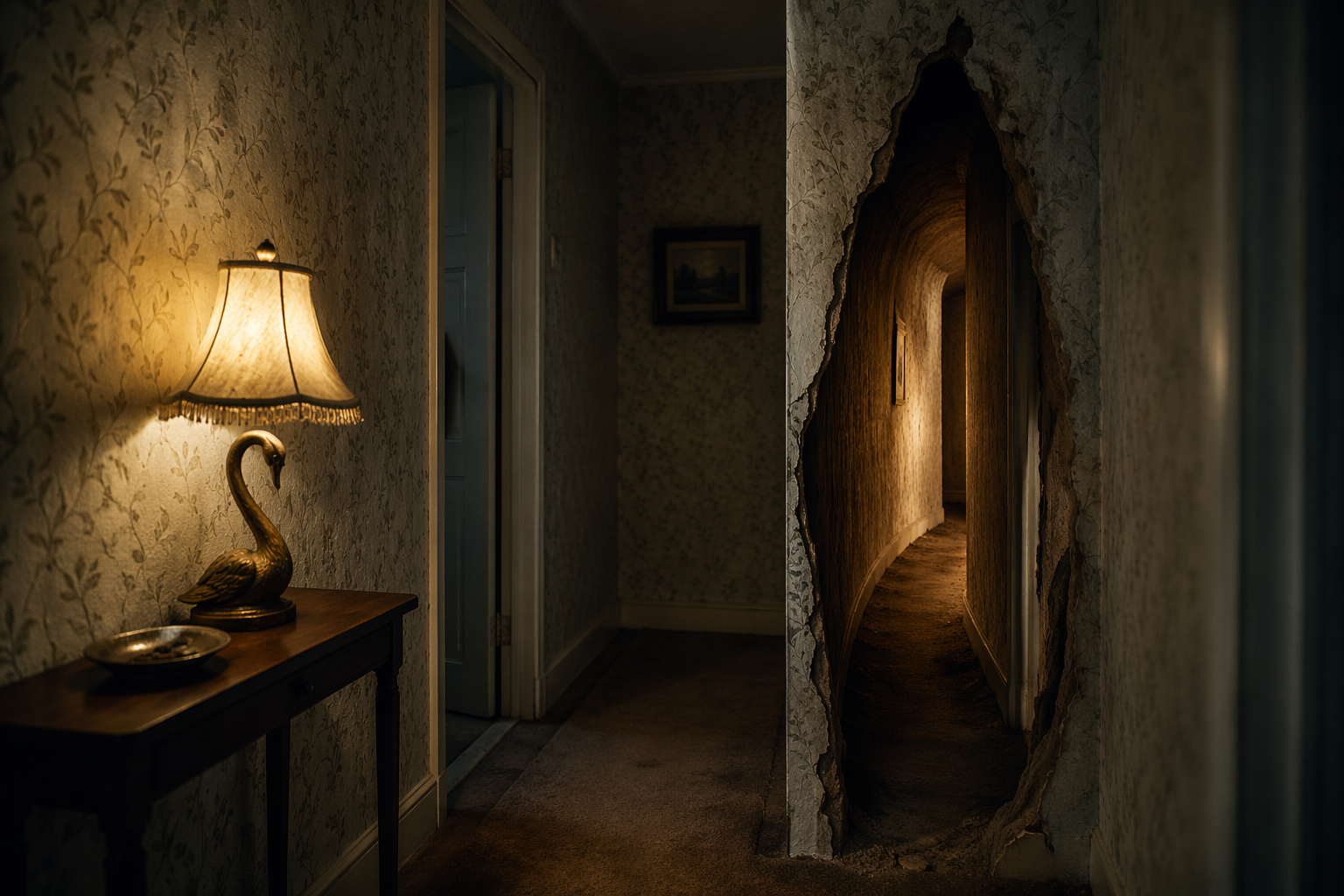
My mother had papered the hall herself in a cream pattern of tiny leaves. At the far end, the bathroom door stood open. Next to it was the wall in question, blank except for a narrow table with a dish for keys and a brass lamp shaped like a swan.
I measured it. Hall width. Box room width. Bathroom width. Exterior width. The missing space was still there, on paper and nowhere else.
I told myself I was indulging the dead. Nothing more. I took the lamp down, moved the table away, and knocked on the wall.
Plasterboard has a cheap, flat sound. This did not. The first section sounded solid. The second sounded dull. The third, just before the bathroom frame, gave back a hollowness so deep and soft that I stopped at once.
It was not the sound of a cavity wall.
It was the sound of knocking on something that had an atmosphere.
I stood there with my knuckles against the leaves of the wallpaper, all the tiny printed stems wavering because my hand had begun to shake.
Then, from the other side of the wall, something knocked back.
Not a scrambling noise. Not pipes. Not an animal. Three firm, spaced taps, at the height of a standing person.
I moved before I knew I’d decided to. I was halfway down the hall, breath gone thin and useless, when I stopped. The house had returned to stillness. I could hear traffic on the main road. A gull. My own pulse in my ears.
“You old cow,” I whispered, and laughed.
I was angry with her then. Angry because the wall had made her real. Angry because I had spent years declining to believe her and now there was no one left to apologise to except a patch of wallpaper.
I fetched the stepladder from the shed and a stripping knife from the kitchen drawer. By the time I came back, the light outside had gone the colour of damp wool. I turned on every lamp in the bungalow before I started.
The wallpaper peeled badly. My mother had always overdone the paste. Underneath was painted plaster, and beneath that, after a little scraping, a rectangle of board had been scored around the edges and skimmed over. Neat work, but not professional. Someone had closed something up.
My mother had lived there for forty-two years. My father had died when I was eleven. There had been no one else to do it.
I cut along the seams with the knife. The blade snagged. Dust came out in little beige sighs. Then the point punched through, and a smell touched my face.
Not rot. Not mould. Nothing so easy.
It was warm air with the faint scent of old carpet, rain on concrete, and the inside of a wardrobe that has been shut around clothes still holding a body’s heat.
I widened the slit. The board flexed inward.
Behind it was darkness.
I should have stopped. But if there is something impossible inside your mother’s wall, you cannot leave it there and sleep in the house. You need it to become a cupboard or a pipe chase. You need the world repaired.
I levered the panel loose.
The gap was about two feet wide and went back much farther than the outer wall allowed. I shone my phone torch in. The beam found a strip of carpet, brown and threadbare, then a skirting board, then a corner turning away out of sight.
A corridor.
Not raw timber and pipes. A corridor papered in the same tiny cream leaves as the hall.
My mother had decorated inside it.
I remember making a sound then, a small animal sound of refusal, and stepping back until my calves hit the opposite wall. The corridor stayed where it was, patient and domestic. The carpet bore a shallow track down the middle, as if someone had walked it many times.
There were no footprints. Only the flattened pile.
I called my husband, Dan, and got his voicemail. I did not leave a message because there is no way to say this without hearing yourself from the outside. I texted instead: Can you ring me. Weird thing at Mum’s. Very weird.
Then I stepped inside.
It was warmer there than in the bungalow. Not by much, but enough to feel inhabited. The corridor was so narrow I had to angle my shoulders. The wallpaper brushed my sleeves.
I went perhaps eight feet before the corridor turned again. On the skirting board, I saw marks in pencil. Short vertical lines with dates beside them in my mother’s handwriting.
1979
1986
1998
2007
2019
Growth marks. The sort you make for a child.
By the most recent one she had written: Too quick now.
My torch shook over the words. A noise came from farther ahead.
A person clearing their throat.
I backed into the wall so hard it stung. The sound came again, followed by a dry little click, as though someone had opened and closed their mouth.
“Mum?” I said.
Put anything in the dark and sooner or later you will call it by the name of someone you miss.
The corridor breathed.
The wallpaper beside my cheek lifted and settled, softly, like ribs expanding under skin.
Then, from around the corner, my mother said, in her ordinary voice, “Don’t stand there. You’re letting the heat out.”
Every part of me failed at once. Knees. Hands. Mouth. The torch beam spun crazily over leaves, skirting, carpet. I do not remember turning. I only remember the violence of needing distance and the filthy softness of the corridor resisting me, as if the walls had moved closer in my panic.
Something touched the back of my cardigan.
Not grabbed. Not clawed.
Just a polite fingertip between my shoulder blades.
I hit the hall floor on hands and knees and vomited into the umbrella stand.
After that there is a clean stretch in my memory, because terror is merciful in patches. I know I dragged the loose board back into place. I know I shoved the table against it and put the swan lamp on top. I know I sat in my mother’s armchair with all the lights on and the television muted, staring at the hall until Dan arrived.
He found me with a bread knife in my lap.
“What happened?”
“There’s a corridor in the wall,” I said.
He looked at me for a very long moment, then at the knife, then back at me. He was tired from the drive and wearing the expression people wear when they are trying to sort crisis from embarrassment.
“Show me.”
“I’m not going near it.”
He went anyway. I followed as far as the sitting room door. He moved the table, frowned at the damaged wallpaper, ran a hand over the seam, then tugged the board free.
Nothing.
No corridor. No carpet. No turn in the wall.
Just the shallow cavity of a normal partition, full of pipes and dust and pink insulation, exactly as the world required.
Dan looked over his shoulder. I can still remember the relief in his face. Relief. And something gentler.
“You’ve had a shock,” he said. “And no food. And you’re here alone with all this.”
“I went inside it.”
“There is no inside.”
“There was.”
He came back and put his arms round me, and I hated him for being solid. I hated the warm common sense of his body. I hated, most of all, the ease with which the world had sealed itself up again, leaving me looking like the one thing my mother had begged me not to become.
“She wasn’t mad,” I said into his coat.
“I know,” he lied.
We did not stay the night.
Dan moved quickly once he had decided. A bag. Keys. Lights off one by one, as if the house might settle in the dark. I stood on the path and watched the bathroom window. The curtain hung still. Nothing moved behind it.
In the car, he kept one hand on the wheel and one on my knee, steady pressure, as though I might drift.
“You’re safe now,” he said.
I nodded.
It seemed reasonable.
By the time we reached home, the strangeness had thinned. The house smelled as it always did: detergent, warm dust from the radiators, the basil plant on the kitchen sill. Familiar things arranged in familiar ways. I stood in the doorway longer than I needed to, letting the shape of it settle around me.
Dan put the kettle on. I washed my hands. The ordinary sequence of movements returned without effort, as if I had only stepped out for an hour.
We did not speak about the wall.
At half past one I went upstairs.
There is a stretch of wall between the wardrobe and the en-suite door where nothing has ever been. Too narrow for furniture, too wide to ignore entirely. A blank space that belongs to no one.
There was a table there.
A narrow hall table in dark wood. A brass lamp shaped like a swan.
I stopped. The room no longer arranged itself around me. The bed, the wardrobe, the door — all of it remained, but the distances had altered slightly, as though something had been accommodated without asking.
I tried to remember the wall without the table and found I could not hold the image.
Dan came up behind me.
“What’s wrong?”
I moved aside so he could see.
He looked directly at the space, then at me.
“What?”
I did not answer. I stepped into the room, slowly, watching the table as I passed it. The air around it felt neither warmer nor colder, only settled, as if it had been undisturbed for some time.
The lamp was slightly crooked.
I reached out and straightened it.
Behind me, Dan said my name in a tone I had not heard before.
“Don’t.”
I left it where it was.
We stood there, neither of us moving further into the room.
“It’s late,” he said eventually. “You’re tired.”
“Yes.”
That seemed reasonable.
We left the light on.
I did not sleep.
The house held its shape, but lightly, as if it were being remembered rather than occupied. Small things failed to align. The landing seemed longer when I crossed it. The stairs took one step more than they should have. Once, I paused halfway down and had the impression that there was space beneath the staircase that had not been there before, though I did not look.
At some point near morning, I understood something I had not allowed myself to think in my mother’s house.
She had not been trying to hide anything.
She had been making room.
The thought settled.
As if it had been there already.
Dan woke before me.
I heard him moving about upstairs, then stopping, then moving again. Not alarmed. Slower than that. Careful.
He called my name from the landing.
“Can you come up here a moment?”
I went.
At the top of the stairs, he was standing slightly to one side, as if leaving space.
“There’s a door here,” he said.
There was.
It stood where the wall should have been continuous. Plain. Painted to match. A handle at the correct height, turned slightly, as though recently used.
I looked at it for a long time.
“I don’t remember that,” he said. Not frightened. Only uncertain.
“No.”
“Do you?”
“No.”
He nodded, accepting this as one accepts a minor fault in a familiar place.
“I think it’s the airing cupboard,” he said. “Only… deeper.”
He reached for the handle.
I said nothing.
He opened the door.
Inside, there was space.
Not darkness. Not emptiness. Space, arranged with the same quiet care as the rest of the house. The air that came from it was faintly warm.
“I must have never noticed,” he said.
“Yes,” I said.
From somewhere within, a floorboard shifted. Not under weight. Just the sound of a house settling.
Dan leaned slightly forward, listening.
He began to say ‘that door’ and then didn’t.
“There’s a draught,” he said. “We should keep it closed.”
He shut the door gently.
The day settled around the new proportions of the house. There was always a little more room than required. A place to stand. A place to set something down. Objects shifted without effort into better positions.
Once, I found the hall table at the foot of the stairs. Not moved, exactly. Just present there, as if it had always served that purpose.
I did not question it.
In the afternoon, while Dan was in the garden, I stood on the landing and looked at the door.
It did not draw attention to itself.
It did not feel wrong.
It simply existed in a way that required no comment.
I placed my hand on the handle.
From the other side, I heard movement. Light, domestic. The small sounds of someone occupying a space without urgency.
I opened the door.
The room beyond was not a room.
It was a continuation of the house that had not decided what it was for.
Wallpaper, not quite matching. Floorboards, but without the marks of use. A chair, placed slightly too far from the wall. A sense of arrangement without history.
Beyond it, another space.
I did not enter.
I stood in the doorway, looking in, as if visiting someone else’s home.
From further inside, a voice said:
‘Don’t stand there. You’re letting the heat out.’
My voice.
I closed the door.
When Dan came back in, he paused at the foot of the stairs.
“Did you move something?” he asked.
“No.”
“There’s more space in here.”
“Yes.”
He nodded, as if this confirmed something.
“We should get another lamp,” he said. “It’s a bit dim on the landing.”
“Yes,” I said.
That seemed reasonable.
That night, the house was quiet.
Settled.
I lay in bed and listened to the small sounds of it: the pipes, the boards, the low shift of air through spaces that connected more easily now.
At some point, I realised I could no longer remember the exact layout of the house as it had been before.
Not precisely.
Only approximately.
It did not trouble me.
From the landing, faintly, I heard movement. Then a voice, low and familiar, speaking in the tone one uses not to wake someone:
“It’s all right. There’s room.”
I did not get up.