The flat smelled of antiseptic and old takeaways, a cocktail Kayla had stopped noticing weeks ago. Curtains drawn against the daylight. Not for mystery. Just because fuck the sun. She sat in the same dent in the same sofa, one leg folded beneath her, the other stretched out like a truce with pain. The air was heavy with the faint hum of a city that had long since stopped pretending to care.
The news droned low in the background. Some senator found dead with a belt around his neck and a child’s bracelet in his pocket. Some protest turned “regrettable.” Some new drought where there hadn’t been one last year. No one apologised anymore. They just rebranded the suffering.
Her phone rested on her stomach, screen tilted toward her chin. The algorithm knew her well—terminal diagnosis, thirty-six, single, uninsurable. A perfect target. Clickbait dressed as comfort. Top five hospice playlists. DIY morphine smoothies. How to die with dignity in a rented flat.
She scrolled. One thumb, slow. Numb.
One trivial video after another. Clickbait and influencers. Lives she didn’t want, bodies she’d never get back. But one caught her eye.
A grainy video. Twenty seconds long. No music, no filters. Just five lads in an alley somewhere—laughing, drunk, cocky. One of them knocked on a rusted steel door. Twice. A pause. Then something opened it. From the inside something pulled them in.
No—not pulled. Inhaled.
The footage stopped before anyone screamed. Or maybe they never did scream. But it had that edge, that quality that made your spine twitch, made you lean closer without realising. There was a second clip too—stitched to the first. Apparently the only one left on the phone when it was found in a charity shop three towns over.
Low-res, almost black. No people this time. Just a corridor—long, narrow, the colour of wet rot. The lens jittered as whoever held the phone stepped forward. At the far end of the passage, something moved. Something slow. Something waiting.
She watched it again. And again.
Not because she believed it. Not yet. But because the air in her flat had shifted. Just a little. As though something old and patient had just remembered her name.
She clicked on the comments. Thousands of them—most predictable, some obscene. A few stood out. People arguing over where the alley was. Rumours about the door: knock twice and it opens. Knock three times and it doesn’t stop.
One account, since deleted, had claimed the boys were from Doncaster. Another said Glasgow. A third insisted the door had been in Berlin last week and São Paulo before that. Someone posted coordinates. Someone else posted coordinates and then deleted their account two hours later. A reply underneath simply read: Too slow. The door doesn’t like tourists.
Kayla rubbed the side of her jaw where the lymph nodes were always tender now. A pain with no edge. Just a smear across her thoughts.
She kept digging.
Hours passed. The flat darkened around her. She didn’t turn on a light.
There were other clips. Not many—never the same people, never the same place. All had the same shape. Someone laughing. Someone knocking. Someone filming. A moment of silence. Then something wrong in the frame. A shape that didn’t walk right. A door that didn’t open so much as flex.
She found a subreddit with barely a hundred users—half-banned, buried in layers of other horror ARGs and crypto scams. They called it the Bazaar. Capital B. They never explained what was inside. Just that most times, no one came back. And those who did were… different. Changed like milk left too long in the heat.
There was a theory it was a government black site. Another said it was older than government. Older than language. A place where rules didn’t apply, because money had never stopped buying.
Kayla read every word. Absorbed them like painkillers.
It didn’t matter if it was true. What mattered was that it didn’t end with hospital beds and vomit bowls. That it was strange. That it had shape. That it didn’t look like the flat she was going to die in.
She found herself thinking, If I find the alley, will it look at me? Not take. Not save. Just see her. That would be enough.
She hadn’t been seen in months.
By morning, the video had a watermark. A meme page claimed it. A hundred knockoffs followed—edited, overdubbed, buried in clown emojis and reaction gifs. The raw version was harder to find now, buried beneath noise. She didn’t care. She’d already seen it. What she wanted now was context.
It took three hours, two forums, and a VPN that screamed at her for accessing deprecated protocols. But she found something. Not indexed. Not in the open net. And not easy to parse. The page was clunky—text in white on blood-red background, links nested in links. The font looked scorched, like it had been typed in heat.
It called itself Second Knock. No domain. No menu. Just stories.
She read the first one out of morbid curiosity. A girl from Liverpool, name redacted but dates intact. Said her sister had gone missing in 2022 after becoming obsessed with a local urban legend. Knocking on a metal door in a back alley behind a pawn shop near Bootle Strand. The sister disappeared for three months. When she returned, she was mute. And smiling. Always smiling. One doctor described her teeth as “congenitally wrong.” Too many. Wrong shapes. “Infantile in growth stage, adult in density.”
Kayla would’ve written it off—Reddit creepy-pasta repackaged—but there was a photo. Blurry. Cropped. A girl in hospital greens, back turned. The mirror caught just enough of her face to see the grin. And just enough of her reflection to show her shadow didn’t match.
She kept scrolling.
A boy from Rio. Last seen livestreaming a prank in a flood tunnel. The phone was recovered a month later, crusted in black mould. One video still intact—his face covered in blood, not injured, just… bleeding. Saying the same word over and over: “Entrada.” Except the file was labelled “Exit.”
Then Chicago. A nurse on night shift heard knocking in the boiler room. Two knocks. Always two. She opened the door. There was no one there. She didn’t come back from her break. The knocking stopped.
Comments below each post varied. Some screamed hoax. Some offered GPS coordinates. A few argued. But a few… recognised things.
“I saw the Bootle door. It had moss on the handle.”
“That shadow in the mirror—I saw the same thing in Warsaw. It waved at me.”
“Don’t knock twice. Don’t even touch the fucking door.”
Each post had a little icon in the corner. A key, pixelated and flickering. She clicked one and was taken to a page with nothing but coordinates. Another led to a chatroom full of lurkers—no usernames, just timestamps and the occasional message:
Still there. Still breathing.
She gave them her voice. They let her in.
One token. One play. One chance.
Kayla read every word. Not like a believer, not yet. But like a woman drowning in silence, clinging to whatever made a ripple.
And this—this rippled.
The more she searched, the less sense it made.
The door had been spotted in an alley behind a laundrette in Luton, but the next day the alley was sealed with bricks. Someone posted a photo—same rusted handle, same water-stained metal—but it was in Manila, smeared with grease and tucked between two collapsed buildings. A week later: Detroit. A grainy dashcam still, timestamped at 03:41, showed it standing alone in an empty lot. No building. Just a door in a frame and a shadow spilling outward.
She collected the sightings like some people hoarded last meals. Dozens of locations, never the same twice. All of them forgotten spaces—alleys, tunnels, derelict factories, train yards no one used anymore. Places where the world looked away.
Not all the reports ended in disappearance. Some were just… moments. Someone walking past, hearing a knock from the inside. Someone else catching a whiff of something foul—wet leather and scorched sugar—and then the alley was gone, like it had never been there.
Kayla began keeping a notebook. Not because she believed she'd need it. But because writing made it real.
She listed places. Times. Weather. A pattern started to form—not in logic, but in mood. The door didn’t follow coordinates. It followed despair. It bloomed in rot. Like a mushroom.
By the third day she’d stopped checking her hospice schedule. She told the palliative nurse not to come. “I’m not dead yet,” she said, and shut the door on her before the woman could speak.
Food delivery piled up by the front door. She ate what she needed, not always aware of the taste. She took her medication, but skipped the stronger painkillers. She wanted her mind sharp. If something came for her, she wanted to know it.
She stopped scrolling for entertainment. Now it was research. The kind that made her blood run cold not because it was frightening—but because it was consistent.
No hoax ran this long. No myth stitched itself across continents with such precision. Every story varied—but the details, the language, the tone… it matched. Different mouths, same whisper.
A voice she couldn’t place.
That was when she found the Fixer. Not a person exactly. A presence.
The post had been buried in the comments under a thread about the Rio boy. The text was in Portuguese, but the message was unmistakable:
"You don’t find the door. You pay the price and it finds you. Ask the Fixer. But don’t ask twice."
Someone had replied with a string of emojis—eyes, a flame, then a key. Clicked, it opened a private channel on the same shadow site. One message:
“You’re not ready to knock. But you’re close.”
No name. No instructions. Just those words. And a second message appeared, only when she tried to close the window.
“Come alone. Bring nothing you aren’t willing to lose.”
That night, for the first time in months, she slept without dreaming of her own death.
She followed the coordinates without hesitation.
The Fixer hadn’t replied again. Just the one message, then silence. But the location arrived in her inbox at 3:17 a.m. Precisely. No explanation. No note. Just a set of digits and a timestamp: Tonight. 01:12.
It led her to a part of the city she didn’t recognise—not because it was hidden, but because it was forgotten. A district of shuttered store-fronts and collapsing signage. Rain-slick cobbles and gutted lamplight. The sort of place property developers lost interest in halfway through gentrifying and then abandoned like a failed bet.
She moved slowly, wrapped in her old hospice coat, one hand braced against her ribs whenever the pain flared. It was always there now—deep in the bones, clinging like mould—but tonight it felt quieter. Not absent, but observant. Like it too was waiting.
The alley was easy to miss. She wouldn’t have found it if she hadn’t stopped to vomit. Just a turn between two vape shops, one long-dead, the other pulsing with sickly neon. The air changed as soon as she stepped in. Thicker. Warmer. The scent hit her immediately—copper, mould, and something sweet, like sugar left too long on a radiator.
No sound. Even her footsteps didn’t echo.
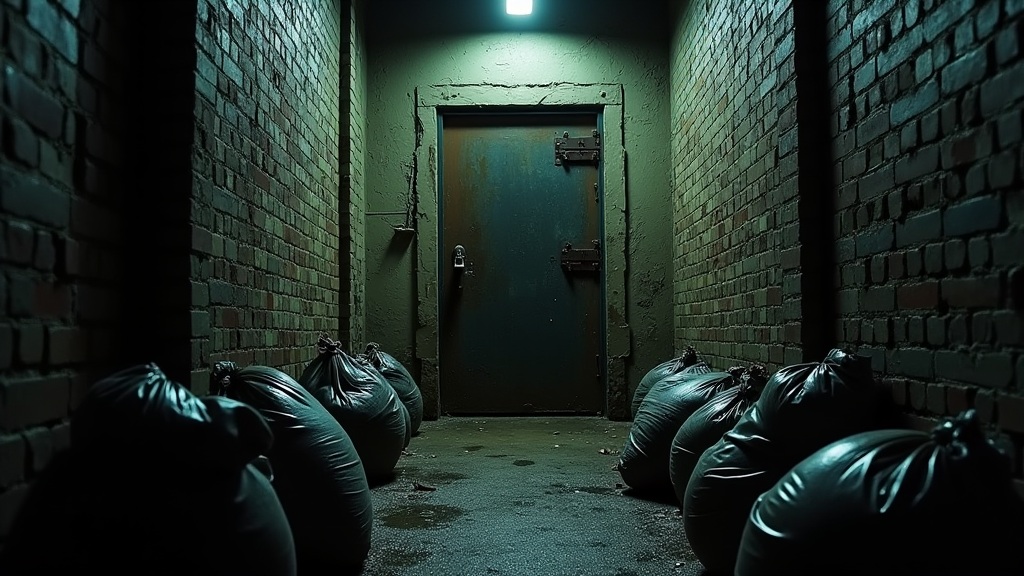
The alley narrowed as she moved forward. Brick walls weeping with moisture. Garbage bags leaking fluids she didn’t try to name. And at the end—squatting in the dark like something waiting to be remembered—was the door.