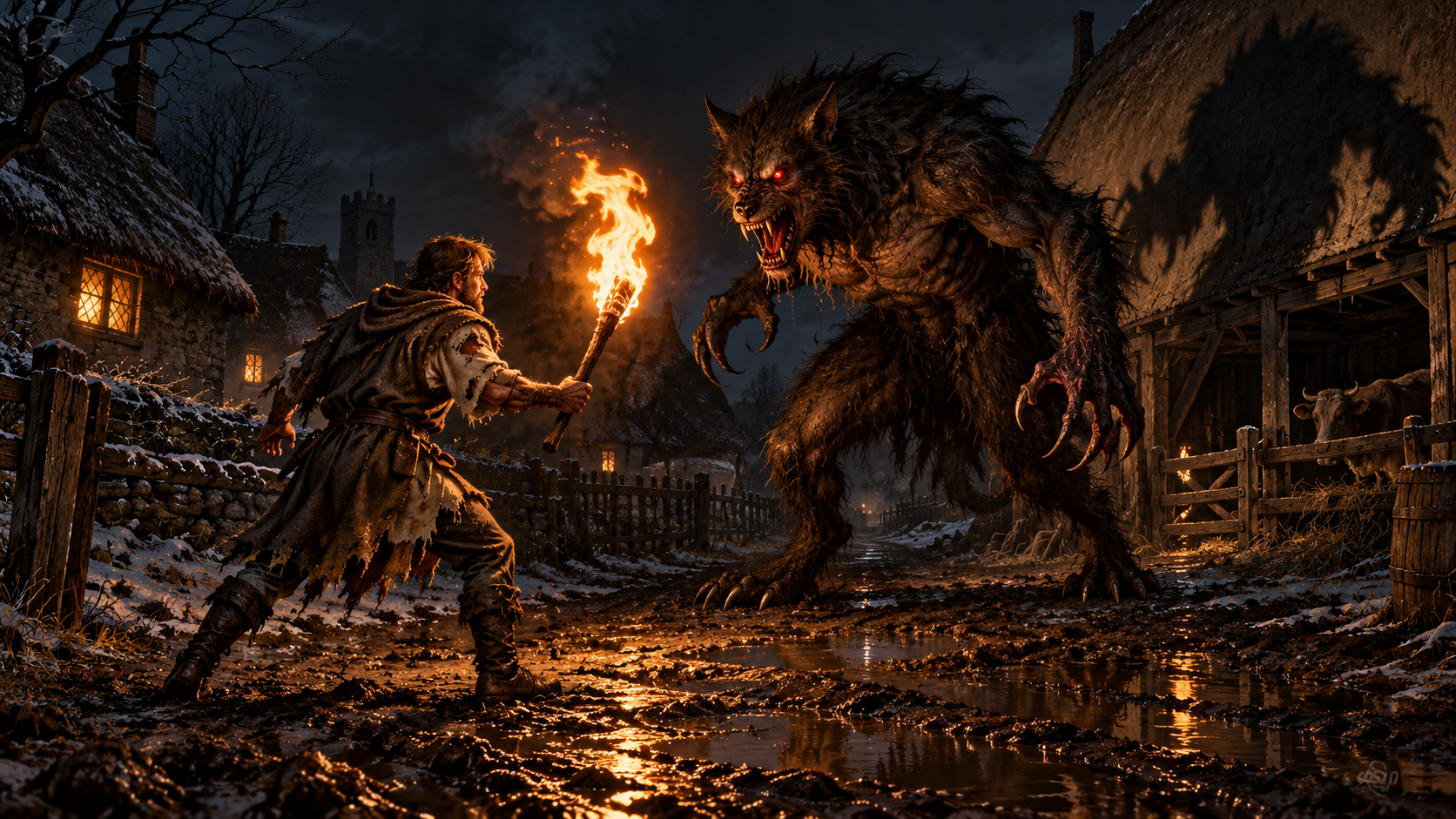
Hear now the name the winter keeps,
When frost lies white on Wetherdown,
When sheep draw close and children sleep,
And darkness hems the village round.
Hear Edric’s name, and mark it well,
For once, when moon and stars withdrew,
A thing came prowling out of Hell,
And none but Edric faced it true.
No common wolf from wood or fen,
No lean grey thief of lamb or ewe,
But something born of beasts and men,
With shoulders high and sinews thew.
Its breath came steaming through the night,
Its paws struck sparks from frozen stone;
Its eyes burned red with devil-light,
Its howl could chill the marrow-bone.
Half beast it was, and half a man,
Or so the oldest tell it still;
Upon four feet the creature ran,
Its shadow tall as any mill.
The dogs crept whining to their chains,
The horses kicked against the stall;
The watchman fled across the lanes
And cried the Devil walked the wall.
But Edric came with flame held high,
Alone beneath the moonless heaven.
He heard the beast’s unearthly cry
And stood where stronger men were driven.
“Back, fiend!” he called. “You shall not feed
On child nor kine while I draw breath!”
Then flame met fang, and man met need,
And Edric stood his ground with death.
❦ ─── ✦ ─── ❦
There had been little frost. Rain had fallen since noon, a slow winter rain that got beneath wool and stayed there. By nightfall the midden behind Widow Cale’s house had begun to stink again.
There were cabbage leaves in it, bones, a split turnip and the skin from something that had once been boiled long enough for nobody to remember what animal it belonged to. Somewhere beneath the heap lay half a sheep’s foot.
The wolf had found that first.
It was young. Not a cub, but not yet filled out. Its ribs showed beneath a coat made ragged by winter, one ear was torn, and mange had taken the fur close to the skin along one hindquarter. It had probably followed the smell from the wood. Perhaps it had followed nothing more complicated than hunger.
There were no red eyes. There was only the brief orange reflection of fire when it turned its head towards the torch.
❦ ─── ✦ ─── ❦
Through muck and dark the monster came,
Its jaws were wet, its hunger dire;
It bore no fear of mortal name,
Nor dread of God, nor cross, nor fire.
Three times it leapt, three times he stood,
Though claw had torn his cloak apart;
And wolf-blood blackened frozen mud,
Yet still there beat the hero’s heart.
He gave no ground. He made no plea.
No prayer escaped his steadfast tongue.
Behind him slept the village free;
Before him death stood lean and young.
And when at last the creature broke,
And fled towards the ancient trees,
Men woke to ash and drifting smoke
Edric still strong though on his knees.
Thus first was Wetherdown made sure
Of what one mortal soul could be:
A wall where lesser hearts were poor,
A flame against calamity.
❦ ─── ✦ ─── ❦
He had gone out because Mara had told him to.
“The bucket, Edric.”
He had pretended not to hear. He was sitting close enough to the fire for one side of his face to ache pleasantly. His boots were wet, his back hurt from splitting wood, and there was stew left in the pot. He wanted another bowl before Bren finished it.
“The bucket.”
“I took it yesterday.”
“And Bren took it this morning.”
“Then let Bren take it again.”
“Take the bloody bucket.”
So Edric took the bloody bucket.
He did not put on his cloak. That part of the song was true, in its way.
He carried a torch because the yard was dark and because, two weeks earlier, Jory Finch had walked straight into the pig trough and broken a tooth. The wolf was already at the midden when Edric came around the corner.
For a moment neither moved. Edric saw something low and grey rise from amongst the refuse. The wolf saw a man holding fire.
The bucket slipped from Edric’s hand, struck the ground and tipped, sending grey water and potato peelings across his boots. The wolf jumped.
Edric screamed.
There were no words. Certainly not, “Back, fiend.” It was simply a sound pulled out of him before thought had caught up.
He thrust the torch forwards with both hands. The wolf recoiled, and Edric thrust it forwards again. The animal snapped once at the flame, more frightened than fierce, and Edric stumbled backwards into the midden.
That was where the tear came from. Not claws. A broken length of wicker caught his tunic below the shoulder and ripped it almost to the waist. He fell amongst cabbage stalks, old bones and something soft that he never afterwards identified.
The wolf ran.
It did not limp and it did not bleed. It simply vanished into the wet darkness beyond the last house.
For some while Edric remained where he had fallen. His heart hammered and his hands shook. The torch lay beside him, still burning.
Then somebody opened a shutter and called, “Who’s there?”
Edric tried to stand. His left foot went into the slop bucket.
By morning, everyone knew.
❦ ─── ✦ ─── ❦
They found the marks where claws had lain,
They saw his garment split in two;
They heard how blood had mixed with rain,
How close the beast to Edric drew.
Old Cale declared its shoulders wide,
As broad as any harvest cart;
Young Jory swore the thing had cried
With words no wolf could shape or start.
A shepherd said he’d seen such eyes
Beyond the ridge three years before:
Red coals beneath a man’s disguise,
A cursed soul for evermore.
The priest said little. Crossed himself.
Then asked that none repeat the tale.
By noon the creature was no wolf.
By dusk, no mortal beast could pale
Beside the thing that Edric fought,
The nameless horror from the wood.
And every telling added aught
To prove how firm the hero stood.
One said he’d battled till first light.
One swore the wolf had spoken plain.
One claimed he’d seen, by torch’s light,
A human hand beneath its mane.
❦ ─── ✦ ─── ❦
At first, Edric said, “It was only a wolf.” No man believed him.
Later, when the story came round again, he said, “A large wolf.”
That travelled better.
A week afterwards, at the alehouse, someone asked how close its jaws had come. Edric held his hands perhaps a foot apart. Someone watching from behind thought he meant the width of its mouth.
By spring, it had teeth as long as fingers.
By harvest, Edric had scars.
He did not have scars, but he had begun occasionally to rub his shoulder when the story was told: the shoulder where the wicker had torn his tunic. He never quite said the wolf had done it. He simply stopped saying that it had not.
When strangers came through Wetherdown and asked which man had faced the beast, people pointed. It is difficult to remain entirely ordinary while people are pointing at you.
The children began following him. Men who had barely spoken to him before bought him ale. Widow Cale, whose midden the wolf had actually been raiding, told anyone who would listen that Edric had placed himself between the creature and her door.
Her door was on the other side of the house.
Eventually even Mara stopped correcting people. Perhaps she grew tired of it. Perhaps she liked being the wife of Edric Wolfbane rather more than she had liked being the wife of Edric who complained about carrying out the slops.
And perhaps Edric liked it too. Who would not?
The name came later: Wolfbane.
It was not given that night. No bard stood beneath the eaves. No villagers gathered with lamps. No priest blessed his torn tunic and no child touched his hand and wept.
There had been a frightened animal, a frightened man, a bucket of kitchen waste and a torch.
Yet all songs must begin somewhere.
❦ ─── ✦ ─── ❦
And so, when winter closes Wetherdown,
When moonless clouds consume the sky,
They tell how Edric held his ground
When something neither wolf nor man came nigh.
They tell how red its eyes had burned,
How Hell itself had loosed the beast;
How Edric stood while others turned,
And saved the greatest and the least.
And still, when winter grips the down,
And frost lies hard on field and fen,
They sing how Edric faced the beast
And drove the wolf from Wetherdown.
They sing how fire was in his hand,
How none beside him dared remain;
And so his name outlived the night,
And none would call him plain again.

10/4/2026
The Words That Got to Me
So many, it’s actually hard to choose. Favourite lines: It’s breath came steaming through the night, It’s paws struck speaks from frozen stone (lovely sibilance). Red coals beneath a man’s disguise sublime! No priest blessed his torn tunic and no cold touched his hand and wept. (Oh dear, reality strikes!)
What a fabulous read - a Beowulf style epic! I loved it and thought it was very clever the way you brought us back and forth between the epic style poem and the short, more prosaic and realistic scenes. There was a wry wisdom shown as the tale grew legs and expanded - hilarious. A phenomenal job, Tim.