Wednesday
6 May 2048 (Darian)
The door didn’t creak. It sighed.
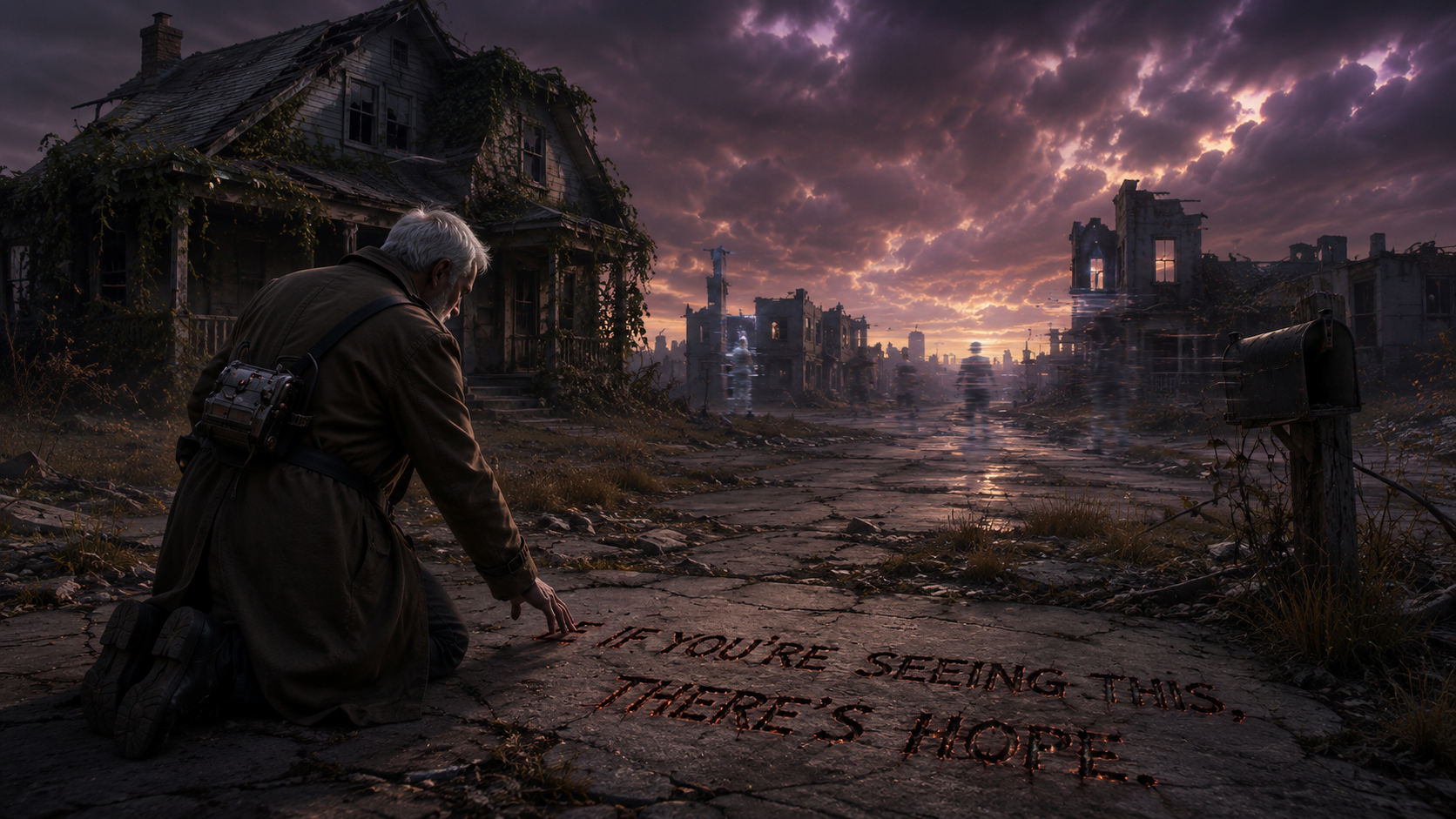
Darian stepped out of the house for the first time in thirty years, barefoot, coat fraying, eyes ringed with sleepless logic. He paused on the top step, letting the air touch his skin like an alien atmosphere. The porch had collapsed on the left side. Ivy grew inside the walls. The roof was half gone.
It was still his house.
He hadn't set foot outside since the moment he broke the world.
He glanced at his watch. The seconds ticked forward. It was the only thing that did anymore.
He had entered the chronosphere in 2043. Five years had passed out here. Thirty in the corridor. Time ran six times faster in that sealed channel, a small side alley off reality where he’d lived, worked, withered. He had refined the machine inside the silence, fed only by memory, obsession, and the occasional tin of beans.
Always beans. Or crackers. Or brittle old pasta.
Sometimes, the food was newer. A brand he didn’t remember stocking. A dented packet with dust from a shelf he hadn’t touched in years. They always appeared quietly. No fanfare. One moment the cupboard was empty, the next, not.
He never saw her. Not once. But the signs were there.
One day, a single spoon had been left in the sink.
Another day, a cracked mug with a daisy printed on it, Evryn's, from when she was a girl, had moved from its shelf.
She’d known he was still alive. Somehow.
He hadn’t thought about what it had cost her.
Now, standing in the open air, he looked out at the wreckage of the world she’d walked through alone.
The sky was wrong, like oil slicked over bruises. The wind moved in fits and starts, as though time itself had forgotten how to breathe properly. No birds. No engines. No life beyond the twitch of ash in the gutter.
Darian stepped forward. The wooden stair cracked but held.
He turned a dial on the chronosphere strapped tight beneath his coat, adjusting his phase to let himself bleed into the “now.” The transition always made his ears pop. His stomach lurched slightly, like catching the tail-end of a falling dream.
The street shimmered, then focused.
A memory overlaid in rot.
His car was still in the driveway. Or what was left of it. Its bonnet had caved in under the weight of a fallen tree. Bark had grown through the windshield like veins. The tyres had fossilised into the ground.
He walked slowly down the path.
The city skyline in the distance looked like it had suffered a collapse of thought, not structure, angles confused, windows missing from one building and perfectly intact in the ruin beside it. Movement caught his eye: a flicker, a person running, then not. A woman seated on the pavement then reversed like a skipped frame. A man shouting silently, glitching in and out of being.
Darian stayed still.
He adjusted the dial again, thinning his presence, stepping back into his corridor between seconds. The world stuttered, and the flickering forms vanished. People existed here, but not with him. Their timelines moved forward, disintegrating. His ran backwards, whole. And alone.
On the pavement just beyond the mailbox, once Evryn’s childhood graffiti canvas, he saw something new. Something placed.
Carved – no - burned, into the cement, etched deep with heat and precision:
IF YOU’RE SEEING THIS, THERE’S HOPE.
His breath caught.
Evryn.
The handwriting, distorted by time and erosion, still bore the hallmarks of her engineering precision: tight curve on the H, the cross of the T slightly higher than centre.
His knees almost buckled.
She had survived. At least long enough to leave this.
Why here? Why this spot?
Had she stood on this very path? Five years ago? Three?
Or just five minutes ago, in her own time?
He knelt, fingers hovering above the carving. It was not just a message. It was proof. She had known he’d find it. She’d known how he would find it.
Darian pressed his hand to the concrete, closed his eyes. The wind stirred again, or maybe it was just the house breathing behind him, as it always had, as it never would again.
He stood.
There would be more.
There had to be more.
He adjusted the chronosphere. The world around him blurred, then snapped tight.
Darian stepped backward into the next moment.
Evryn’s voice was out there. Waiting to be found.
Sunday
27 October 2047 (Evryn)
The torch hissed like a snake, the last breath of something spent.
Evryn crouched by the front path, knees stiff from cold and caution. The acetylene torch was heavy in her hand, rigged to a cracked cylinder she’d stolen from what used to be Benny’s Garage, a one-man auto shop half-swallowed by bramble, broken glass and rot. Most of the tools had been looted long ago. She’d only taken what no one else seemed to want: rusted clamps, copper wire, the torch, and a single half-empty tank.
She hadn’t dared use it until now.
The concrete smoked beneath her hand. Each letter took time, not because the tool was slow, but because she couldn’t afford a mistake. One word wrong, one tremor in the line, and it might not mean anything. It had to outlast weather. Outlast chaos. Outlast time.
IF YOU’RE SEEING THIS, THERE’S HOPE.
She straightened up, bones cracking in protest. The torch gave a final sputter and died. The tank was empty. Spent. Like everything.
The wind moved dry leaves in tired spirals.
Behind her, the house stood as it always had: crooked, weary, and full of ghosts. She hadn’t seen her father in four and a half years, but she had felt him. The open cupboard doors. The vanished tins. Once, she’d left a can of beans on the counter just to see.
It was gone the next morning.
She never saw the flicker. Not directly. But sometimes, out of the corner of her eye, a breath of movement, a shift in dust, she knew.
He was still here. Moving differently. Slipping through time like a fish through silt.
She’d tried to understand it. Pored through his notes, those meticulous, desperate calculations covering every surface of his bunker-world. She’d slept under whiteboards covered in quantum gibberish, woken up in armchairs with data pads still glowing weakly in her lap. The old solar trickle kept them running. Barely.
It had taken her two years to even make sense of the pre-collapse logs. Another two to reverse-engineer what he might have built inside the chronosphere. She was never sure if she was trying to replicate it or undo it. Probably both.
The last few years had been a lesson in despair.
Nothing worked. Not well enough. She was smart, smarter than he’d given her credit for, maybe even smarter than him in the end, but she didn’t have his machine. She couldn’t go back. And she couldn’t stay.
The world was fraying. Not exploding, not falling, just unravelling, like a thread pulled from the edge of a coat. Systems gone. Days out of order. People hollowed by uncertainty. Some walked in circles. Some simply… stopped.
She’d done what she could. Kept him fed. Left notes he’d never read. Murmured to the air when she passed his room.
But now she had to go.
Someone out there must still be trying to fix this, some collective, some mind, some hidden refuge of science or hope. Maybe there was still time to pass along what she’d learned. The way the equations had bent. The thing she was beginning to understand about paradox bleed.
She looked at the carving one last time. It was jagged. Ugly. But strong.
She knelt beside it, placed a gloved hand on the cool concrete, and whispered, “Dad… I’m sorry. But if you’re seeing this, you found your way back. Let’s hope you can find the way back for everyone else as well.”
She stood, pulled her satchel over one shoulder. Inside: half a dozen notebooks, her last datapad, the final printouts she could scrounge. A knife. Two days of water. The roads would be dangerous. Not because of people, there were fewer of those now, but because nothing was sure anymore. A road might not be where it was yesterday. A sunrise might arrive before midnight.
She didn’t look back at the house. She’d said goodbye to it every morning for weeks, just in case that was the day she’d leave.
Instead, she turned and walked down the street, her boots quiet on the cracked pavement. Somewhere behind her, the daisy mug still sat by the sink.
She didn’t know it, but it would be the last thing her father would touch before stepping into the wreckage that was 2048.
Monday
1 October 2046 (Darian)
The wind had a voice again. Not words, exactly, more like muttering.
Darian stepped lightly across the yard, his boots brushing against dry weeds and fractured gravel. A gust dragged the smell of burnt plastic and old pine across the lawn. Somewhere in the distance, a door slammed, the echo wrong, like it had ricocheted off more than just walls. He slowed his pace. Not because he was afraid.
Because the house was warm. Not heated. Not alive. But not empty.
The chronosphere hummed faintly at his back, calibrated to hold him just outside phase. He’d grown used to the strange stillness, the way people flickered and bent like pages caught in a breeze. But this was different. The house was in time.
And someone was in it.
He opened the back door with care. No resistance. It had been repaired, crudely, but intentionally. Screws he hadn’t placed. A wedge of brick to keep it from swinging open. These were not his touches. These were hers.
Evryn.
She was here.
The kitchen was brighter than he expected. Solar rig still half-functional, it seemed. Panels on the roof must have held out longer than he’d imagined. The battery pack buzzed somewhere deeper in the house. The counters were cluttered but not wrecked. Flour dust. An empty mug. A tin can with the lid peeled and placed carefully aside.
Darian’s throat closed unexpectedly.
She lived here. Not just hiding away, lived. Endured. Worked. He moved through the hallway slowly, careful not to breach his phase too far. The walls were familiar and unfamiliar. Paint bubbled. A child's drawing still stuck near the stairs, one she’d made at six, of a horse with too many legs and stars all around it.
The door to the dining room was open.
And inside, the only way he could describe it was, the war room.
Every surface was papered with her work, his work. Strings, pinned notecards, projected overlays faded into the wall like half-memories. A map of quantum convergence zones. A cross-section of a crude chronosphere, annotated in red.
He drifted closer.
There, pinned with four bent nails, was a page of scrawled formulae. A tight hand. Angular. Compressed into the margins.
Darian inhaled sharply. He knew that formula.
It had taken him nineteen years to arrive at that expression, scrawled on the back of a bread wrapper in the dark. It had felt like madness then, like drawing God’s skeleton. But Evryn… she’d written it here. Four years after he disappeared. No access to the chronosphere. No superpositioned bubble. Just paper. Just grief. Just her.
He swallowed. His fingertips hovered above the ink.
She had solved it. On her own.
He heard a creak, real, sharp. The kind of sound no ghost should hear. Darian turned.
And saw her.
Evryn walked past the doorway. Didn’t see him, not quite. But the room bent faintly, just for a moment, like gravity misstepping. She stopped. Tilted her head. The air thickened.
“Dad?” she whispered.
He didn’t move.
She waited, staring into a silence she couldn’t pierce. Then shook her head, muttered something inaudible, and walked on.
Darian stood frozen. Breath shallow. The chronosphere buzzed a warning, too long in near-phase. His body was starting to slow, to sync. The paradox pressure prickled at his spine.
He stepped back. One foot, then another. The hum faded. The moment passed.
Her shadow lingered longer than it should have.
In the living room, he found her boots by the door. Worn through at the sides. Next to them, a battered rucksack. Open. Half-packed. A map of the county marked in pencil, route options, scavenging notes, and places to avoid.
Pinned above it on the wall, a checklist:
Radio batteries
Last notes
Food rations
Torch fuel
Leave the message
Don’t look back(rewritten twice)
His eyes blurred. He wiped them without thinking.
She was preparing to leave. Not yet, but soon. The timeline folded inward, edges touching. This was as close as he’d ever be.
A notebook lay open on the couch. He moved to it.
At the top of the page: Observations. Below it:
Still no change in the cupboard pattern.
Sometimes I think I’m just feeding ghosts.
But maybe ghosts can fix things.
One of us has to.
He closed his eyes. The wind outside shifted. The air smelled of pine and old data.
Darian turned the dial. And the room released him.
He stepped backward again, one year deeper into the broken world.
But not before whispering to the room, though she’d never hear it: “You already have.”
Monday
1 October 2046 (Evryn)
The cupboard door was open again.
Evryn stared at it, arms crossed, lips pressed into a thin line. She hadn’t touched it since yesterday. The beans were gone. Not all of them, just the top can, the one with the faded label and dented side, she always avoided. Gone. Just... gone.
She closed the door slowly, deliberately. It clicked softly into place. She didn’t like the way it echoed. The air in the kitchen always felt thinner after it happened, as if the house had exhaled something it wasn’t supposed to.
“I’m not crazy,” she muttered, like it might help.
A few months ago, she’d laughed about it. Whispered jokes to the air: Enjoy your lunch, ghost. But now, it made her stomach tight. The disappearances. The mug that moved. The way her notebook, left closed, would be open when she came back. Never much, just enough.
She walked into the dining room and stopped.
It felt colder in here. Not temperature, something else. Like the room had just been used, and only now remembered to be empty.
The formula still hung on the wall, the one she’d cracked three nights ago at three in the morning, brain humming from too much cold instant coffee and the half-rusted thought: What if he was right? It had frightened her when she wrote it. It still did.
She circled a new note beneath it, half talking to herself.
Then the air changed.
Like someone walking into a room mid-argument. It tugged at her, made her skin prickle. The light didn’t shift, but something behind her ribcage did. She paused. Turned.
And saw nothing.
But still,
“Dad?” she said aloud.
Silence. She waited. Nothing.
Evryn let out a breath she didn’t remember holding. Shook her head. “Get a grip,” she whispered.
She walked to the hall, stepped carefully toward the front room, and stopped at the coat rack. She stared at the boots she’d set out two days ago, wondering for the hundredth time if she would really leave.
She looked over her checklist on the wall. Re-read the last line.
Don’t look back.
She crossed it out again.
A flicker passed in her peripheral vision, the light in the dining room stuttering once, like an eye squeezed shut.
She froze. Then stepped back. Slowly.
The room was empty.
Just notes. Just old books. Just absence.
Evryn sat on the couch and pulled the notebook into her lap. She opened to her observations page. Date. Time. Write it down. Keep it real.
Still no change in the cupboard pattern.
Sometimes I think I’m just feeding ghosts.
But maybe ghosts can fix things.
One of us has to.
She paused. Tapped the pen once against the margin. Then added:
He’s still out there.
I can’t prove it. But I know.
She closed the book, held it to her chest a moment.
The house didn’t make a sound. Evryn leaned back, eyes closed.
“Be safe,” she whispered to no one.
Thursday
6 July 2045 (Darian)
The street was louder than it should have been.
Not in the old way, no cars, no children yelling, no garbage trucks complaining their way down the curb. This noise was sharper. Raw. A distant argument echoed between broken buildings. The metallic bark of a gun, far off, followed by the fluttering panic of birds.
Darian walked quickly, eyes down. The road here was buckled, swollen with the weeds of neglect. Shop fronts were boarded, burned, or both. He could feel the pressure building. The hum of the chronosphere at his back had grown tense, as though even it sensed the day mattered more than most.
The end had already begun. This was the moment it became irreversible.
He reached the corner where the old grocery used to stand, now hollowed out and tagged with crude chalk warnings, and hesitated. A figure stood in the shade of the collapsed awning. Tall, lean, wrapped in patchwork layers. A scavenger, maybe. Or worse.
Darian shifted slightly, ready to fade back out of phase. But the man spoke.
“Hey,” he called. “You okay, sir?”
Sir. That word hadn’t landed on Darian’s shoulders in thirty years.
He turned just enough to see the man’s face. There was something familiar in the jawline, the way he tilted his head. Recognition prickled, but too far back, too deep.
“Do I…?” the man began, squinting. “Wait. Are you… related to Darian Lorent?”
Darian said nothing.
The man rubbed his beard. “Damn, sorry. Just… you look like him. Same eyes. Little older, maybe. Father? Uncle?”
Darian almost laughed, a short, breathless sound. He looked thirty years older because he was thirty years older.
“I haven’t seen Darian since before things really got weird,” the man continued, stepping forward. “What was that… ‘43? When the clocks all went to hell. People thought it was a glitch. We all thought it was just some system bug. But after that, nothing kept sync. My neighbour’s son aged backwards for a week. That’s when I stopped trying to explain anything.”
He looked past Darian, toward the horizon. “You know, it wasn’t just the power grid. It was memory. Events. Cause and effect. It all started coming undone. Like the world forgot how to keep score.”
Darian stood very still. The air tasted like copper.
The man looked back at him. “Anyway… if you see him, Darian, I mean, tell him there’s folks still remember. His daughter, Evryn, yeah? I think she still lives up the road. Brave girl. Kept that house standing longer than anyone thought she could.”
Darian felt something twist in his chest.
He nodded once, a gesture too slow, too soft.
The man smiled faintly. “You take care. World’s not exactly friendly these days.”
He turned and walked away, boots crunching on gravel and glass.
Darian stood alone at the edge of the street. His hands were trembling.
The chronosphere buzzed louder, insistent.
He reached for the dial, twisted hard, and the world blinked.
Flickered.
Folded.
And left the street behind.
Friday
10 March 2045 (Evryn)
“Damn it,” she muttered, slamming the notebook shut.
The equation wasn’t balancing. Again. A subtle phase offset, just half a decimal wrong, but it warped the whole model like a ripple in water. She rubbed her eyes, fingers smudged with graphite and frustration. The living room was a paper storm. Notes, simulations, sticky tags, printouts from the old thermal reader, all swirling around a cracked laptop with a dying hinge.
Then her stomach growled.
Evryn sighed, long and exasperated. Food. Of course.
The cupboard was nearly empty again, two dented tins, stale oats, something unlabelled that might’ve once been lentils. She had meant to stock up earlier in the week, but she'd been too deep in the logic. The chronofield notes were almost starting to make sense now, and she'd rederived two-thirds of her father's final loop corrections by hand.
Going out meant time lost. Momentum lost.
Still… starving wasn’t going to solve time.
She grabbed her pack, checked the knife on the strap out of habit, and slung her scarf around her shoulders. The cold didn’t bother her as much anymore, the world had more pressing discomforts. At the door, she paused to tug on her boots. They squeaked faintly, leather cracked, rubber heel worn through on one side. A checklist on the wall stared at her as she left: battery rotation, power spike log. Grocery run wasn’t on it. She frowned.
Outside, the sky was the strange white-grey it had settled into over the last year, too bright and too dull at once. The clouds no longer moved like they used to. The wind came and went as though it couldn’t decide what season it was.
She took the long route to the shop, staying off the cracked main road where buildings slumped inward like tired lungs. Every block brought another silence, another absence. Windows that once glowed now stood black-eyed and watchful.
The store came into view, and she stopped walking, carefully checking around.
The front was smashed. Glass glittered on the pavement. The doors hung broken. The windows were shattered inward. A bent shopping trolley leaned against the frame like someone had tried to batter it open and succeeded. Inside, the shelves gaped like ribcages.
“Of course,” she murmured, swallowing her disgust.
She scanned the street. No one. No one ever. Or too many in the wrong place, in the wrong mood. She clenched her jaw and stepped inside.
The stink hit her first. Not rot, that was old news, but time. Stale air. The metallic smell of air that didn’t know which way it was moving.
Inside, the shelves were stripped at random. Crisps and sweets, of course, gone first. Cold cases, dark, long since warm. A trail of footprints led through the dried puddle of something sticky.
Evryn walked carefully, skimming shelves with a practised eye. She passed over crushed packets of rice, ignored open jars, and reached instead for sealed tins. Beans. Soup. Powdered eggs.
In the back corner, behind a fallen display, she found a carton of sealed meal bars. Probably expired. But they were sealed. She pulled them into her pack one by one, glancing over her shoulder every few seconds.
The sound of something shifting, a loose can tumbling down the aisle, made her jump. Her hand was already on her knife before she saw it: a rat. Just a rat. She exhaled slowly.
She didn’t want to be here any longer than necessary.
At the exit, she paused. Looked back.
The store had once had piped-in music. Overhead lights. Shelves stacked with nonsense. The kind of place her dad used to call a "necessary irritant." Now it was just another cavity in a dying world.
Evryn stepped back into the grey light and started walking home.
Food in her pack. Guilt in her gut. Equations waiting on the table.
The day was already half-lost.
Monday
26 October 2043 (Darian)
The lights were off.
That was the first thing Darian noticed — not just the darkness, but the way the switches were frozen halfway down, like someone had flicked them off mid-thought. The hallway bulb hung motionless. Dead, but expectant.
He stepped inside, boots dragging dust across the floorboards. The air tasted flat. Behind him, the door creaked slightly as the pressure equalised, like the house exhaling after six months without a heartbeat.
Six months for the world. Thirty years for him.
He moved through the front room slowly, adjusting the dial on the chronosphere to bring himself fully into phase. No more flickering. He wanted to feel this.
And he did.
The silence buzzed.
On the side table, a small stack of notebooks waited. A chipped mug beside them. The coffee ring was weeks old, maybe more. He recognised the handwriting immediately: clean, sharp, a little too fast. Evryn’s.
He opened the top journal. The pages crackled faintly.
I don’t know if you’ll ever read this.
But if you do, I hope it means something can still be fixed.
I haven’t started the calculations. Not yet. I don’t think I’m ready. But I’ve started reading. Everything. Even the things I wasn’t supposed to touch. Especially those.
You always said time was a tool. But you never asked what kind of hand should hold it.
Darian sat heavily in the chair. It creaked under him like it remembered. He turned the page. More notes, some questions. Doodles in the margins, a sketch of the prototype chronosphere’s frame, drawn from memory. A broken formula he recognised from one of his early dead ends.
She was trying to understand him.
Trying to fix his mess.
The radio crackled from the far corner.
He stood, crossed the room, and gave the old solar rig a cautious tap. It stuttered to life, weak but functional. Somewhere, a broadcast was still playing on loop, perhaps an emergency signal, perhaps just a machine no one had turned off.
"...military units are no longer complying with federal containment orders. Governors in four states have formally dissolved legislative sessions, citing breakdown of civil coordination. Riots continue in major metro zones. Government buildings in D.C. and Atlanta have been reported burning. No confirmation yet whether key infrastructure survives..."
Darian closed his eyes.
"...fuel supply now intermittent across most sectors. Grid collapse expected within the week. Communications lag increasing. Memory drift confirmed. Time drift remains unquantifiable..."
The voice was too calm for what it said. As if the announcer had already checked out emotionally. As if they were simply narrating the weather.
He leaned forward and turned the volume up.
"...six months ago, clocks began failing. Now it’s cause and effect. Decision and outcome. Action and memory. It’s not just time - it’s logic itself. And when logic dies, there’s nothing left to hold civilisation together..."
Darian turned the volume down.
In the hallway mirror, he caught his reflection. A stranger. Thirty years older than the man who’d stood here pressing the switch, arms raised, sure of his legacy. His face was carved with work. Not wisdom, just exhaustion.
He looked at the journal in his hand. The words she’d written. The quiet, desperate hope behind them.
Evryn wasn’t trying to save the world.
She was trying to save him.
He crossed the room and pulled the blackout curtain aside. The sky outside was smeared with the wrong colour, that violet-orange hue that never quite resolved into dusk or dawn. It bled like a bruise across the horizon.
There were no sirens. No voices. Just stillness that pretended to be peace.
Darian turned from the window. The end had already begun. All that remained was unmaking it.
Wednesday
3 May 2043 (Evryn)
The clocks were off again.
She tapped the microwave. 88:88 blinked back. Her wristwatch had frozen at 04:17 and stayed there through lunch. Even her old analogue travel clock upstairs was ticking backward, not quickly, just enough to be unsettling.
Evryn stood by the kitchen window, arms crossed, staring at the pale morning sky. Something felt wrong. Not wrong like a storm coming. Wrong like the air was an inch out of tune.
That’s when the hallway creaked.
Not the usual groan of old beams, but something sharp, like the house reacting to a new weight.
She turned, and the mug slipped from her hand.
There, in the middle of the hallway, stood her father.
Or someone who looked like him.
He was older. So much older. Hair greyed, face leaner, shadowed. He wore strange gear, scavenged, patchy, the frame of the chronosphere strapped to his back, humming faintly like it was half inside the walls.
“Evryn,” he said.
She backed away instinctively, confusion turning to fear.
“Who are you?”
“I’m your father.”
“No,” she said automatically. “No, my father’s; he… he vanished. He -”
“I did. And I’m sorry.”
Evryn stared. Her chest tightened.
“What… what is this? Why do you look like that?”
“I’ve been gone thirty years,” he said. “For me. For you, it’s been one night.”
She shook her head. “I don’t, You activated something. I tried to stop you, and then you were just… gone. And now you’re here?”
Darian nodded slowly. “I stepped out of the timeline. Into something adjacent. A sideways channel, where time flowed differently. Faster. It was supposed to give me space to think. Time to work.”
“And it worked?” she asked, numb.
“No,” he said. “It broke everything.”
Evryn blinked. “What?”
“The chronosphere didn’t just shift me,” he said. “It fractured time. Globally. Subtly at first, the clocks, the inconsistencies, strange little slips. But it doesn’t stop there. It spreads. Tech fails. Logic erodes. The world comes undone.”
She stared at him. The room felt like it was tilting.
“You’re saying this is my fault?”
“No,” he said gently. “It’s mine. I was warned. You tried to stop me. But I couldn’t hear you then.”
Evryn’s voice was tight. “Why are you telling me this now?”
“Because I’m about to fix it,” he said.
She didn’t respond. The silence stretched.
“There’s a paradox window,” he said. “One moment in which both versions of me exist, me now, and the me that flipped the switch. I can stop myself.”
Evryn swallowed. “And what happens to you?”
“I vanish,” he said. “Both of us do.”
She felt the sting at the corners of her eyes. “You’re going to erase yourself.”
“I already did,” he said. “This is the repair.”
She looked away. “Why are you telling me all this?”
“So you’ll know,” he said. “So you won’t blame yourself. So you’ll understand.”
He pulled a letter from his coat. “Don’t open this today. Read it tomorrow. When I’m gone.”
Evryn took it without thinking. The paper was warm from his hands.
“I’m scared,” she admitted.
“I know,” he said. “So was I.”
They stood in silence for a moment, two versions of trust trying to take root.
Then he reached out, gently, and touched her shoulder.
“I love you,” he said.
She closed her eyes.
When she opened them, he was gone.
Just the letter in her hand.
And the clocks, still ticking in all the wrong directions.
Tuesday
2 May 2043; 18:08 (Evryn)
“You’re not listening to me!” Evryn shouted. “You never do!”
Her father stood by the terminal, shoulders squared, every inch of him vibrating with the tension of genius and legacy. One hand hovered over the final sequence, the other clenched in a white-knuckled fist.
“I’ve calculated it. It’s ready,” he said. “I’m not going to waste this.”
“Dad,” She stepped forward. “Please. I’m not asking you to walk away. I’m asking you to wait. Test it longer. Think. Talk to me.”
And then,
The air buckled.
A ripple cracked the room like heat on pavement.
Her dad stepped into the room, but her dad was here; this man was older. His coat dusty, his boots scarred, his eyes decades older than her father's. The chronosphere on his back emitted a low, mournful hum.
Younger Darian recoiled. “Who the hell?”
“Evryn,” the older man said, calm and clear, cutting through the tension like a scalpel. “It can never be turned on.”
She blinked. “Who -?”
Older Darian smiled, but it was tired. “You’ll understand. Look for the letter. Not tomorrow. The day after next. You’ll know when.”
Younger Darian moved to intercept him. “You need to get out of here.”
But the older man was already stepping forward, slow and steady. “I always thought it was about time,” he said softly. “But it was never about time.”
He reached out, gently, and placed a hand on his younger self’s shoulder.
For a fraction of a second, the two men, same blood, same bones, separated by thirty years and a million regrets, locked eyes.
And then:
Whump.
The air sucked inward with a deep, visceral compression. Light curled in on itself. Sound vanished. There was no explosion. No dust.
Just nothing.
Where two had stood, there was now only silence.
Evryn stumbled back, heart racing, chest heaving.
She ran to the console, untouched. The chronosphere inert. No readings. No glow.
Everything was still.
The timeline, quiet.
It would take her a day to stop trembling.
It would take her another to remember the words: look for the letter.
And on the morning of Thursday, 4 May 2043, she would find it.
Tucked beneath her father’s old journal, sealed in an envelope she didn’t recognise in her own handwriting.
She’d never written it.
Not in this life.
Thursday
4 May 2043 (Evryn)
The house felt wrong in a way Evryn couldn’t articulate.
Nothing had changed. Everything had changed.
She stood at the table where he’d left the chronosphere’s last prototype. It hadn’t moved. No wires, no flickers, no residual hum. Just a beautiful, inert shell of possibility and warning.
The argument still echoed in her head. Her father’s last words, his last look. Then that impossible flicker, an older version of him, speaking riddles, touching his younger self, and then... vanishing.
Both of them, gone. As if they had never been.
She’d barely slept. She didn’t cry. Not yet. It felt like the world had held its breath and then released it.
Now, in the grey morning light, she found it.
Tucked beneath his journal, barely visible: a folded envelope. Her name on the front, written in her own handwriting. But she hadn’t written it.
Her fingers trembled as she opened it.
Inside, a single sheet. Not long. No date.
If you’re reading this, it means the paradox held.
It means time is healing.
It means I made the right choice, finally.
The Chronosphere will break the world, it must never be used. I implore you, destroy it, burn all my notes, leave nothing for others to find and misuse.
You’ll feel echoes, moments that don’t quite fit. You may remember things you never did. Don’t be afraid of them. They are just fragments burning off.
You saved me, Evryn. Not with equations or machines, but by standing your ground.
This world is yours now. Not fractured. Not borrowed. Yours.
Live in it.
Be happy.
And when you can… forgive me.
Dad
Evryn sat down slowly, letter in her lap, the journal beside it.
She stared out the window, half expecting the sky to crack open again, for someone else to step through. For something that hadn’t happened to be.
But the world was quiet. Stable. Whole.
She pressed the paper to her chest and whispered, “I remember.”
She didn’t know how.
But she did.
7/8/2026
The Words That Got to Me
He hadn't set foot outside since the moment he broke the world. I thought this was a very strong and intriguing line. the two men, same blood, same bones, separated by thirty years and a million regrets, locked eyes. What a vivid image!
Wow what a ride! This was a completely original, mind-boggling and tense read. I love a dystopian story now and then so this met that need beautifully. I loved the strong relationship between father and daughter that survived the catastrophic events. Excellent!